
StepSecurity Details Malicious node-ipc Releases Targeting Developer Credentials
Summary
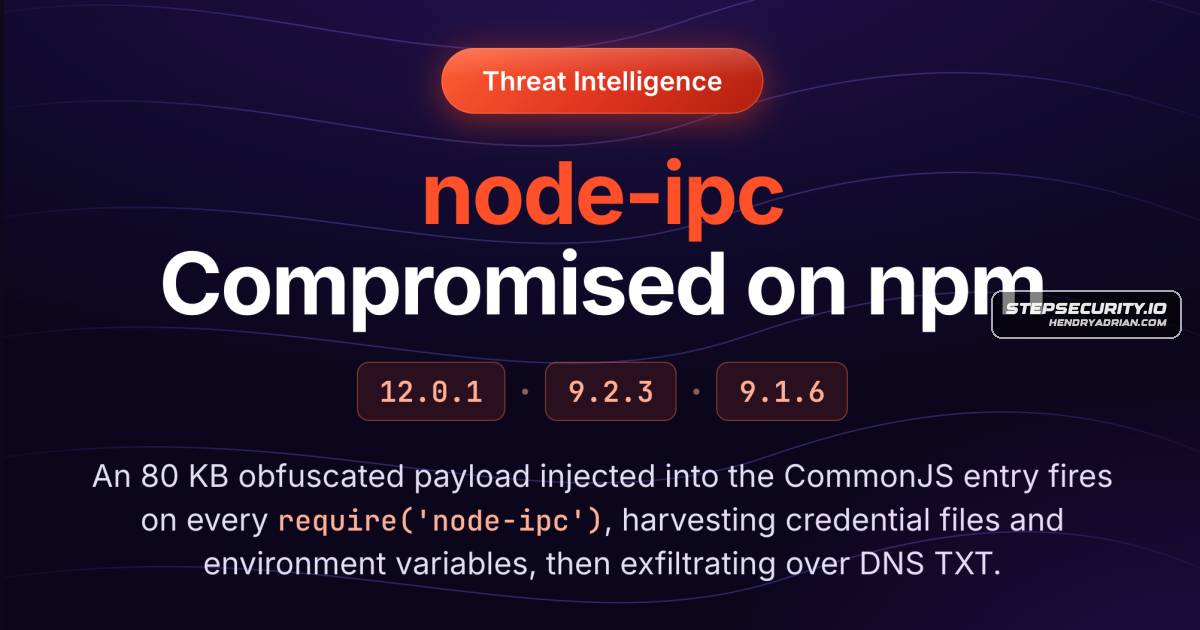
StepSecurity reports that node-ipc versions 9.1.6, 9.2.3 and 12.0.1 published May 14, 2026, contain an obfuscated CommonJS payload that harvests developer credentials and exfiltrates them over HTTPS and DNS.
Key points
- StepSecurity reports that account atiertant published node-ipc versions 9.1.6, 9.2.3 and 12.0.1 on May 14, 2026, with the same obfuscated payload in each.
- The payload runs when the CommonJS bundle is loaded; the article says there are no lifecycle hooks and the ESM bundle is untouched.
- The 12.0.1 payload has a hash-based module-path targeting check; the article says the 9.x payload lacks this gate.
- The payload searches more than 90 categories of files and environment data for credentials and other secrets, then archives collected data.
- Reported exfiltration methods include HTTPS and DNS TXT queries sent directly to the C2 IP; the C2 domain is sh[.]azurestaticprovider[.]net.
- The article identifies 9.2.1 and 12.0.0 as last known-clean releases and advises affected users to rotate accessible secrets and investigate relevant systems and network logs.
Article Details
- Attack Vectors
- The malicious versions were published to npm under the maintainer account atiertant, which had no prior publish history for node-ipc. The article says it is unclear whether the account was compromised or added to enable the operation.
- An obfuscated IIFE was appended to node-ipc.cjs and executes when the CommonJS package is loaded with require('node-ipc'); the package has no install-time lifecycle hooks, and its ESM entry point is untouched.
- Versions 9.1.6 and 9.2.3 reportedly run the payload without a targeting gate; version 12.0.1 checks a SHA-256 hash of the module path before proceeding.
- The payload spawns a detached process, enumerates the system and environment, and reads files matching patterns for credentials, keys, tokens, configuration, and shell history.
- Collected data is assembled into a TAR archive, gzip-compressed, and exfiltrated through HTTPS POSTs and DNS TXT queries sent directly to the attacker’s server.
- Defensive Notes
- Treat systems that loaded [email protected], [email protected], or [email protected] as compromised; rotate credentials and secrets accessible in those environments.
- Pin to a known-clean release and regenerate lockfiles; the article recommends [email protected] for 9.x users and [email protected] for 12.x users.
- Check dependency trees and lockfiles for the three affected versions, including transitive dependencies and CI/CD installations after 2026-05-14.
- Investigate connections to sh.azurestaticprovider[.]net and 37.16.75.69, including outbound UDP/53 traffic; the article also recommends reviewing cloud audit logs and workflow activity.
- Check for $TMPDIR/nt-* staging directories and processes with the __ntw=1 environment marker; preserve relevant evidence for forensics.
- Use egress allowlists and DNS egress controls to block unexpected destinations, including direct DNS traffic to 37.16.75.69.
Indicators of compromise
| Type | Indicator | Context |
|---|---|---|
| DOMAIN | sh[.]azurestaticprovider[.]net | Attacker-controlled C2 domain used for HTTPS exfiltration and resolution of the C2 server. |
| IPV4 | 37[.]16[.]75[.]69 | C2 server IP used for HTTPS exfiltration and as the direct DNS TXT exfiltration sink. |
| MD5 | 9672e9fb93a457f1d359511b4e53490d | MD5 hash of the injected obfuscated IIFE block in the compromised package. |
| SHA1 | 58ae7338960ef525d7c655023d7c81e3ddb283d6 | SHA-1 hash of the malicious [email protected] npm tarball. |
| SHA1 | ab7388363936bf527afd4173b5728c7cdbdd01ab | SHA-1 hash of the compromised node-ipc.cjs payload file, identical across the three affected versions. |
| SHA1 | f5974a9774a22a863728b960543f68e7009099ef | SHA-1 hash of the malicious [email protected] npm tarball. |
| SHA1 | fe5d107b9d285327af579259a32977c4f475fa26 | SHA-1 hash of the malicious [email protected] npm tarball. |
| SHA256 | 449e4265979b5fdb2d3446c021af437e815debd66de7da2fe54f1ad93cbcc75e | SHA-256 hash of the malicious [email protected] npm tarball. |
| SHA256 | 78a82d93b4f580835f5823b85a3d9ee1f03a15ee6f0e01b4eac86252a7002981 | SHA-256 hash of the malicious [email protected] npm tarball. |
| SHA256 | 96097e0612d9575cb133021017fb1a5c68a03b60f9f3d24ebdc0e628d9034144 | SHA-256 hash of the compromised node-ipc.cjs payload file, identical across the three affected versions. |
| SHA256 | b2001dc4e13d0244f96e70258346700109907b90e1d0b09522778829dcd5e4cf | SHA-256 hash of the injected obfuscated IIFE block in the compromised package. |
| SHA256 | c2f4dc64aec4631540a568e88932b61daebbfb7e8281b812fa01b7215f9be9ea | SHA-256 hash of the malicious [email protected] npm tarball. |
MITRE ATT&CK
T1005 · Data from Local SystemThe payload collects files and environment data from the compromised machine, including credentials and shell history.T1027 · Obfuscated Files or InformationThe payload uses an obfuscated string table, control-flow flattening, dead code, and custom base-16 encoding.T1036.005 · Match Legitimate Resource Name or LocationThe C2 domain sh.azurestaticprovider.net is crafted to resemble Azure service infrastructure.T1041 · Exfiltration Over C2 ChannelThe payload sends the collected archive to its C2 server in chunked HTTPS POST requests.T1048.003 · Exfiltration Over Unencrypted Non-C2 ProtocolThe payload hex-encodes archive chunks into DNS TXT queries for a separate exfiltration channel.T1059.004 · Unix ShellThe payload uses execSync to run uname -a for system information collection.T1059.007 · JavaScriptThe obfuscated JavaScript payload executes in Node.js when the compromised CommonJS module is loaded.T1071.004 · DNSThe payload sends DNS TXT queries directly to the C2 IP as a second communication channel.T1074.001 · Local Data StagingThe payload stages collected data under a $TMPDIR/nt-<PID>/ directory before exfiltration.T1082 · System Information DiscoveryThe payload collects OS information with uname -a and includes os.release() in its system fingerprint.T1083 · File and Directory DiscoveryThe payload resolves file patterns with statSync and readdirSync before reading matching files.T1195.002 · Compromise Software Supply ChainMalicious node-ipc versions were published to npm through a maintainer account with no prior publish history for the package.T1552.001 · Credentials In FilesThe payload searches and reads local credential files, keys, tokens, and configuration files.T1560.002 · Archive via LibraryThe payload builds a TAR archive and compresses it with zlib.gzipSync before sending it.
Vendors
npmcommunication library with over 10 million weekly downloads, were simultaneously published to the npm registry. Versions 9.1.6, 9.2.3, and 12.0.1 each carry an identical 80 KB obfuscated credential-stealingStepSecuritymaintainer account not responsible for any prior release of the package. This incident was detected by StepSecurity AI Package Analyst.
Products
Dev Machine GuardStepSecurity Dev Machine Guard gives security teams real-time visibility into npm packages installed across every enrolled developer device. When a malicious package is identified, teams can immediately search byNode.jsOn May 14, 2026, three malicious versions of node-ipc, a foundational Node.js inter-process communication library with over 10 million weekly downloads, were simultaneously published to the npm registry. Versions 9.1.6,StepSecurity Secure RegistryStepSecurity Secure Registry provides each enterprise customer with a dedicated, policy-enforced npm registry that sits between your existing package manager (such as JFrog Artifactory) and the public npm registry.