
Step Security Reports ChainDrop Worm Compromised 444 npm Packages
Summary
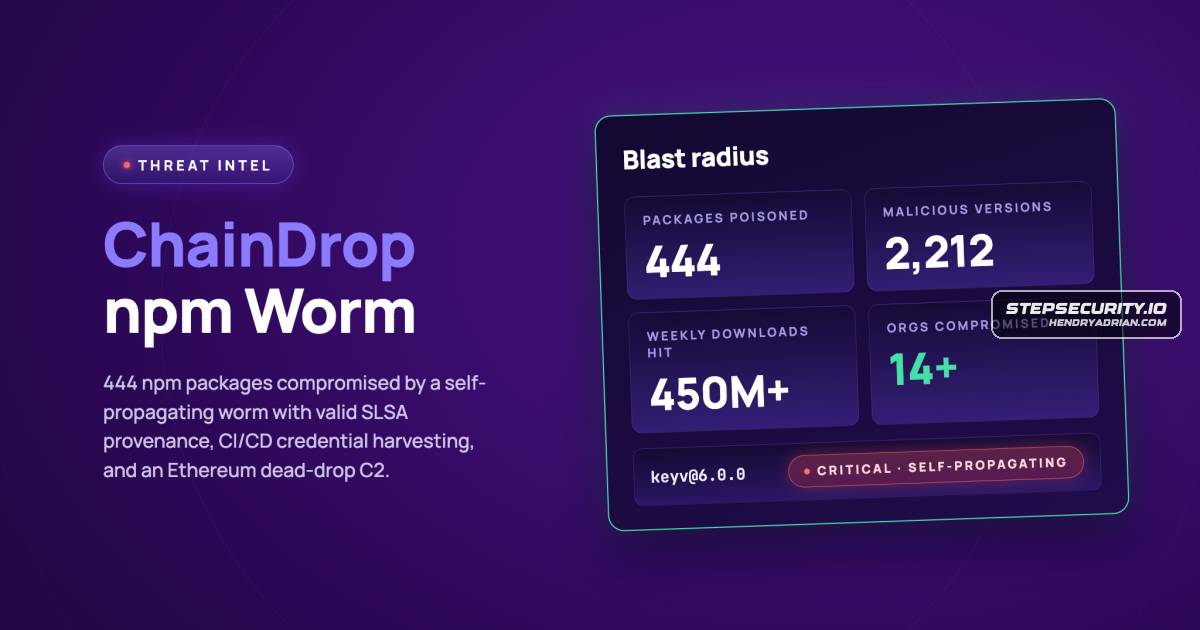
Step Security reports that the ChainDrop worm poisoned 444 npm packages across 2,212 versions on Aug. 4, 2026, using preinstall scripts to download Bun and run a credential-stealing payload that republishes packages.
Key points
- Step Security says its feed flagged malicious releases from 09:40 to 13:20 UTC on Aug. 4, 2026; the reported total was 444 packages and 2,212 versions.
- The report identifies 11 initial worm carriers, including keyv, flat-cache and file-entry-cache, and 433 additional packages reportedly republished by the worm.
- Affected versions reportedly added a preinstall script that ran setup.mjs, downloaded the Bun runtime and launched an obfuscated 727,680-byte second-stage payload.
- Step Security says the payload steals credentials and uses harvested CI credentials to publish additional malicious package versions.
- The report describes Ethereum blockchain command-and-control and persistence targeting Claude Code, VS Code and GitHub Copilot workflows.
- Step Security says attackers compromised a maintainer’s GitHub account and used trusted release workflows; valid SLSA provenance attested to the build commit but did not establish that the commit was authorized.
- The article advises treating systems that installed affected versions as compromised and says the package count was still increasing.
Article Details
- Victim Organization
- More than a dozen organizations using affected npm packages; no specific victim organizations are named
- Incident Type
- Self-propagating npm supply-chain worm that compromised package releases, harvested credentials, and republished malicious packages
- Incident Date
- 2026-08-04
- Disclosure Date
- 2026-08-04
- Data Types Exposed
- Maintainer credentials and tokens
- CI credentials and tokens
- Affected Records
- 444 packages and 2,212 versions were reported compromised as of August 4, 2026; the count was still increasing
- Operational Impact
- Malicious versions were published through affected projects' release workflows. The payload executed during npm installation, harvested credentials, republished packages, and targeted AI developer tooling. The article advises treating systems that installed affected versions as compromised.
- Ransom Or Extortion
- None reported
- Claim Status
- confirmed
MITRE ATT&CK
Malware
ChainDropTL;DR: On August 4, 2026 (UTC), a self-propagating supply chain worm, which we are calling ChainDrop, ripped through npm. In under four hours it poisoned 444 packages and 2,212 versions across more than a dozen victimShai-Hulud 2into AI developer tooling. Our analysis identifies the payload as a heavily evolved descendant of the Shai-Hulud 2.0 worm, now with an Ethereum blockchain C2 (EtherHiding), analyst-proof encrypted exfiltration, and
Vendors
GitHubanalyst-proof encrypted exfiltration, and persistence that targets Claude Code, VS Code, and GitHub Copilot workflows.npmAugust 4, 2026 (UTC), a self-propagating supply chain worm, which we are calling ChainDrop, ripped through npm. In under four hours it poisoned 444 packages and 2,212 versions across more than a dozen victim
Products
Bunpoisoned version carries the same infection pattern: a preinstall dropper that downloads the legitimate Bun JavaScript runtime, and a 710 KB obfuscated second stage that steals credentials, publishes more maliciousClaude Codeblockchain C2 (EtherHiding), analyst-proof encrypted exfiltration, and persistence that targets Claude Code, VS Code, and GitHub Copilot workflows.GitHub Copilotanalyst-proof encrypted exfiltration, and persistence that targets Claude Code, VS Code, and GitHub Copilot workflows.npmAugust 4, 2026 (UTC), a self-propagating supply chain worm, which we are calling ChainDrop, ripped through npm. In under four hours it poisoned 444 packages and 2,212 versions across more than a dozen victimVS CodeC2 (EtherHiding), analyst-proof encrypted exfiltration, and persistence that targets Claude Code, VS Code, and GitHub Copilot workflows.