Acronis Study Finds Script Reuse and AI Generation Require Different Security Controls
Summary
Acronis platform data shows that script reuse and AI generation are distinct scaling approaches. Reused templates can spread defects across tenants, while AI-generated scripts require review and verification before running with endpoint privileges.
Key points
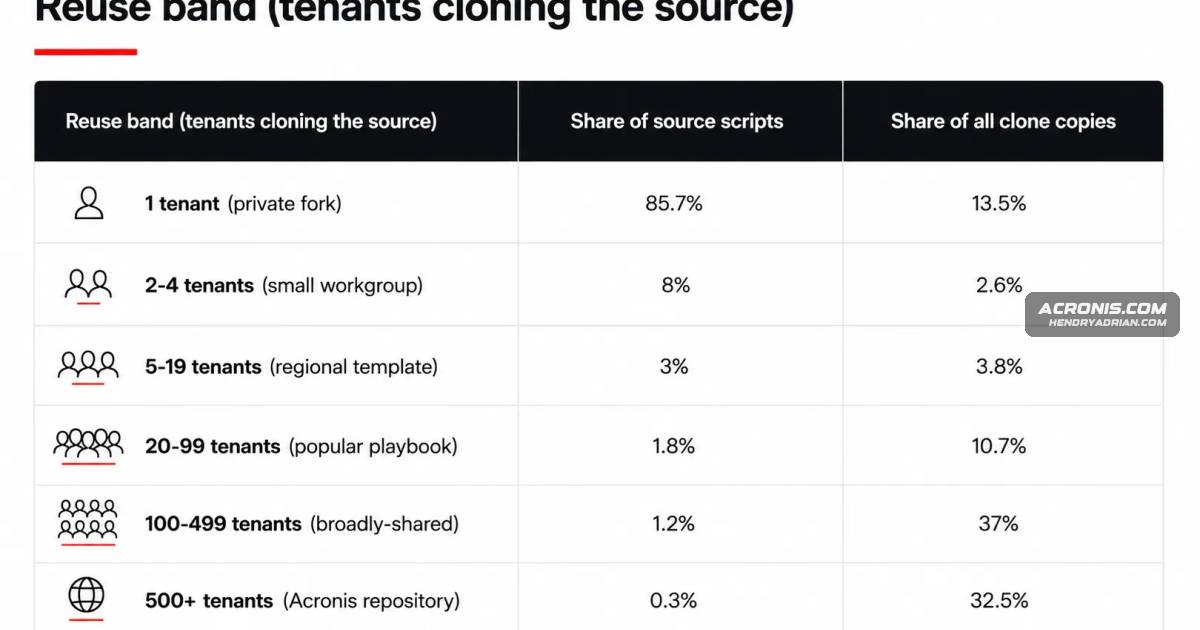
- About 38.9% of active scripts are clones; six Acronis-built templates account for about 32.5% of clone copies.
- About 15.6% of active scripts are AI-generated; AI-heavy tenants make up about 13.9% of classified script-using tenants.
- AI-heavy tenants clone less on average than tenants that use no AI, suggesting AI generation often substitutes for template reuse.
- All six most widely cloned templates carry credentials in at least some tenant copies, and only about 63.5%–78.8% of their copies are marked approved.
- Scripts commonly run with administrative privileges, so defects or unsafe behavior can affect customer endpoints.
- The article recommends tracking script origin and ownership, reviewing and versioning scripts, curating clone sources, and verifying AI-generated scripts before deployment.
Article Details
- Publisher
- Acronis Threat Research Unit
- Scope
- Acronis platform script-usage patterns, including script reuse, AI generation, and regional differences.
- Key Statistics
- About 38.9% of active scripts are clones of existing scripts.
- About 15.6% of active scripts are AI-generated.
- Six Acronis built-in scripts, each cloned by 500 or more distinct tenants, account for about 32.5% of clone copies.
- The 28 most-cloned templates account for about 69.5% of clone copies.
- AI-heavy tenants are about 13.9% of classified script-using tenants; within this cohort, about 74.4% of scripts are AI-generated.
- Recommendations
- Inventory scripts by authorship and refresh the inventory quarterly.
- For cloning-primary teams, maintain a master-source register and trace each clone to a known, owned master.
- Review cloned scripts in production that have been in use for more than six months.
- Review AI-generated scripts before production, version them in source control, and attribute the prompt and model that produced them.
- Validate inputs, handle outputs and errors, and avoid embedding secrets in AI-generated scripts.
People
Vendors
Products
Countries
AustraliaAI-augmentation markets (Australia, Singapore, the United Kingdom) use AI butAustriaAustria, Switzerland) stay with established templates. None is wrong; eachBotswanamarkets (Brazil, Mexico, Italy, France, South Africa, Botswana, Colombia, IndiaBrazilmarkets (Brazil, Mexico, Italy, France, South Africa, Botswana, Colombia, IndiaColombiamarkets (Brazil, Mexico, Italy, France, South Africa, Botswana, Colombia, IndiaDenmarkkeep cloning heavily alongside it; cloning-dominant markets (Spain, Denmark,Francemarkets (Brazil, Mexico, Italy, France, South Africa, Botswana, Colombia, IndiaIndiamarkets (Brazil, Mexico, Italy, France, South Africa, Botswana, Colombia, IndiaItalymarkets (Brazil, Mexico, Italy, France, South Africa, Botswana, Colombia, IndiaMexicomarkets (Brazil, Mexico, Italy, France, South Africa, Botswana, Colombia, IndiaNetherlandsSwitzerland and Netherlands — stay with established templates and use AISingaporeAI-augmentation markets (Australia, Singapore, the United Kingdom) use AI butSouth Africamarkets (Brazil, Mexico, Italy, France, South Africa, Botswana, Colombia, IndiaSpainkeep cloning heavily alongside it; cloning-dominant markets (Spain, Denmark,SwitzerlandAustria, Switzerland) stay with established templates. None is wrong; eachUnited KingdomAI-augmentation markets (Australia, Singapore, the United Kingdom) use AI butUnited Statessparingly. The United States is a distinctive case: AI use is widespread, yet