Autonomous Weapons Raise Civilian Risks, Requiring International Rules
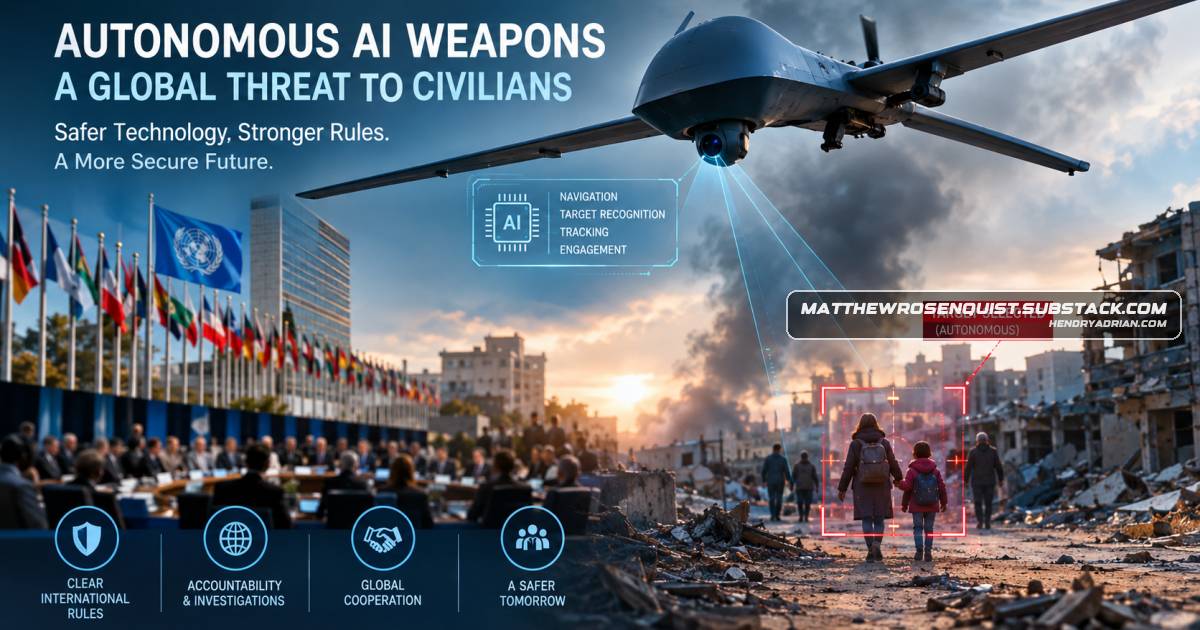
Summary
The article argues that autonomous weapons used in Ukraine pose risks to civilians and calls for international agreements establishing limits, accountability, investigations, and coordinated responses.
Key points
- The article cites a July 2026 Russian drone strike in Zaporizhzhia that killed three civilians; investigators reportedly found an Nvidia Jetson Orin chip and an onboard AI system.
- Investigators reportedly said human operators directed the drone toward the area, while its AI selected the specific target.
- The author says autonomous weapons are in use by Russia and Ukraine, while other militaries are developing and testing them.
- The article argues that autonomous systems should be restricted to legitimate military objectives and never intentionally used against civilians.
- It calls for shared rules covering acceptable use, accountability, incident reporting, and independent forensic investigations.
- The author proposes coordinated international responses, including sanctions, export restrictions, supply-chain measures, and joint countermeasures.
Article Details
- Topic
- Autonomous weapons and international rules to protect civilians
Products
Countries
RussiaAutonomous weapon systems, from both Ukraine and Russia, are currently in use. Militaries across the globe are developing, testing, and beginning to deploy such AI enhanced weapons.UkraineAutonomous weapon systems are no longer theoretical and represent a real threat to civilians. The war in Ukraine has become a proving ground for weapons that can navigate, identify targets, resist electronic