Compromised LiteLLM Release Distributed Credential Stealer and Backdoor
Summary
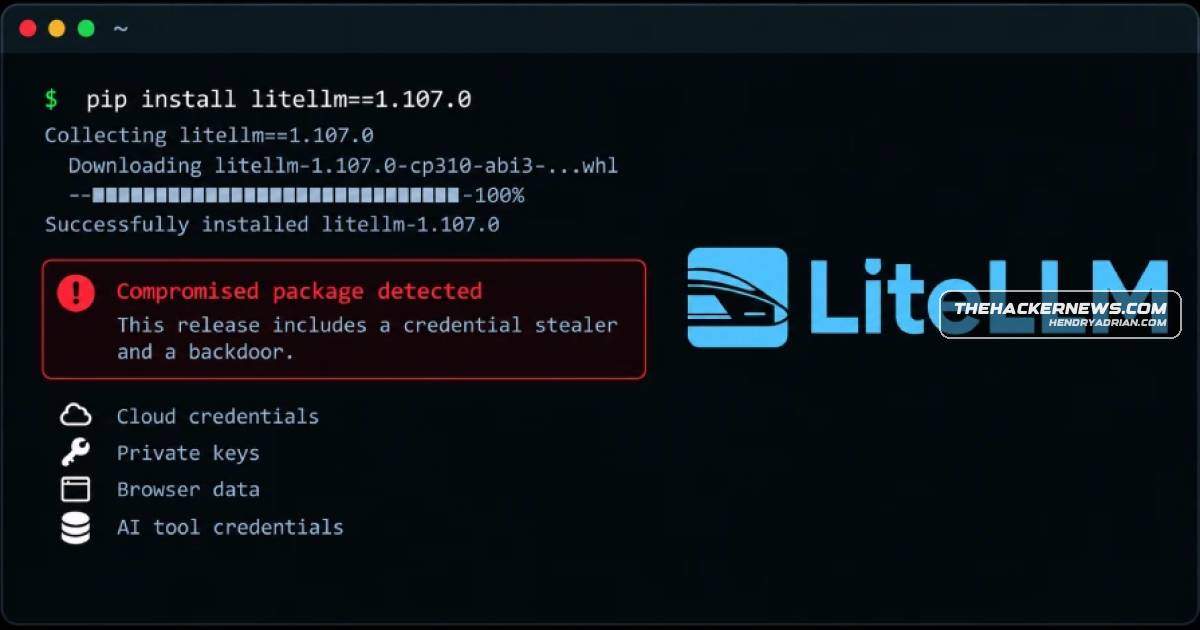
LiteLLM 1.107.0 was compromised via PyPI and Docker, delivering malware that steals credentials and can run attacker-supplied Python. LiteLLM revoked involved tokens and advises affected users to rotate credentials and pin version 1.106.2 by digest.
Key points
- The compromise affected LiteLLM 1.107.0 distributed through PyPI wheels and Docker images; PyPI quarantined the package and the malicious images were removed.
- LiteLLM said the attacker used three engineers’ GitHub accounts, apparently via stolen GitHub CLI OAuth tokens, to trigger and approve a release. The tokens have been revoked; the original token-theft mechanism remains unknown.
- A cook.pth file runs code when Python starts, launching the privcollect credential stealer before LiteLLM is imported.
- The malware targets cloud tokens, private keys, developer accounts, AI-tool credential files, browser data, environment variables, and LiteLLM proxy credentials and model configuration.
- A second payload checks a GitHub dead drop hourly and runs attacker-supplied Python; the cited repository, github[.]com/letters9813, currently returns a 404 error.
- Collected data is sent in a GZIP-compressed TAR archive to litellm[.]dev/healthcheck.
- Affected users are advised to revoke and replace exposed credentials from a clean environment and pin LiteLLM 1.106.2 by digest.
Article Details
- Event Type
- Software supply-chain compromise involving a malicious LiteLLM package release and Docker images.
- Impact
- LiteLLM 1.107.0 contained a credential stealer and a backdoor. The malware could collect cloud credentials, private keys, developer and AI-tool authentication data, browser data, environment variables, and LiteLLM proxy credentials and model configuration, then transmit collected data to a specified endpoint. LiteLLM said the malicious release was published using three engineers' GitHub accounts, apparently through stolen GitHub CLI OAuth tokens; the investigation into how the tokens were acquired was ongoing.