
AI-Related Activity Is 0.43% of SOC Alerts, Mostly Noise
Summary
An Intezer analysis of enterprise SOC alerts found that AI-related activity made up 0.43% of alerts; 94.1% were noise, 5.8% risks and 0.02% attacks. It recommends tuning detections and restricting AI tools.
Key points
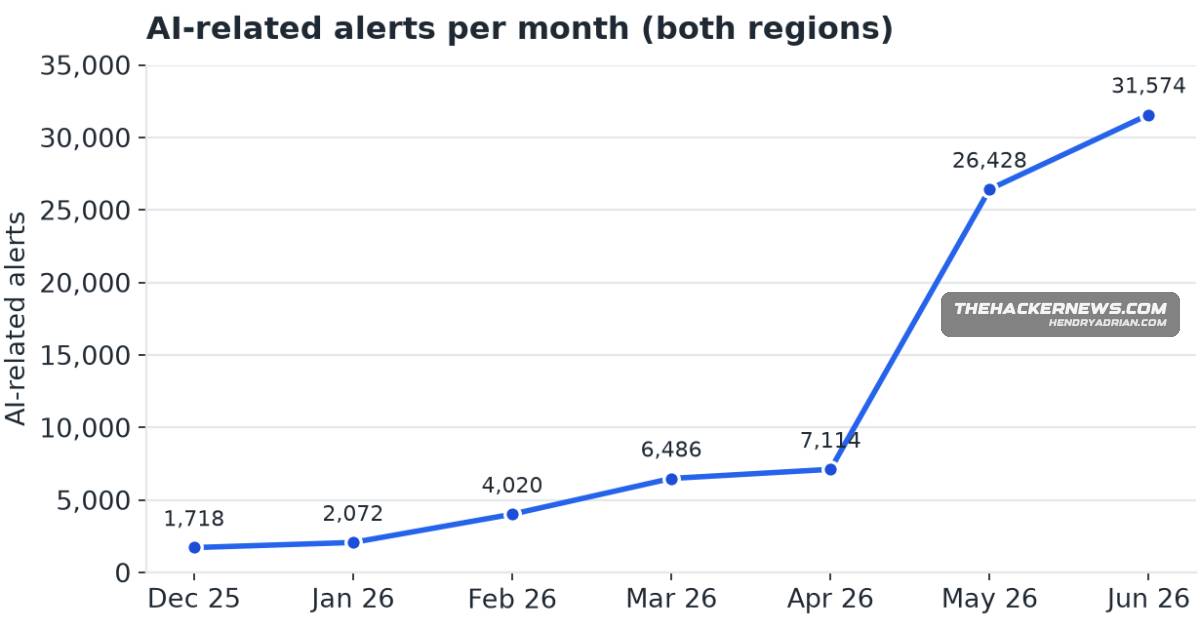
- The analysis covered roughly 16.9 million SOC alerts; about 73,000 were AI-related, and that alert share grew 685% from February to June 2026.
- Intezer classified 94.1% of AI-related alerts as noise, 5.8% as genuine security risks and 0.02% as real attacks.
- The analysis found that confirmed attacks in this alert class were phishing campaigns using AI brand names as lures; it found no confirmed compromises caused by an organization’s own AI agents.
- Unsafe agent behavior included running with permission safeguards bypassed, opening a public reverse tunnel, and dumping a macOS keychain to retrieve a token.
- Legacy detections often flagged legitimate coding-agent activity as severe threats; the article reports benign rates of 77% to 99% across several noisy detections.
- The article recommends tuning detections for routine AI activity, hunting for risky agent behavior and OAuth grants, and isolating AI tools in restricted environments.
Article Details
- Publisher
- Intezer
- Report Period
- February-June 2026 (stable reporting window); broader review covered the preceding year
- Scope
- AI-related SOC alerts and activity across enterprise environments
- Sample Size
- Approximately 16.9 million SOC alerts, including about 73,000 AI-related alerts; exact number of environments not disclosed
- Key Statistics
- AI-related alerts were about 0.43% of approximately 16.9 million reviewed SOC alerts.
- AI-related alert volume increased 685% from February to June 2026.
- The reviewed AI-related alerts were classified as 94.1% noise, 5.8% genuine security risks, and 0.02% real attacks.
- Among AI-related alerts, 79.8% received a benign verdict, 81.7% were automatically suppressed, and 5.4% were escalated to a human analyst.
- A single detection at one customer accounted for 55% of critical verdict alerts flagging Expand.exe as a lateral-tool-transfer.
- Recommendations
- Tune legacy detections that generate high-severity alerts on routine AI-agent activity.
- Define policies for information shared with third-party AI platforms.
- Proactively hunt for permission-bypass flags, unauthorized tunnels, and risky OAuth grants.
- Run AI tools in isolated environments, such as Docker containers or virtual machines, with restricted access to credentials and sensitive information.
Indicators of compromise
| Type | Indicator | Context |
|---|---|---|
| DOMAIN | gemini-advertisers[.]com | Identified as suspicious infrastructure used in a fake Google/Gemini Ads invitation lure intended to direct recipients to a malicious site. |
MITRE ATT&CK
T1003 · OS Credential DumpingA Cursor-initiated sequence used MiniDump via comsvcs.dll to dump process memory, creating credential-exposure risk; the report does not describe this as a confirmed compromise.T1566 · PhishingA phishing campaign used AI-brand-themed email lures, including a fake Google/Gemini Ads invitation.T1572 · Protocol TunnelingAn AI code editor launched ngrok to open a named reverse tunnel to the public internet; the report describes the observed use as a risk with benign intent.
Vendors
Products
ChatGPTWe observed multiple alerts for OAuth application consent granted to ChatGPT across tenants, “first sign-in to a new application: OpenAI” events, and, at one customer, a sizeable cluster of data-protection alerts forClaude DesktopThe genuine Anthropic Claude Desktop installer, verified by its code signature, triggers major EDR rules such as “Ransomware Operations detected” and “Encoded PowerShell Download and Run” across several customers.Codex CLIA process originating from node.exe executing the OpenAI Codex CLI agent with –yolo or –dangerously-skip-permissions tripping ClickFix, DisableTools, and DLL-injection detections.Cursor#Anthropic