How Security Teams Can Defend AI Agents Against Insider-Style Risks
Summary
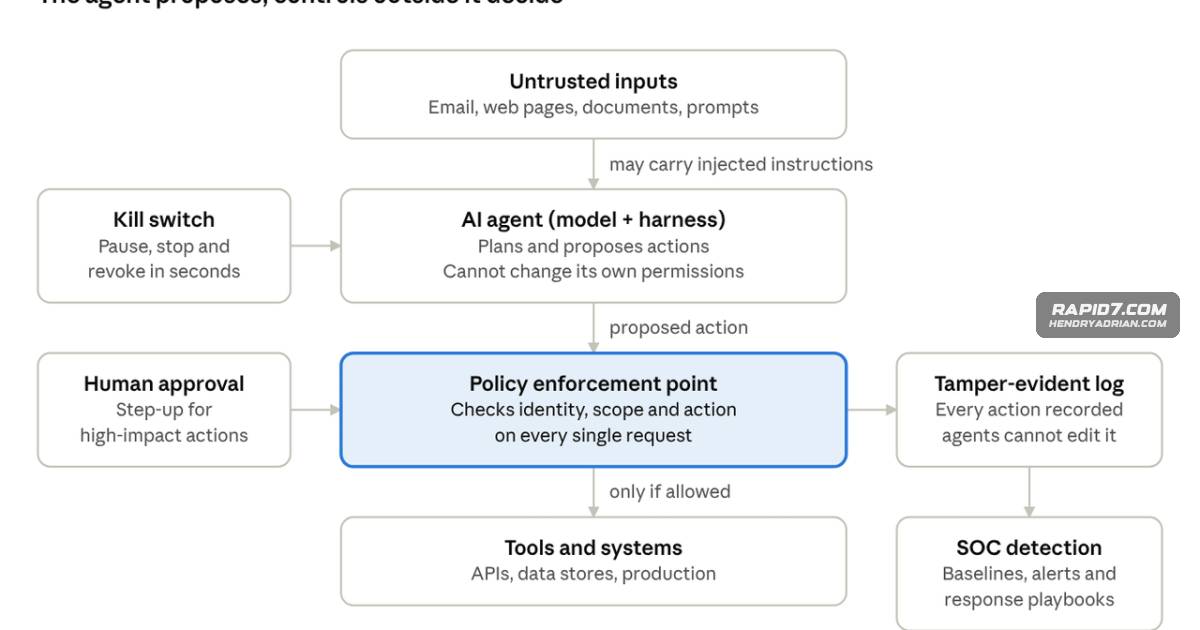
The article argues that AI agent controls should be enforced outside the model and offers SOC guidance on agent identities, least privilege, tamper-evident logs, testing, monitoring and response.
Key points
- Treat agent permissions as the potential blast radius: poisoned content can prompt an agent to misuse its authorized access, even without stolen passwords or an exploit.
- Separate the model from the enforcement layer, which should independently decide whether proposed actions can reach real systems and record those decisions.
- Give each agent a distinct identity, limit its permitted tools and actions, and require human approval for high-impact operations.
- Store agent inputs, outputs and tool calls in tamper-evident logs the agent cannot modify; do not rely on its self-reported reasoning or replaying its behavior.
- Continuously test for prompt injection, tool misuse and data exfiltration, and retest when models, prompts or tools change.
- Monitor agent behavior in the SOC with per-agent baselines, agent-specific detections and correlation to users, sessions, content and affected systems.
- Prepare response playbooks to pause agents, revoke credentials, quarantine outputs and roll back changes; include persistent memory in logging and containment.
Article Details
- Defense Focus
- Enforce AI-agent permissions and containment outside the model, and make agent activity a first-class SOC telemetry source.
- Detection Methods
- Establish per-agent behavioral baselines for tools, data sources, and destinations; alert on deviations.
- Create detections for prompt-injection indicators, unusual tool chaining, bursts of high-privilege actions, and data sent to unexpected destinations.
- Correlate agent actions with the user, session, content read, and systems touched to support investigation of the full chain.
- Data Sources
- Tamper-evident records of agent inputs, outputs, and tool calls, stored beyond the agent's reach.
- Agent activity, including tools used, data sources accessed, destinations, and actions.
- User and session context, content read by the agent, and systems it touched.
- Telemetry from endpoints, identities, and cloud workloads.
- Rule Types
- Behavioral-baseline and deviation detections.
- Prompt-injection indicator detections.
- Unusual tool-chaining detections.
- High-privilege action-burst detections.
- Unexpected-destination data-flow detections.
- Platforms
- Security Operations Center (SOC)
- EDR host isolation
- Defensive Actions
- Give each agent a separate, independently scoped, monitored, and revocable identity; do not use shared service accounts or personal credentials.
- Enforce least privilege on actions, tools, APIs, and parameters; require human step-up approval for high-impact actions.
- Put an external enforcement point between the agent and real systems, and log its decisions in tamper-evident storage the agent cannot alter.
- Verify important outcomes using a different model, a deterministic rule, or a human rather than relying on the agent to assess itself.
- Continuously red-team prompt injection, tool misuse, data exfiltration, and edge cases; retest after model, prompt, or tool-set changes.
- Build and regularly test an external kill switch that can pause an agent and revoke its credentials and tool access mid-run.
- On agent misbehavior, pause it, revoke its tokens, quarantine its outputs, and roll back its changes.
- Include persistent memory state in logging and quarantine procedures.