
Four Cyber Hygiene Failures That Let Attackers Into Networks—and How to Prevent Them
Summary
Huntress describes four intrusions involving compromised credentials, brute-forced VPN access, abandoned accounts, and credential theft, and recommends account audits, MFA, strong passwords, VPN monitoring, and logging.
Key points
- A compromised doctor’s credentials and an unused former employee account gave an attacker access to a medical network; the SOC stopped lateral movement.
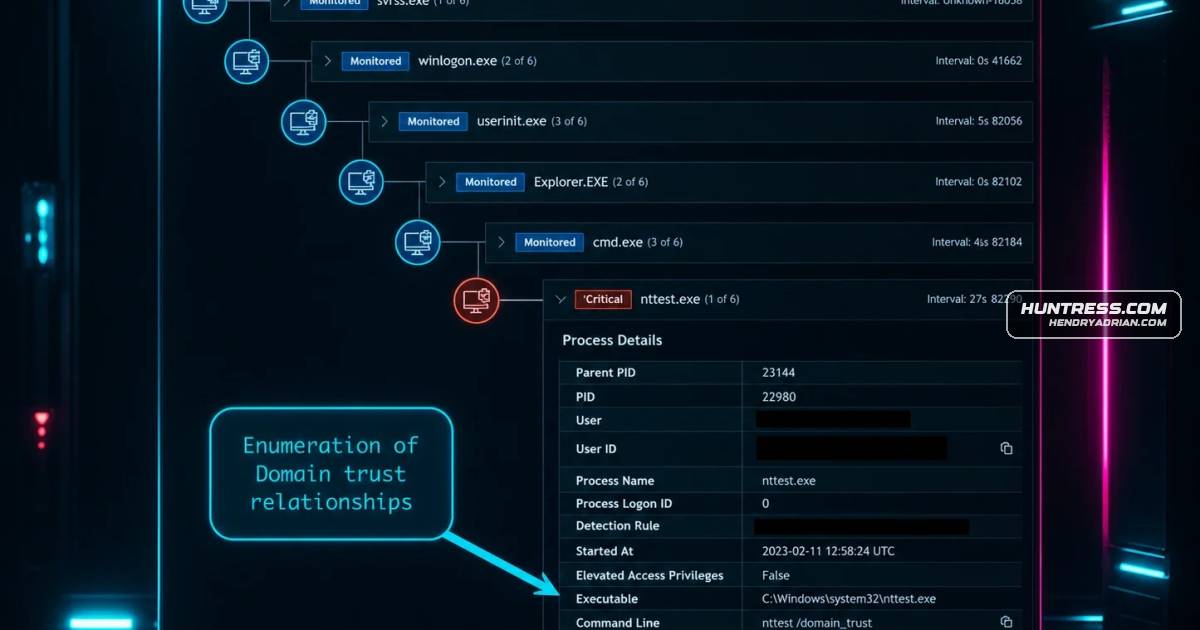
- An attacker brute-forced a manufacturer’s VPN, cracked an account, and enumerated domain relationships before the SOC cut off access.
- Compromised VPN credentials at an industrial supply company enabled local administrator account creation, firewall changes, and domain reconnaissance.
- At a container manufacturer, an attacker accessed a Fortigate VPN and attempted credential theft and persistence; Microsoft Defender alerted on registry dumping.
- The article recommends auditing accounts, promptly disabling departed employees’ access, enabling MFA on externally facing services, enforcing strong passwords, and monitoring VPN access and logs.
Article Details
- Defense Focus
- Detect and contain unauthorized VPN access, credential theft, and lateral movement, supported by stronger account and VPN hygiene.
- Detection Methods
- Monitor VPN access and investigate use of compromised credentials.
- Alert on domain trust relationship enumeration.
- Detect changes to Windows Firewall settings and the registry that enable RDP or lateral movement.
- Investigate attempts to dump credentials from the Windows Registry.
- Audit user accounts regularly and disable accounts when employees leave.
- Data Sources
- VPN access logs
- Domain trust relationship enumeration activity
- Windows Firewall and registry activity
- Security alerts from Microsoft Defender and the Huntress portal
- Platforms
- VPN appliances
- Windows endpoints
- Active Directory
- Defensive Actions
- Enable MFA for externally facing services and VPN access.
- Enforce strong passwords and consider time-of-day restrictions for authentication.
- Regularly audit accounts and promptly disable access for departing employees.
- Monitor VPN access and investigate suspicious activity.
- Investigate and contain lateral movement, then secure compromised VPN access and accounts.
MITRE ATT&CK
T1021.001 · Remote Desktop ProtocolAn actor modified the registry and firewall to enable lateral movement via RDP.T1078 · Valid AccountsThreat actors used compromised, legitimate accounts to access VPNs and pivot within victim networks.T1110 · Brute ForceA threat actor brute-forced a manufacturer's VPN appliance until they obtained one account's credentials.T1112 · Modify RegistryAn actor modified the registry to enable lateral movement via RDP.T1136.001 · Local AccountAn actor created local Administrator accounts on multiple hosts.T1482 · Domain Trust DiscoveryAfter gaining VPN access, an actor enumerated domain trust relationships.T1562.004 · Disable or Modify System FirewallActors manipulated local or Windows Firewall settings to open pathways and enable RDP access.
Vendors
Products
Fortinet FortiGateThreat actors compromised the Fortigate VPN at a container manufacturing company and got their hands on a legitimate Active Directory account.Microsoft Defender Antimalware PlatformMicrosoft Defender caught the credential theft attempt and raised the alarm, but our SOC didn’t stop there.