
Using ASN Enrichment to Improve Threat Hunting and Incident Response
Summary
Huntress explains how analysts can enrich IP data with ASN information to investigate suspicious authentication and identify compromises across remote desktop, RADIUS, and VPN systems.
Key points
- ASN data can add hosting-provider context to IP addresses, helping analysts distinguish suspicious connections from patterns associated with residential ISPs.
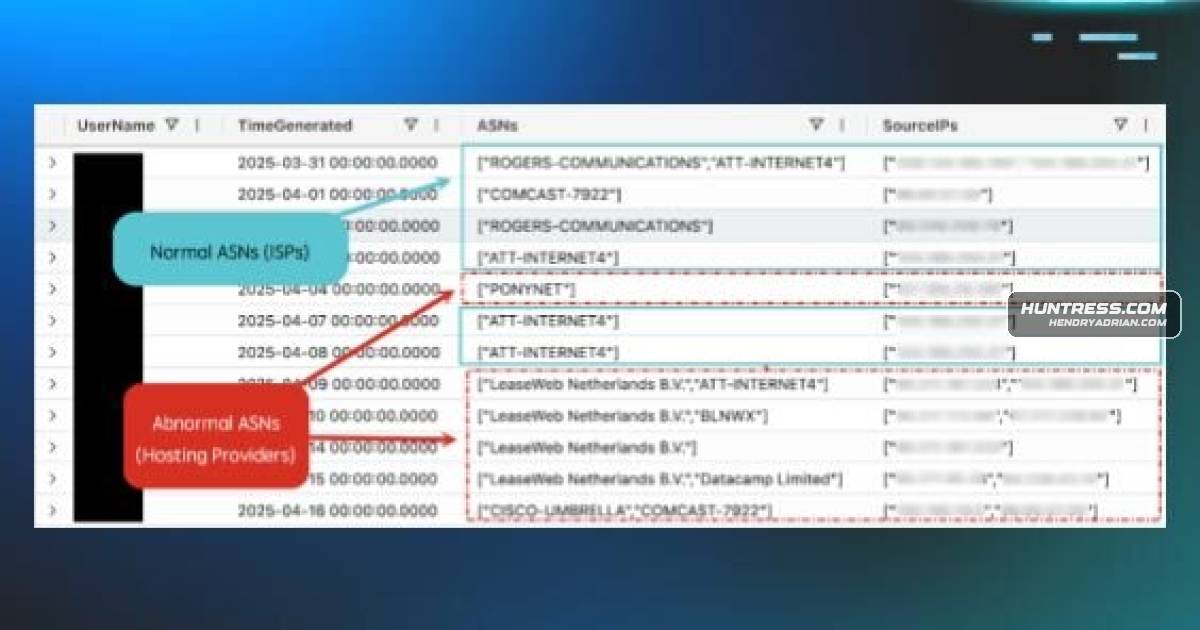
- In a remote desktop gateway case, ASN enrichment helped identify abnormal authentications from hosting providers and establish the likely initial access vector.
- During a RADIUS password-spray incident, about 60 accounts were targeted; Entra telemetry showed that none of the users accepted the unexpected MFA prompts.
- In the RADIUS case, geolocation looked normal, while ASN information highlighted suspicious providers and helped identify compromised accounts.
- In a VPN investigation, two near-simultaneous logins using a super_admin profile came from different IPs in the same DigitalOcean ASN; the partner confirmed the behavior was malicious.
- The authors caution that an ASN is not inherently malicious and recommend combining ASN data with authentication logs and other context.
Article Details
- Defense Focus
- Use ASN enrichment alongside IP and authentication telemetry to identify and investigate suspicious access and account compromise.
- Detection Methods
- Enrich authentication-event IP addresses with ASN information and compare observed ASNs with each account's normal pattern.
- Correlate RADIUS logins with corresponding Microsoft Entra authentication events to distinguish successful device-side authentication from successful MFA authentication.
- Compare ASN data with geolocation; the article describes an incident where locations appeared normal but the associated ASNs were suspicious.
- Triage unusual VPN authentication patterns, including near-simultaneous logins to a privileged profile from different IP addresses, using ASN context.
- Review large authentication datasets for anomalous ASNs rather than manually checking IP addresses individually.
- Data Sources
- Remote desktop gateway logs
- RADIUS authentication logs
- Microsoft Entra authentication telemetry
- VPN appliance logs
- Windows event logs
- Firewall logs
- IP enrichment data, including ASN and geolocation
- Platforms
- Microsoft Entra
- Defensive Actions
- Isolate the affected network when lateral movement is detected to limit further unauthorized access.
- Investigate the initial access vector and identify the affected account and compromise timeframe using available authentication telemetry.
- Correlate authentication sources and understand the environment's authentication and authorization configuration before judging logins as successful.
- Use ASN information as contextual evidence, not as a standalone verdict; the article notes that a hosting-provider ASN is not inherently malicious.
- Recommend stronger authentication controls, including multi-factor authentication, where supported by the incident evidence.
MITRE ATT&CK
T1003 · OS Credential DumpingThe VPN-compromise investigation identified registry dumping as a method used to obtain credentials.T1110.003 · Password SprayingThe RADIUS incident involved password spraying that targeted about 60 accounts.T1133 · External Remote ServicesThe article describes an intrusion attributed to compromise through a VPN appliance.