Explainer: How the Surface Web, Deep Web and Darknet Differ
Summary
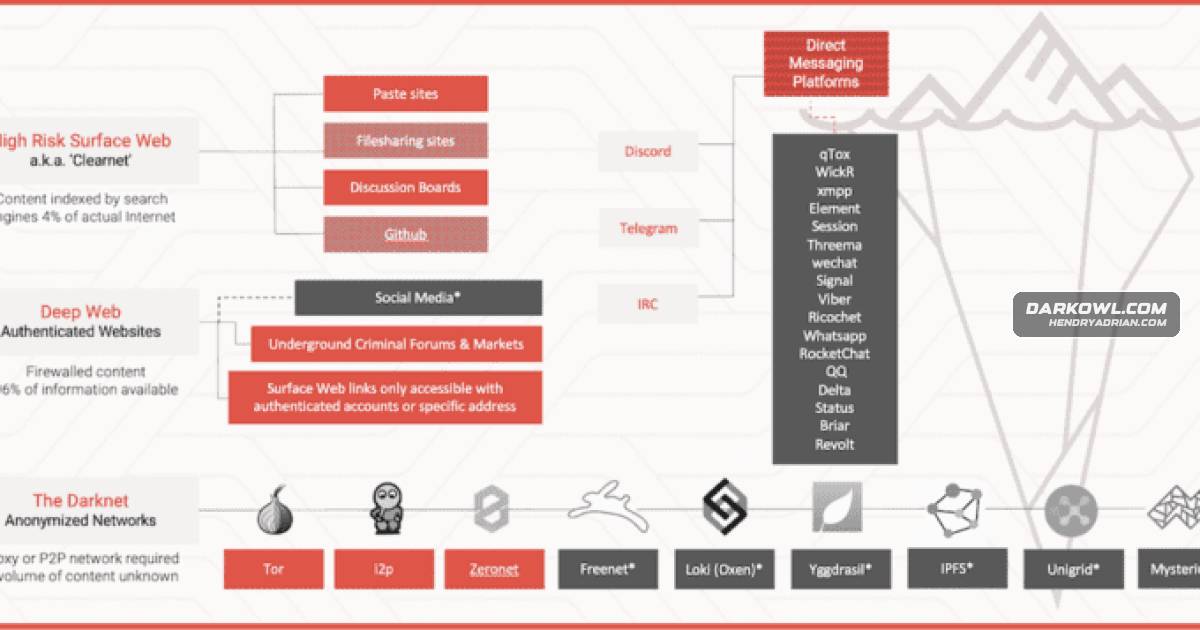
An explainer distinguishes the surface web, deep web and darknet, describing how Tor, I2P, ZeroNet, Freenet, Lokinet and Yggdrasil work and why darknet terminology matters to OSINT investigators.
Key points
- The surface web is generally searchable; deep web content includes databases and sites not indexed by search engines, such as account portals and medical records.
- Darknets are intentionally hidden anonymous networks that require specialized tools or protocols to access.
- Tor routes traffic through volunteer-operated servers; I2P uses a distributed peer-to-peer model and garlic routing.
- ZeroNet and Freenet use peer-to-peer designs; Freenet can store encrypted content fragments across users’ devices.
- Lokinet uses multi-hop LLARP routing, while Yggdrasil is an encrypted IPv6 mesh network.
- The article says investigators and organizations may need to account for darknet activity, and notes the risk that Freenet users could unknowingly host illicit content.
Article Details
- Topic
- Overview of the surface web, deep web, darknet, and examples of anonymous overlay networks
Products
CJDNSYggdrasil is still considered ‘proof of concept’ and is designed as a more scalable version of CJDNS.FreenetI2P routing is described as “garlic routing” where Tor is “onion routing.” It originated in 2003 as a ‘fork’ of Freenet.I2PI2P, or the Invisible Internet Project, is an anonymous overlay network – using the distributed peer-to-peer (p2p) model – intended to protect communication from surveillance and monitoring.i2pdThe I2P router relies heavily on Java to I2P browser, but i2pd is built on C++ for those adverse to Java.LokinetLokinet is another example of an overlay decentralized network built on the Blockchain that serves as a darknet providing enhanced anonymity and privacy.SessionThe Loki network is developed atop the Oxen Blockchain which also hosts the end-to-end encrypted chat application, Session.TorYou cannot technically directly access the darknet by simply typing a darknet address into your web browser, even though browsers like Brave offer private tabs with Tor for enhanced privacy.YggdrasilYggdrasil is an IPv6 overlay fully encrypted mesh network where each node in the network is assigned a cryptographic public key (like Zeronet) and routing is highly adaptable, using spanning trees for synchronization.ZeroNetZeroNet is another example of a decentralized peer to peer network built on the Blockchain that functions as a darknet.