Holiday Security Guide Covers React2Shell, ClickFix, Phishing and Practical Defenses
Summary
A Huntress webinar recap discusses active React2Shell exploitation, ClickFix, phishing through trusted services, and online scams, then offers practical steps for families to improve account, device, and social-media security.
Key points
- Huntress reported active exploitation of React2Shell (CVE-2025-55182) across multiple customers, with payloads including cryptominers, the Linux backdoor PeerBlight, tunneling tools, Go-based implants, and a Kaiji botnet variant.
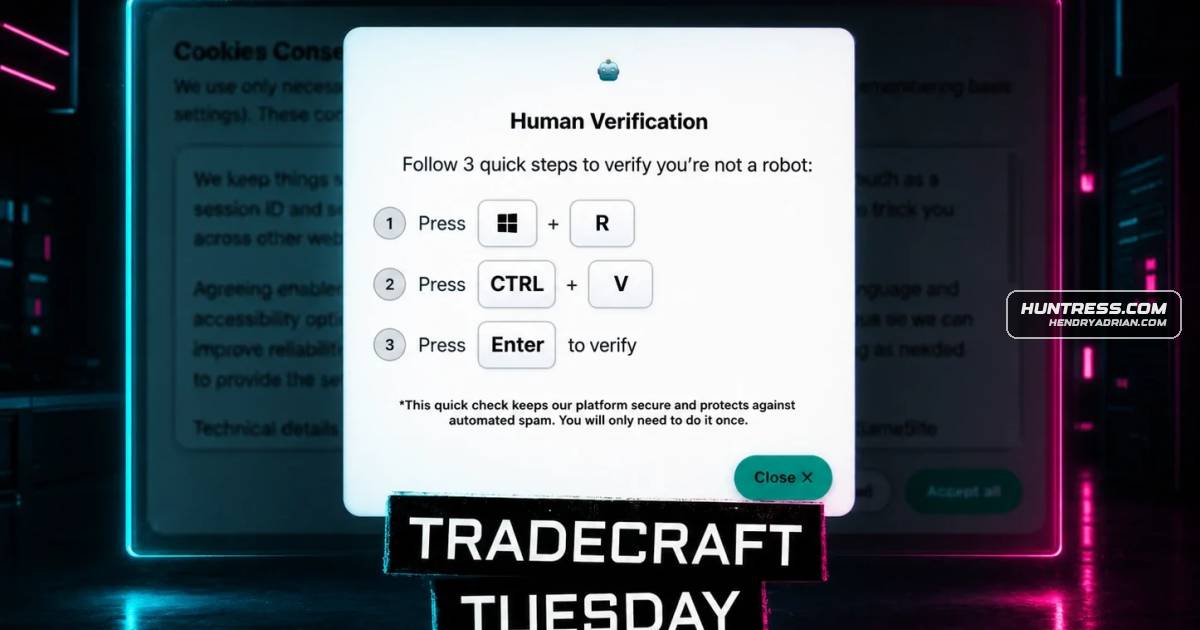
- ClickFix scams prompt victims to leave the browser, paste clipboard contents, and run commands, making the user execute the malware. The article advises treating such verification requests as malicious.
- Phishing may abuse legitimate services such as PayPal or DocuSign to send convincing messages. The guidance is to avoid unexpected links and check directly through the service’s app or website.
- The speakers described sextortion, romance scams, and pig-butchering schemes, including the use of AI chatbots and generated images to scale deception and target victims.
- Recommended account protections include enabling MFA, using passkeys where available, and adopting a password manager; the speakers advised avoiding SMS MFA when practical.
- Other suggested precautions include call screening, limiting social-media visibility and incoming messages, freezing credit when not seeking loans, and verifying suspicious messages through a separate channel.
Article Details
- Defense Focus
- Detect and mitigate active React2Shell exploitation and help users resist malware delivery, phishing, sextortion, romance scams, and identity fraud.
- Detection Methods
- Rapidly assess internet-facing React exposure and monitor for exploitation and resulting payloads.
- Treat unexpected messages as suspicious regardless of whether they come from a legitimate service or a known contact; verify through a separate channel or by visiting the service directly.
- Warn users that verification prompts asking them to leave the browser, paste clipboard contents, or run commands are malicious.
- Data Sources
- System logs showing users launching tools and running commands.
- Email sender and message context, including whether the communication was expected.
- React application exposure and endpoint activity associated with exploitation or delivered payloads.
- Platforms
- Huntress SOC
- Defensive Actions
- Assess React vulnerability exposure, patch where possible, and apply compensating controls; aim for a 24-hour response turnaround at minimum.
- Prioritize MFA for email and financial accounts; prefer options other than SMS when practical, but enable SMS MFA if it is the only usable option.
- Use passkeys and a password manager where available, and avoid password reuse.
- Enable call screening and restrict social-media visibility, messaging, and contact from strangers.
- Freeze credit when not seeking new loans.
- Do not click unexpected messages; access the relevant service directly and verify suspicious messages through another channel.
MITRE ATT&CK
T1189 · Drive-by CompromiseThe article describes phishing that abuses legitimate services and workflows, including sharing and calendar invites, to reach victims.T1203 · Exploitation for Client ExecutionReact2Shell exploitation of the React remote code execution vulnerability was reported across multiple Huntress customers.T1204.004 · Malicious Copy and PasteClickFix prompts users to paste attacker-provided clipboard content and run commands, making the victim execute the malware-delivery steps.
CVE
People
Malware
Kaijifrom cryptominers and a Linux backdoor (PeerBlight) to tunneling tools, Go-based implants, and even a Kaiji botnet variant.PeerBlightvulnerability across multiple customers, dropping everything from cryptominers and a Linux backdoor (PeerBlight) to tunneling tools, Go-based implants, and even a Kaiji botnet variant.
Vendors
Products
1PasswordSeveral common options (1Password, Bitwarden, Keeper, LastPass) were mentioned alongside an acknowledgment that a notebook in a house can be safer than “passwords.xls on the desktop,” and even browser storage can beatBitwardenSeveral common options (1Password, Bitwarden, Keeper, LastPass) were mentioned alongside an acknowledgment that a notebook in a house can be safer than “passwords.xls on the desktop,” and even browser storage can beatDocuSignshady lookalike domains, attackers abuse legitimate services that can send legitimate email (PayPal, DocuSign, Intuit, OneDrive/Google Drive sharing workflows, and calendar invites).Google Driveattackers abuse legitimate services that can send legitimate email (PayPal, DocuSign, Intuit, OneDrive/Google Drive sharing workflows, and calendar invites).InstagramThe pattern: an account (often via Instagram or similar platforms) builds rapport, solicits compromising images, then threatens to send them to the victim’s follower list unless paid.Intuitlookalike domains, attackers abuse legitimate services that can send legitimate email (PayPal, DocuSign, Intuit, OneDrive/Google Drive sharing workflows, and calendar invites).KeeperSeveral common options (1Password, Bitwarden, Keeper, LastPass) were mentioned alongside an acknowledgment that a notebook in a house can be safer than “passwords.xls on the desktop,” and even browser storage can beatLastPassSeveral common options (1Password, Bitwarden, Keeper, LastPass) were mentioned alongside an acknowledgment that a notebook in a house can be safer than “passwords.xls on the desktop,” and even browser storage can beatMicrosoft OneDrivedomains, attackers abuse legitimate services that can send legitimate email (PayPal, DocuSign, Intuit, OneDrive/Google Drive sharing workflows, and calendar invites).Paypalregistering shady lookalike domains, attackers abuse legitimate services that can send legitimate email (PayPal, DocuSign, Intuit, OneDrive/Google Drive sharing workflows, and calendar invites).Reactthreat lines are dissolving and included an urgent call for defenders to mitigate the critical React remote code execution vulnerability (CVE-2025-55182) that has led to fast-moving exploitation across the