
AI-Enhanced Candidate Fraud Raises Insider Threat Risks, Huntress Says
Summary
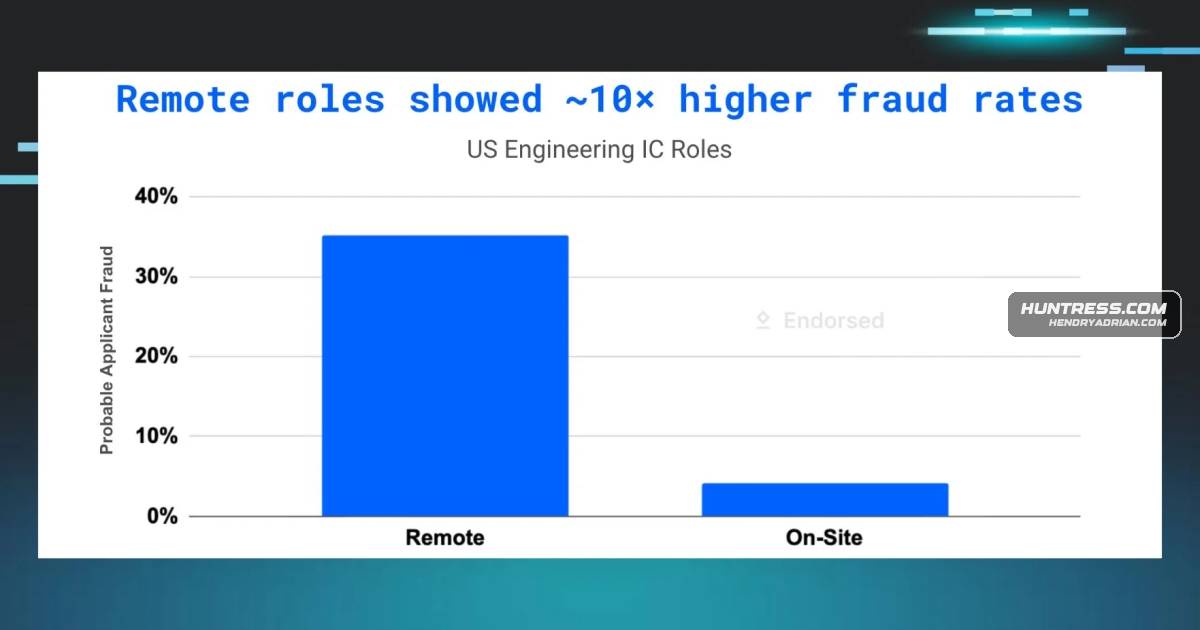
Huntress cites hiring-fraud figures, including 23.2% of applicants flagged as fraud risks in its September–November 2025 data, and recommends identity checks and contextual assessments to reduce deepfake and insider-threat risks.
Key points
- Huntress says its Endorsed screening tool flagged 23.2% of applicants as fraud risks from September to November 2025, based on signals including contact details, social profiles, identity traces, and fraud networks.
- The article cites a Gartner projection that one in four candidate profiles worldwide will be fake by 2028, and a survey finding that 17% of hiring managers have encountered candidates using deepfakes.
- Huntress warns that fraudulent candidates who bypass hiring checks could create insider-threat risks by gaining access to internal systems.
- Recommended safeguards include human-led identity checks, biometric or liveness validation, and cross-checking candidates’ digital footprints.
- The article advises replacing conventional take-home tasks with spontaneous, scenario-based exercises and setting clear policies on candidates’ AI use.
Article Details
- Topic
- AI-enhanced candidate fraud, including AI-generated applications, deepfakes, and synthetic identities in recruitment
Vendors
Products
Tools
Industries
recruitmenta reality defined by high-volume, automated deception. In this third series of our recent blogs about recruitment scams, we’ll examine data and the sheer scale of AI-driven deception in hiring today.Technologytheoretical: data shows that 17% of hiring managers report encountering candidates using deepfake technology at some point in their hiring process. These successful breaches can lead not just to hiring failures