
MikroTik RouterOS Flaw Chain Enables Passwordless Administrative Access to Exposed Routers
Summary
CERT Polska explains how CVE-2026-67279 and CVE-2026-86060 can be chained to take over Internet-exposed MikroTik routers. Logs indicate exploitation before patches; administrators should update and check for compromise.
Key points
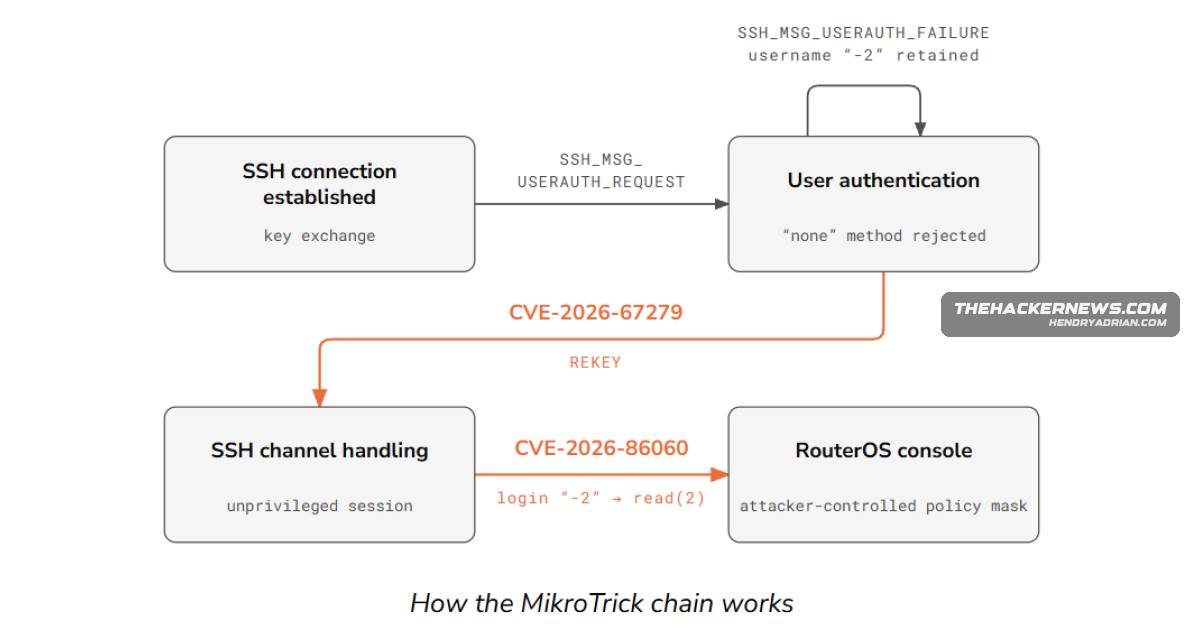
- The MikroTrick chain combines an SSH state-machine flaw, CVE-2026-67279, with a login argument-injection flaw, CVE-2026-86060.
- Attackers can use the username -2 to reach a fully privileged RouterOS console without completing authentication.
- CERT Polska says matching logs appeared by September 2, before patches were released on September 3 in RouterOS 6.49.21, 7.23.4, and 7.24.2.
- Some affected-device reports showed creation of an ops account; other activity strongly suggested configuration data was transferred to attacker infrastructure.
- CISA added CVE-2026-86060 to its Known Exploited Vulnerabilities catalog on September 10. No authoritative count of compromised devices has been published.
- Administrators should patch, inspect logs and devices for suspicious accounts and other changes, and isolate, preserve evidence, factory reset, and rebuild devices if compromise is suspected.
- CERT Polska recommends changing credentials and not restoring backups from compromised devices. The Flagged status check can detect selected traces, but its absence does not prove a device is safe.
Article Details
- Attack Vectors
- Attackers chained CVE-2026-67279 and CVE-2026-86060 over SSH to gain full administrative control of Internet-exposed MikroTik RouterOS devices without completing authentication.
- The attack used the username -2 to trigger argument injection in the RouterOS login process.
- Defensive Notes
- Patch RouterOS to a fixed release: 6.49.21, 7.23.4, or 7.24.2.
- Review SSH logs for failed login attempts using username -2, and check for the ops account with full privileges, unknown users, scripts, scheduler entries, tunnels, proxies, unexpected .rif diagnostic files, and unexplained fetch activity.
- Check device status with /system/device-mode/print, but do not treat the absence of a Flagged status as proof that the device is safe.
- If compromise is suspected, isolate the device, preserve logs and configuration, factory reset it, and rebuild it from a trusted configuration. Change passwords, keys, and other credentials, and do not restore a backup from a compromised device.
Indicators of compromise
| Type | Indicator | Context |
|---|---|---|
| IPV4 | 103[.]102[.]31[.]18 | IP address used in exploitation attempts, according to CERT Polska. |
| IPV4 | 82[.]192[.]72[.]4 | IP address observed in successful attacks, according to CERT Polska. |
MITRE ATT&CK
CVE
CVE-2026-67276Some publications have incorrectly included a third flaw, CVE-2026-67276, which CERT Polska says is a separate SSH vulnerability that lets an attacker forge an RSA key to log in as an existing user.CVE-2026-67279CERT Polska says two MikroTik RouterOS SSH flaws, CVE-2026-67279 and CVE-2026-86060, can be chained to give attackers full administrative control of Internet-exposed routers without a password or completedCVE-2026-86060CERT Polska says two MikroTik RouterOS SSH flaws, CVE-2026-67279 and CVE-2026-86060, can be chained to give attackers full administrative control of Internet-exposed routers without a password or completed