Huntress Details How Attackers Chain RMM Tools for Persistent Access and Credential Theft
Summary
Huntress analyzes campaigns using phishing lures and chained RMM tools to gain access, steal credentials, and complicate detection. It reports RMM abuse accounted for 24% of observed incidents and rose 277% last year.
Key points
- Huntress says RMM abuse accounted for nearly a quarter of its observed incidents last year, increasing 277% over the prior year.
- Investigated campaigns used invitation- and Social Security-themed lures, search poisoning, and phishing pages to deliver rogue RMM installers.
- Attackers chained tools such as Action1 and ScreenConnect to establish remote access, fragment telemetry, and complicate investigation and containment.
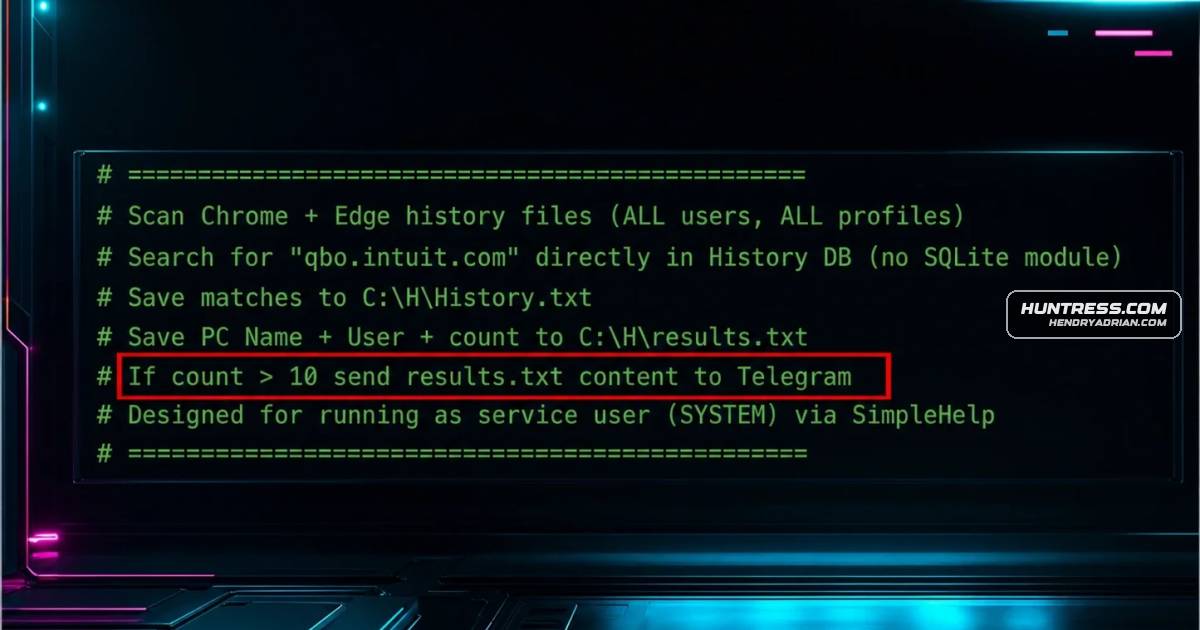
- Some LLM-generated infostealer scripts collected browser-history references to financial services but did not implement the Telegram exfiltration described in their comments.
- In observed post-access activity, a fake Windows Security prompt solicited users' PINs and saved entered values in plaintext; other activity targeted email accounts and banking portals.
- Huntress recommends scrutinizing unapproved RMM deployments, allow-listing approved tools, improving platform logging, and monitoring suspicious trial usage.
Article Details
- Attack Vectors
- Email and search-engine-poisoning lures led victims to invitation- or document-themed downloads that installed rogue RMM clients.
- Threat actors chained RMM and deployment tools, including Action1 and WScript, to install ScreenConnect clients for persistent remote access.
- Phishing pages hosted in abused GitHub repositories used browser-native download methods to deliver MSI installers.
- A separate mobile-only campaign presented a greeting card and prompted victims to sign in to an email provider to harvest credentials.
- A .NET executable impersonated Windows Security, repeatedly prompted users for their Windows login PIN, and saved entered values to plaintext.
- Threat actors used Hotmail combo lists to access victim email accounts, then attempted to access associated banking portals.
- Defensive Notes
- Explicitly allow-list approved RMM tools and scrutinize unrecognized deployments, particularly those launched from user-writable paths, email-delivered installers, or trial-based deployments.
- Treat RMM installation as a security-relevant event and review installer prevalence, deployment history, audit logs, and parent-child process relationships.
- Use stronger identity verification, tighter deployment limits, and monitoring for anomalous activity in RMM trial and free-tier accounts.
- Share recurring lure themes, delivery paths, and RMM daisy-chain behaviors, since filenames, hashes, and infrastructure change.
Indicators of compromise
| Type | Indicator | Context |
|---|---|---|
| IPV4 | 105[.]113[.]63[.]173 | Source IP listed in logon activity observed on the threat actor's server. |
| IPV4 | 209[.]160[.]115[.]150 | Source IP listed in logon activity observed on the threat actor's server. |
| IPV4 | 93[.]152[.]214[.]210 | Source IP listed in logon activity observed on the threat actor's server. |
| IPV4 | 98[.]97[.]79[.]68 | Source IP listed in logon activity observed on the threat actor's server. |
| SHA256 | 1a0769b8445cc27e2ddcdcee9a85a072c2be729e254f6c732548b0fb2bdfe0ef | Hash listed for hide_from_cp.exe among the artifacts associated with the threat actor's toolbox. |
| SHA256 | 22006710eaad12c4da19edaee4cb6fdd3c3face7e16bbcbd9e4f83eed7f3e7de | Hash listed for EnablePowerOptions.exe among the artifacts associated with the threat actor's toolbox. |
| SHA256 | 27c489d5239a3a25f51119b45b7be1ae8a38a153d708f983837d3c602bd367f8 | Hash listed for hide_mouse.exe among the artifacts associated with the threat actor's toolbox. |
| SHA256 | 429cbc557b1a9c8ceddab06b12b0fc3fc03c2908bb9ccd5ec8d2b386ccdb679a | Hash listed for disable_task_manager.exe among the artifacts associated with the threat actor's toolbox. |
| SHA256 | 42ef97c8260f9f287ead7b978378de2f27056f23dc513de5f36819159bfe5ebe | Hash listed for disable_control_panel.exe among the artifacts associated with the threat actor's toolbox. |
| SHA256 | 499d07894f730fb685ee3cbfc1a933e0da93750c1ed25a49b2eb9c32adef156a | Hash listed for phonepc.exe among the artifacts associated with the threat actor's toolbox. |
| SHA256 | 6cc665057c4a4fe42a309afd3a7fa96cf1af126e9c6e08e56df5105e05378bcc | Hash listed for HideFromControlPanel.exe among the artifacts associated with the threat actor's toolbox. |
| SHA256 | 79f25a73e056ecb8aebf36c593ad1826cefa31346a2feca1ba3ed395453c9c48 | Hash listed for toolbox.rar, an artifact found in the threat actor's administrator documents directory. |
| SHA256 | 83a8c175cdab60d043759ea04d62ac10a147d0b00e7a610f35e4939873416adc | Hash listed for disable_cmd.exe among the artifacts associated with the threat actor's toolbox. |
| SHA256 | a93c946c237b981189d2668d938a9d4d1d9681757e48dae8d9d65ed25b5da657 | Hash listed for PIN (1).exe among the artifacts associated with the threat actor's toolbox. |
| SHA256 | ae5afb20bc1455322c089eed22c81facb19195ed816bb52b0f405a62fd92dda7 | Hash listed for WebBrowserPassView.exe among the artifacts associated with the threat actor's toolbox. |
| SHA256 | b775f42c9d280b115ac0aeb168186583f93d94a19a29b7fac8c5e2c98c986bdd | Hash listed for phone_link.exe among the artifacts associated with the threat actor's toolbox. |
| SHA256 | bfa9c3298a749c8949f890ef02b4d07589bea1635150d57215b2f37b6f3acef0 | Hash listed for Windows Defender DAC.exe among the artifacts associated with the threat actor's toolbox. |
| SHA256 | ca9ac952feaaa5cbbbdea15716ee2acd3b1072f01156b5d2fb35066703de6955 | Hash listed for DisablePowerOptions.exe among the artifacts associated with the threat actor's toolbox. |
| SHA256 | ebc81a8f91d9b18c7d642bfdcf5f8e26d8921d4501e44e1603c0b67666d8c3e1 | Hash listed for no_power_off.exe among the artifacts associated with the threat actor's toolbox. |
| SHA256 | ec2bdcd616d9dcfbb9bff53d9649c4456823b7384aef65ad1838b5a9fc69e879 | Hash listed for EnableTaskManager.exe among the artifacts associated with the threat actor's toolbox. |
| SHA256 | f2c0c09f4871621ce6dc0cc98dbeba596f08453dd6bdc1f001f26449b1eddfb3 | Hash listed for Password.exe among the artifacts associated with the threat actor's toolbox. |
MITRE ATT&CK
T1005 · Data from Local SystemInfostealer scripts parsed local browser history for references to financial and cryptocurrency platforms.T1036 · MasqueradingThe pin.exe executable masqueraded as Windows Security to make its credential prompt appear legitimate.T1056.002 · GUI Input CaptureA .NET executable displayed a fake Windows Security prompt, captured the user's PIN, and wrote it to plaintext.T1056.003 · Web Portal CaptureA mobile-only phishing page prompted victims to sign in to an email provider to capture credentials.T1059 · Command and Scripting InterpreterWScript was used to run scripts that installed additional payloads, including ScreenConnect.T1078 · Valid AccountsAfter accessing victims' email accounts, the threat actor attempted to access associated banking portals.T1110.004 · Credential StuffingThreat actors used Hotmail combo lists and attempted logins to access victims' email accounts.T1204.002 · Malicious FileLures prompted victims to download and run MSI or executable installers that deployed rogue RMM clients.T1219 · Remote Access ToolsThreat actors used ScreenConnect and other legitimate RMM clients to maintain remote access.T1566.002 · Spearphishing LinkBroad email campaigns directed victims to invitation- and document-themed download pages.T1589.002 · Email AddressesAn email-extraction tool collected email addresses and other contact identifiers for potential lead lists.
People
Vendors
CloudflareAnother campaign leverages services like Cloudflare, which is designed to protect legitimate infrastructure.GitHubWhile investigating these watering-hole campaigns, we identified multiple GitHub repositories being abused to host phishing infrastructure, including repositories associated with VH851 and Drasticc user accounts.HuntressDuring this period, we also observed threat actors signing up directly to the Huntress platform itself. This provided us with rare, firsthand visibility into their RMM patterns, operational workflows, and
Products
Action1In January 2026, we observed threat actors leveraging vulnerability management software such as Action1 to deploy ScreenConnect clients via Microsoft Installer packages.CloudflareAnother campaign leverages services like Cloudflare, which is designed to protect legitimate infrastructure.GitHubWhile investigating these watering-hole campaigns, we identified multiple GitHub repositories being abused to host phishing infrastructure, including repositories associated with VH851 and Drasticc user accounts.HeartbeatRMWe’ve observed abuse extending beyond widely used RMM platforms to lesser-known RMMs like HeartbeatRM, often delivered through familiar invitation-themed lures.HuntressDuring this period, we also observed threat actors signing up directly to the Huntress platform itself. This provided us with rare, firsthand visibility into their RMM patterns, operational workflows, andScreenConnectIn January 2026, we observed threat actors leveraging vulnerability management software such as Action1 to deploy ScreenConnect clients via Microsoft Installer packages.Telegramexample, code comments indicated that harvested data would be transmitted to a threat-actor-controlled Telegram channel; however, the script didn't actually implement the Telegram API functionality required to
Tools
9ProxyAlongside the email extractor, the threat actor also downloaded and used Proxy SwitchyOmega 3 (ZeroOmega) in combination with 9Proxy.CertifyTheWebDuring their operational setup, the actor purchased gift cards from business[.]gogift[.]com and downloaded the CertifyTheWeb tool to automate SSL/TLS certificate management.Hide from Uninstall ListOne notable capability missing from earlier versions of this toolkit but observed more recently is the use of Sordum’s “Hide from Uninstall List” utility to conceal RMM installations from Add/Remove Programs.Lite 1.7 Email ExtractorOnce they have the lists, they use Lite 1.7 Email Extractor to parse the data.Proxy SwitchyOmega 3 (ZeroOmega)Alongside the email extractor, the threat actor also downloaded and used Proxy SwitchyOmega 3 (ZeroOmega) in combination with 9Proxy.WScriptThreat actors have also attempted to sidestep detection by reusing familiar daisy-chain techniques from vulnerability management and deployment tooling, this time relying on wscript to install additional payloads.