TeamPCP’s March 2026 Campaign Chained Trivy Compromise Into Multiple Supply-Chain Attacks
Summary
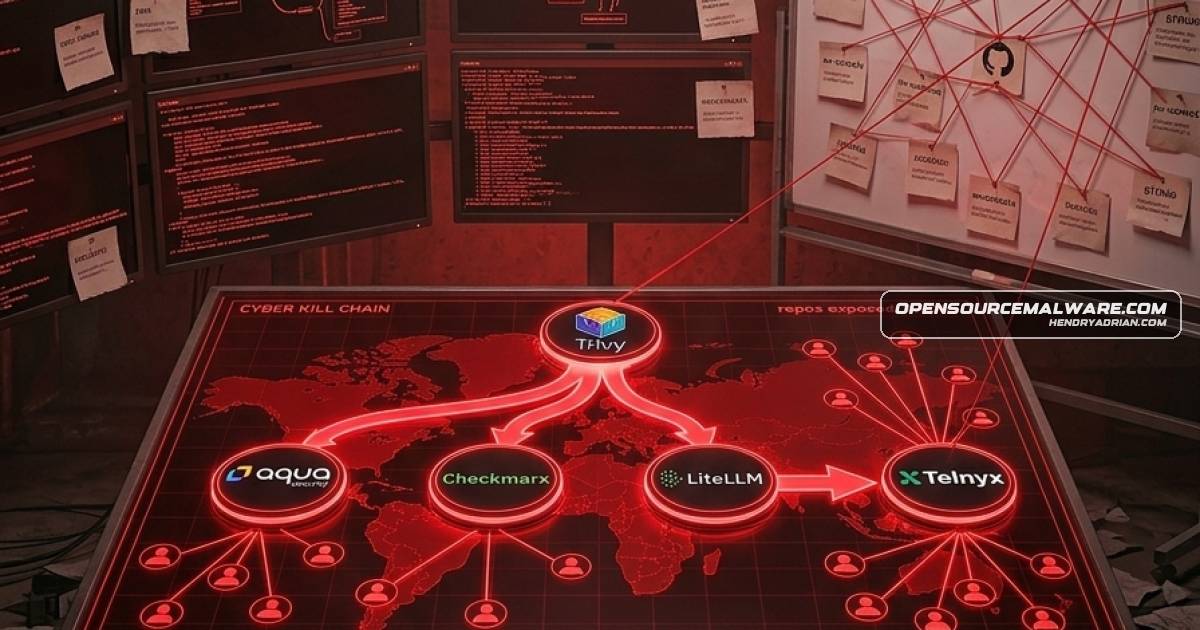
A retrospective traces TeamPCP’s March 2026 supply-chain campaign from retained Trivy credentials into Aqua, npm, LiteLLM, Checkmarx, OpenVSX and Telnyx, detailing credential theft, payloads and defenses.
Key points
- The report traces the campaign to a February Trivy workflow compromise that exposed a personal access token; incomplete credential rotation allegedly allowed access to persist for 20 days.
- On March 19, attackers poisoned Trivy releases and GitHub Actions tags, using compromised CI runners to collect secrets and credentials and exfiltrate them.
- Harvested credentials enabled further compromises across Aqua Security, npm packages, LiteLLM, Checkmarx Actions and OpenVSX extensions, and Telnyx PyPI releases.
- CanisterWorm spread through npm packages; the report also details malicious LiteLLM and Telnyx versions that stole credentials, with Telnyx payloads delivered in WAV files.
- A geotargeted payload reportedly wiped systems in Iran, while non-Iranian systems could receive a persistent backdoor. The report says the campaign’s destructive component remains unexplained.
- The article recommends pinning GitHub Actions to commit SHAs, limiting and rotating credentials, separating CI scanning and publishing permissions, and monitoring runner behavior and outbound traffic.
Article Details
- Attack Vectors
- A pull_request_target workflow executed code from a fork with access to repository secrets; a curl-to-bash payload extracted a Personal Access Token from process memory.
- Credentials retained after an incomplete rotation were reused to push malicious Trivy tags and workflows and to compromise additional Aqua Security projects.
- Compromised CI runners exposed npm and PyPI publishing tokens, enabling malicious package releases and propagation to downstream users.
- Stolen service-account credentials with cross-organization administrative access were used to deface Aqua Security's internal GitHub repositories.
- Malicious GitHub Actions and OpenVSX extensions harvested CI runner secrets and attempted to exfiltrate them to attacker infrastructure or repositories in victims' own GitHub accounts.
- Malicious LiteLLM and Telnyx packages executed payloads on import; Telnyx payloads used WAV files to deliver second-stage payloads through audio steganography.
- A geotargeted payload used Tehran timezone or Iranian locale indicators to select destructive behavior, including Kubernetes DaemonSet deployment and filesystem wiping.
- Defensive Notes
- Audit CI/CD workflows for pull_request_target configurations that run fork code with access to repository secrets.
- Use short-lived OIDC credentials where possible and revoke credentials atomically across all systems after a compromise.
- Pin GitHub Actions to full commit SHAs and verify signatures on security-critical workflow commits.
- Use least-privilege, narrowly scoped service-account and package-publishing credentials; separate CI scanning credentials from deployment credentials.
- Monitor CI runners for unexpected system calls, outbound connections to newly registered domains or IPs, and suspicious package publications.
- Monitor for unexpected repository creation and .pth file creation, and inspect Python environments for the reported malicious package versions.
- Rotate credentials accessible to environments where the affected packages or actions ran; users were advised to downgrade Telnyx to 4.87.0.
Indicators of compromise
| Type | Indicator | Context |
|---|---|---|
| DOMAIN | checkmarx[.]zone | C2 and second-stage payload domain used in the Checkmarx phase. |
| DOMAIN | models[.]litellm[.]cloud | Listed in the article as a C2 domain for exfiltration during the LiteLLM phase. |
| DOMAIN | plug-tab-protective-relay[.]trycloudflare[.]com | Cloudflare Tunnel subdomain used as an additional exfiltration C2 during the Trivy phase. |
| DOMAIN | recv[.]hackmoltrepeat[.]com | Exfiltration destination for the Personal Access Token stolen during the Trivy pull request workflow attack. |
| DOMAIN | scan[.]aquasecurtiy[.]org | Typosquatted exfiltration domain used to receive stolen data from compromised CI runners. |
| DOMAIN | tdtqy-oyaaa-aaaae-af2dq-cai[.]raw[.]icp0[.]io | ICP Canister dead-drop hostname used for CanisterWorm C2 and dynamic payload delivery. |
| IPV4 | 45[.]148[.]10[.]212 | IP address listed as C2 infrastructure for the Trivy campaign. |
| IPV4 | 83[.]142[.]209[.]203 | C2 and exfiltration endpoint used by the malicious Telnyx package to deliver WAV payloads and receive stolen data. |
MITRE ATT&CK
T1005 · Data from Local SystemThe stealer collected SSH keys, cloud credentials, Kubernetes tokens, configuration files, and cryptocurrency wallets from CI runners and developer machines.T1021.004 · SSHLater versions of the Iran-targeted payload added SSH propagation.T1041 · Exfiltration Over C2 ChannelStolen data was encrypted and exfiltrated as tpcp.tar.gz to campaign C2 endpoints.T1057 · Process DiscoveryThe Trivy payload located Runner.Worker processes before scraping their memory for secrets.T1059.004 · Unix ShellThe February workflow attack used a curl-to-bash payload, and the Iran-targeted payload used shell commands to wipe files.T1059.006 · PythonPython backdoors and payloads were installed or executed, including sysmon.py and the CanisterWorm service script.T1059.007 · JavaScriptA Node.js postinstall loader in compromised npm packages decoded and launched a Python payload.T1105 · Ingress Tool TransferCompromised Checkmarx extensions fetched a second-stage payload, and Telnyx packages downloaded WAV files containing payloads.T1195.001 · Compromise Software Dependencies and Development ToolsAttackers compromised Trivy, GitHub Actions, OpenVSX extensions, and PyPI packages to deliver malicious code through software supply chains.T1485 · Data DestructionThe Iran-targeted payload forcibly wiped filesystems and rebooted affected hosts.T1543.002 · Systemd ServiceCanisterWorm installed a persistent systemd user service named pgmon.service.T1547.001 · Registry Run Keys / Startup FolderThe Windows Telnyx payload dropped msbuild.exe into the Startup folder for persistence across reboots.T1552.001 · Credentials In FilesMalware harvested credentials and secrets from CI environments, including environment variables, .env files, shell history, and Docker configuration.T1567.001 · Exfiltration to Code RepositoryWhen direct exfiltration failed, malware created repositories in victims' GitHub accounts and uploaded stolen data as release assets.T1610 · Deploy ContainerOn targeted Kubernetes clusters, the payload deployed a privileged DaemonSet across nodes, including the control plane.
People
Callum McMahonFutureSearch research scientist whose development machine showed runaway processes after a Cursor MCP plugin pulled in LiteLLM.Charles CarmakalMandiant CTO reported at an RSA Conference briefing that TeamPCP and LAPSUS$ were actively collaborating.Charlie EriksenAikido Security researcher who documented later versions of the Iran-targeted wiper.Krrish DholakiaLiteLLM/BerriAI co-founder and CEO whose GitHub PAT and PyPI publishing token were reportedly stolen from a CI runner.Paul McCartyOpenSourceMalware head researcher who reported the initial Trivy compromise and flagged activity in the LAPSUS$ Telegram channel.Rami McCarthyWiz Principal Security Researcher who documented the Trivy campaign and the Iran-targeted wiper.
Threat Actors
DeadCatx3Name the article identifies as another tracking name for TeamPCP.LAPSUS$The article reports coordination with TeamPCP and says Mandiant's CTO described the groups as actively collaborating.PCPcatName the article identifies as another tracking name for TeamPCP.ShellForceName the article identifies as another tracking name for TeamPCP.TeamPCPFinancially motivated, cloud-native threat actor identified by the article as responsible for the March 2026 supply-chain campaign.
Malware
CanisterWormchain territory, building tooling to harvest CI/CD credentials at scale. In late 2025 they deployed CanisterWorm, a self-propagating worm that used ICP Canister nodes as decentralized, censorship-resistant C2kamikaze.shBeyond credential theft, the kamikaze.sh payload evolved through multiple versions on March 22 via the ICP canister dead-drop. Rami McCarthy was the first to document the Iran-targeted wiper, tracking the payload
Vendors
Aqua SecurityWe covered stages of these attacks as they happened (in TeamPCP Defaces Aqua Security's Internal GitHub Org — 44 Repos Exposed and TeamPCP Hijacks LiteLLM's PyPI Package — Credential Stealer Hits 40k-Star Project). ThisBerriAILiteLLM / BerriAI (PyPI)CheckmarxCheckmarx Actions + OpenVSXTelnyxPhase 6: Telnyx (March 27, 2026)
Products
GitHub Actionsthat created an account on February 20 and systematically scanned repositories for exploitable GitHub Actions workflow patterns. Its profile described a vulnerability pattern index covering 9 classes and 47LiteLLMhappened (in TeamPCP Defaces Aqua Security's Internal GitHub Org — 44 Repos Exposed and TeamPCP Hijacks LiteLLM's PyPI Package — Credential Stealer Hits 40k-Star Project). This article serves as a retrospective on theOpenVSXCheckmarx Actions + OpenVSX
Tools
KICSTeamPCP deployed a nearly identical credential stealer in checkmarx/ast-github-action and checkmarx/kics-github-action. The payload collected CI runner secrets and exfiltrated them to checkmarx[.]zone using theTrivyMarch 19, 2026 I got a one line note from OpenSourceMalware head researcher Paul McCarty. It read: "Ouch. Trivy compromised." That signaled the start of this year's biggest software supply chain attack to date. While