
Huntress Details Risks of Overprivileged OpenClaw Apps in Microsoft Tenants
Summary
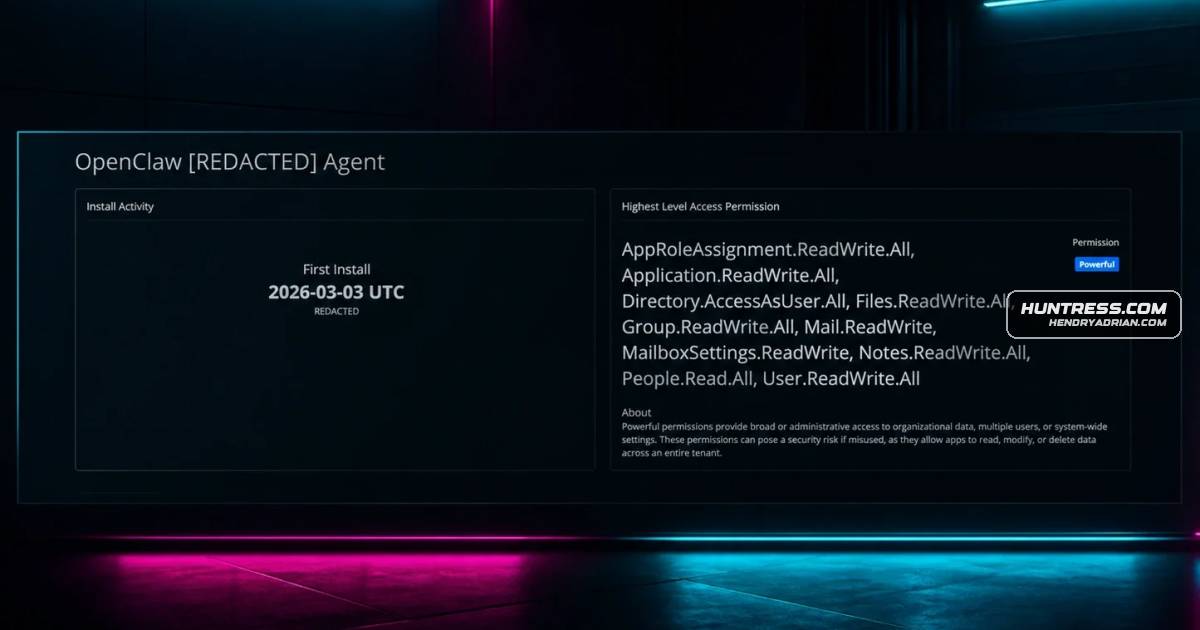
Huntress found OpenClaw- and Moltbot-related apps in customer Microsoft tenants, including service principals with broad directory, mailbox, and SharePoint permissions. It recommends reviewing app consent, permissions, and activity, and removing unnecessary apps.
Key points
- Huntress scans found dozens of apps with OpenClaw-related names in customer environments in late February, with counts continuing to grow in March.
- Some apps were user-installed assistants scoped to an individual mailbox or calendar; others were centrally registered service principals with broad tenant-wide permissions.
- Observed permissions included directory and application management, OAuth permission grants, authentication-method changes, and full SharePoint control.
- Broad permissions could let an attacker who compromises the agent, steals its secrets, or tampers with its backend inherit the app’s tenant access.
- Huntress recommends inventorying cloud applications, checking who consented and when, and reviewing permissions for unnecessary directory-wide or mailbox access.
- Security teams can use Entra audit logs and SIEM searches to examine consent and update events, permission changes, and the app’s downstream actions.
- Mitigations include restricting user consent, applying least privilege, continuously monitoring activity, and revoking consent or disabling unneeded apps.
Article Details
- Defense Focus
- Find and assess OpenClaw-related cloud applications in Microsoft tenants, review their permissions and activity, and reduce identity and data exposure.
- Detection Methods
- Inventory cloud applications and service principals using searches for OpenClaw, Moltbot, and relevant legacy or internal names.
- Review who installed or consented to each application, when it was added, and its permission level.
- Assess application permissions for directory-wide, mailbox, SharePoint, and permission-granting access; identify unnecessary broad scopes and permission drift.
- Search identity and Entra audit logs for application consent and update events associated with OpenClaw-related names.
- Pivot from consent and update events to downstream actions, including which mailboxes, files, and identities the application accessed or modified.
- Data Sources
- Cloud application and service principal inventory
- Application consent and authorization records
- Identity and Entra audit logs
- Application permission and scope data
- Downstream application activity involving mailboxes, files, and identities
- Rule Types
- ESQL queries filtering audit events by application target name
- Platforms
- Huntress Rogue Applications
- Huntress Managed SIEM
- Entra
- Defensive Actions
- Set and enforce policies governing who can consent to third-party cloud applications.
- Search Entra and the application inventory for OpenClaw, Moltbot, and related names; verify each deployment and its purpose.
- Apply least privilege: prefer delegated scopes where appropriate and remove unnecessary broad ReadWrite.All permissions.
- Continuously review application permissions and changes to identify permission drift.
- Use SIEM activity review to determine which identities and content an application accessed and whether its actions were expected.
- Revoke consent and disable service principals for unnecessary or unapproved deployments, and document the decision.
Vendors
Products
EntraDirectory.ReadWrite.All – full read/write access to the Entra ID directory, including users, groups, and roles.Huntress Managed SIEMHuntress Managed SIEM – Identity and Application Activity SearchHuntress Rogue ApplicationsSearch your Entra environment (and Huntress Rogue Applications) for OpenClaw, Moltbot, and related names.OpenClawOpenClaw, Rogue Agents, and Application Hygiene