Attackers Compromised axios npm Releases to Deliver Cross-Platform Malware
Summary
Attackers used a compromised axios maintainer account to publish malicious npm releases that delivered a cross-platform RAT. Huntress observed at least 135 endpoints contacting the attacker’s infrastructure during the exposure window.
Key points
- Attackers gained access to the axios maintainer’s npm account and manually published two backdoored releases, which were removed within three hours.
- Systems that installed the compromised releases during that window could execute the malicious payload; Huntress observed at least 135 endpoints contacting attacker infrastructure.
- The RAT supported macOS, Windows, and Linux, with capabilities including system reconnaissance, credential harvesting, and remote command execution.
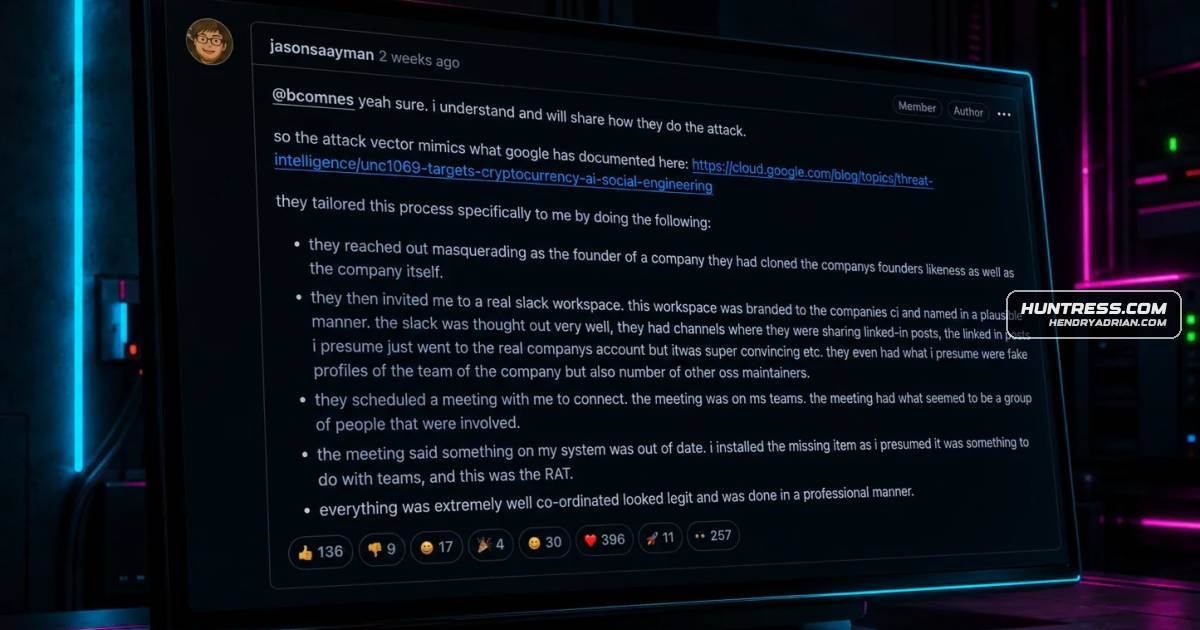
- The maintainer was reportedly deceived through a fake company and Slack workspace, followed by a Teams call that led to installing the RAT.
- Google attributed the incident to UNC1069, a financially motivated North Korean threat actor; other researchers also pointed to links with DPRK infrastructure.
- The article recommends pinning dependencies to verified versions, quarantining new versions for review, applying age-based restrictions, and checking dependency trust.
Article Details
- Victim Organization
- axios npm package and its maintainer's npm account
- Incident Type
- Supply-chain compromise involving unauthorized publication of backdoored axios npm releases that delivered a cross-platform RAT
- Incident Date
- 2026-03-31
- Disclosure Date
- 2026-03-31
- Affected Records
- At least 135 endpoints were observed by Huntress contacting the attacker's command-and-control infrastructure; the number of affected organizations or systems is not established.
- Operational Impact
- The two compromised package releases were removed within three hours. Malicious code could execute in dependent packages, developer workstations, and CI/CD pipelines that installed the releases during the exposure window; Huntress observed endpoints across macOS, Windows, and Linux contacting attacker C2.
- Ransom Or Extortion
- None reported
- Claim Status
- confirmed
People
Ben ReadWiz director of strategic intelligence who participated in Huntress' April Tradecraft Tuesday discussion.Charlie EriksenAikido Security researcher who participated in the discussion and commented on Shai-Hulud.Jason SaaymanAxios maintainer whose npm account was compromised; he described the social-engineering approach in a post-mortem report.Joe DesimoneElastic tech lead whose March 31, 2026 post on X urgently sought contact with the npm security team.John HammondHuntress senior principal security researcher who investigated the attack and presented on it.Josh JunonDeveloper known as “qix”; targeted by a phishing email in September 2025, leading to the compromise of 18 npm packages.Logan MacLarenHuntress staff offensive security engineer who participated in the discussion.
Threat Actors
TeamPCPReportedly compromised Aqua Security's Trivy scanner in March 2026, leading to downstream attacks and a worm spreading to the npm ecosystem.UNC1069Google attributed the axios npm incident to this financially motivated North Korean threat actor; the article says it has been active since at least 2018.
Malware
Vendors
Products
Axiosaxios npm Compromise: The Ultimate Supply Chain ScariesGitHubin particular used techniques that can only be described as “chaotic evil.” The malware first checked for GitHub tokens in victim environments, and then would use that token to upload whatever secrets they found on theMicrosoft TeamsThey then invited Saayman to a scheduled Microsoft Teams call, which had “what seemed to be a group of people that were involved.” npmHomeBlogaxios npm Compromise: The Ultimate Supply Chain ScariesTrivyIn March 2026, TeamPCP compromised Aqua Security’s popular open-source Trivy vulnerability scanner, which then led to several downstream attacks (and later spreading to the npm ecosystem with a worm that used stolen