How Deep API Trace Captures Bounded Runtime Evidence for Malware Analysis
Summary
The guide explains how Malware INFO’s Guided and Deep API Trace distinguish correlated telemetry from exact supported API observations, outlines a safe lab workflow, and details coverage limits and interpretation cautions.
Key points
- Guided API Trace correlates available Guard and Windows telemetry with a verified process identity; it does not establish exact API parameters, return values, or caller addresses.
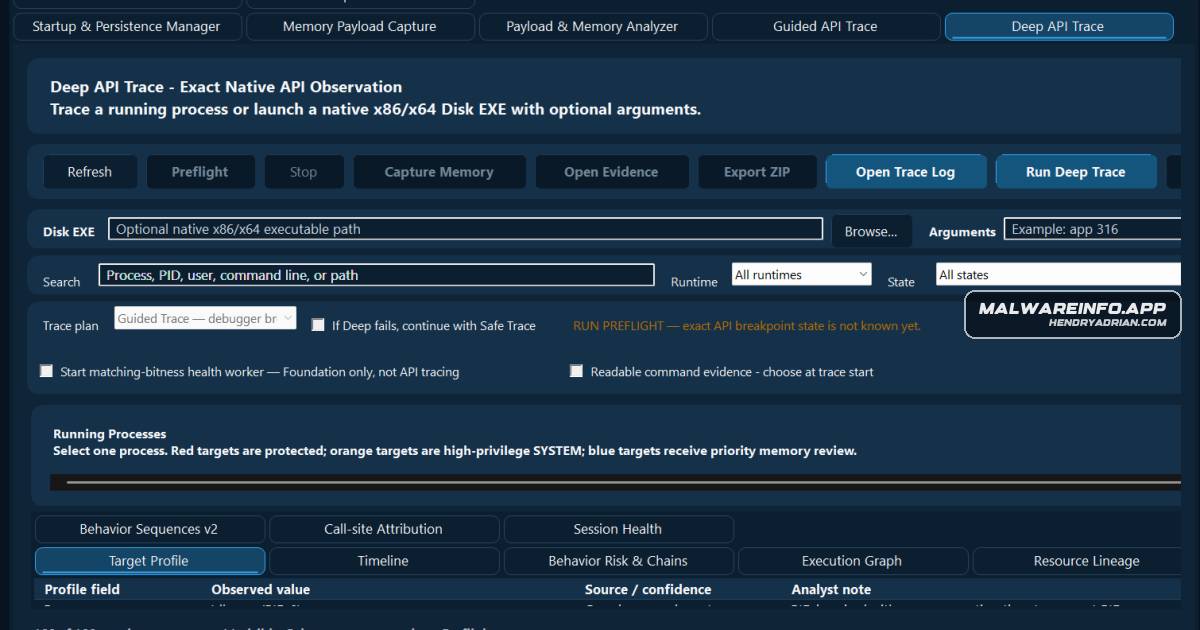
- Deep API Trace uses matching-bitness x86 or x64 workers and debugger-based observation to record selected supported API boundaries, with bounded parameters and outcomes when available.
- Exact observations require validated session, process, worker, architecture, timing, schema, and API-contract checks; other telemetry remains supporting or NotApiCall evidence.
- Coverage can miss activity before readiness, outside the effective window, in another process, or through unsupported APIs, direct syscalls, copied stubs, or custom code.
- The guide recommends starting with Guided when it can answer the question and using Deep only in an authorized, isolated, disposable analysis VM.
- API Hook Trace is described as product-disabled and unavailable, not as a current capability.
- Observed API activity is not by itself proof of malicious behavior, and sparse results mean activity was not observed within available coverage—not that it did not occur.
Article Details
- Topic
- Malware INFO’s Deep API Trace runtime evidence model, workflow, coverage limits, and comparison with Guided API Trace and the unavailable API Hook Trace.
Products
API Hook TraceAPI Hook Trace: an unavailable, more invasive modelDeep API TraceDeep API Trace workspace for selecting a verified process or native x86/x64 executable and reviewing session evidenceGuided API TraceGuided API Trace: identity-bound correlationMalware INFOMalware INFO separates three models because they answer different questions and impose different costs.