Lab Reconstructs QUICSILVER Backdoor Delivered Through a VHD
Summary
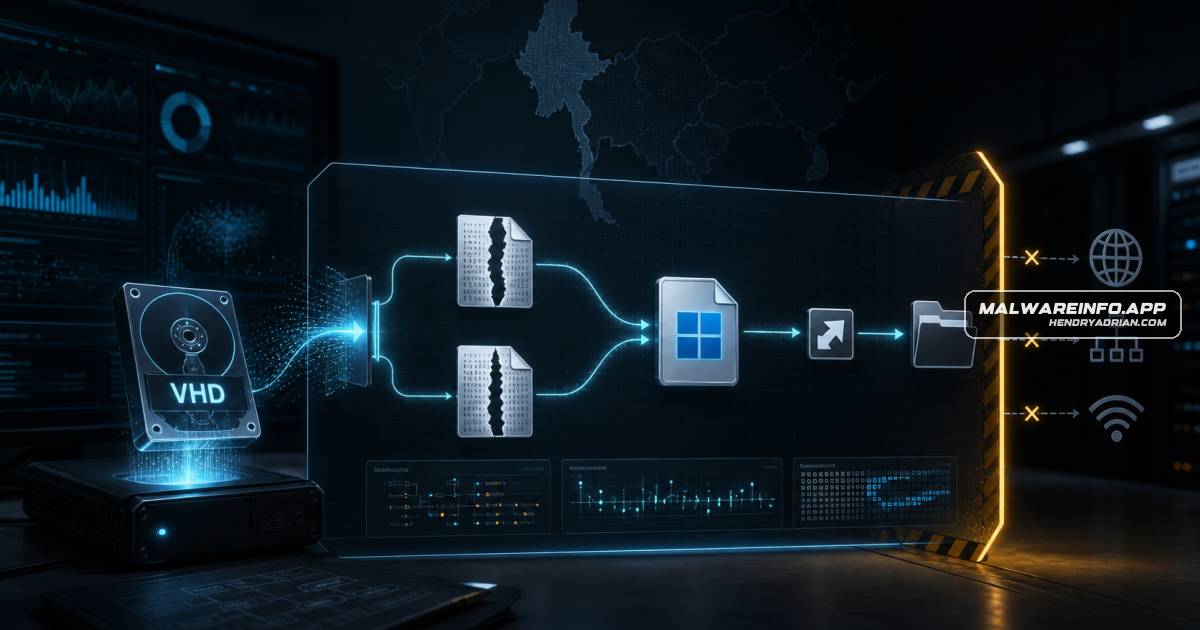
Researchers reconstructed a QUICSILVER backdoor from VHD-contained fragments and confirmed its hash matched a published sample. Isolated testing observed Startup-folder persistence, but no successful C2 session or campaign attribution was independently established.
Key points
- A VHD contained a disguised shortcut, decoy PDF, FTP command script, and two payload fragments; joining the fragments reproduced the published Windowsupdate.exe hash.
- In an isolated direct execution, the payload created a SystemIn shortcut in the user's Startup folder.
- A separate debugger-conditioned trace recorded hidden PowerShell activity and repeated DNS resolution attempts for two Worker hosts; all 46 captured GetAddrInfoW results indicated host-not-found.
- The lab did not reproduce successful C2 communication, QUIC traffic, attacker tasking, file transfer, or the original VHD-mount delivery step.
- The article attributes campaign history, infrastructure, and China-nexus assessment to Seqrite; its own analysis does not independently identify a threat group.
- The MalwareINFO scan reported suspicious findings, but unavailable hash databases and degraded memory protection limited coverage; the result was not treated as a confirmed verdict.
Article Details
- Attack Vectors
- Seqrite reports diplomatic and regional-cooperation themed lures delivered in VHD files containing a disguised PDF-looking LNK, a decoy PDF, an FTP command script, and two payload fragments. The script concatenates the fragments into Windowsupdate.exe and starts it; the original delivery-to-VHD-mount step was not reproduced.
- In a direct lab execution of the reconstructed payload, Windowsupdate.exe created a SystemIn shortcut in the current user's Startup folder. A separate debugger-conditioned trace recorded hidden PowerShell creating a Startup shortcut after analyst intervention.
- Defensive Notes
- Inspect files by content rather than extension, and review scripted ftp.exe use together with its script path and parent container.
- Correlate document-named fragment files, copy /b reconstruction, the resulting executable hash, and source VHD.
- Monitor per-user Startup shortcut creation and verify the shortcut target's file identity.
- Review hidden PowerShell execution, transient create_lnk_*.ps1 files, and their writer, child process, and deletion sequence while preserving process and session boundaries.
- Hunt for both Worker hostnames and repeating resolver attempts; the lab observed failed resolution and no successful C2 session.
- Correlate outbound UDP/443 or Worker-host resolution with the delivery chain, payload identity, and persistence behavior; broad QUIC blocking may cause false positives.
Indicators of compromise
| Type | Indicator | Context |
|---|---|---|
| DOMAIN | maui-cocktailbar[.]com | Domain assigned by the article to the separate HolidayNotice.pdf.exe branch. |
| DOMAIN | register[.]mediumser[.]com | Domain Seqrite reportedly observed being returned dynamically by a Worker; it was not found as a hardcoded payload string. |
| IPV4 | 104[.]64[.]211[.]22 | Historical/runtime infrastructure reported by the article in connection with the campaign. |
| IPV4 | 38[.]60[.]244[.]141 | Historical/runtime infrastructure reported by the article in connection with the campaign. |
| SHA256 | 0803521a7e9081f46f8f9f61d72371ecc1f49657f10202fffa9a33f581d8bb39 | SHA-256 of ACMECS_Pillar_1.vhd, an article-identified delivery container. |
| SHA256 | 26f735cbbb1257be94e6d01656a35bf66a8ae9c34868548d69ec5cb588f9f916 | SHA-256 of TrainingAnnouncement.jpg, which the article identifies as a VHD delivery artifact. |
| SHA256 | 446c09e3ced078f3f70460bac61b665ba60863d9e39c67bcf066ff962f328f17 | SHA-256 of the preserved original archive containing the analyzed sample corpus. |
| SHA256 | 4a1a1b1455c3ea91a3d9203ebff025553227302cede6077e821d303655e2c9f2 | SHA-256 of header.doc, a payload fragment used to reconstruct Windowsupdate.exe. |
| SHA256 | 575305cdaeb1d2187ca6d5ebe32f4c3e3fb53f5ccbe1c0cc257a7f71d84e6f35 | SHA-256 of the TrainingAnnouncement.pdf decoy contained in the delivery chain. |
| SHA256 | aeff39943e254c34187e4a60be3d09d49687439e709eeb4be2b1984310d8ba5c | SHA-256 of body.doc, a payload fragment used to reconstruct Windowsupdate.exe. |
| SHA256 | c4b4647795567ab15528edd1ab1bf37fb50e21b442e59a653051061973e87c02 | SHA-256 of the related HolidayNotice.pdf.exe sample, treated in the article as a distinct branch. |
| SHA256 | cd147efe37003399e174951927e5fe727a4481756b116f0204a14a64cc62b059 | SHA-256 of the reconstructed Windowsupdate.exe payload; it exactly matched the payload indicator published by Seqrite. |
| SHA256 | daeac66441b88ba22806f6617058a2dbf1ea0ddcc6c94f291542ea853ac6f9d3 | SHA-256 of the TrainingAnnouncement.pdf.lnk delivery shortcut. |
MITRE ATT&CK
T1059.001 · PowerShellA debugger-conditioned Deep API Trace recorded hidden powershell.exe executing a transient script that created a Startup shortcut after analyst intervention.T1082 · System Information DiscoveryRecovered function names and Seqrite's analysis support host-information collection capability; the lab did not retain direct execution evidence for it.T1102.001 · Dead Drop ResolverThe payload queried two Worker hosts, but the lab's captured lookups failed and no Worker response or C2 session was retained.T1218 · System Binary Proxy ExecutionThe reconstructed LNK/script chain invokes Windows ftp.exe with scripted input; dynamic execution of that chain was not reproduced.T1547.001 · Registry Run Keys / Startup FolderThe direct PID 644 run created SystemIn.lnk in the per-user Startup folder; a separate debugger-conditioned trace recorded a transient persistence script.
Malware
Tools
Deep API TraceThe retained case contains three separate executions: Process Monitor PID 644, Deep API Trace PID 3556, and Process Capture PID 6704.ExeInfoExeInfo showed a conventional PE entry point in .text and no overlay.IDAWe also reviewed the saved IDA database supplied under the case folder.MalwareINFO ProMalwareINFO Pro reported THREATS OR SUSPICIOUS MATCHES FOUND and displayed seven Zero-Day findings, while also showing unavailable hash-database coverage and degraded real-time memory protection.Process MonitorThe retained case contains three separate executions: Process Monitor PID 644, Deep API Trace PID 3556, and Process Capture PID 6704.