Acronis Data Shows AI Agent Use Across MSP and SMB Endpoints
Summary
Acronis telemetry from June–September 2026 found AI agent tools on 9.4% of Windows endpoints with EDR. Most were graphical apps, while 4.9% of MCP-capable tools had connections enabled, raising visibility and access-governance concerns.
Key points
- Acronis observed AI agent tools on about 9.4% of Windows computers with EDR enabled during June–September 2026; browser-based AI use was not counted.
- Graphical applications accounted for 72.7% of observed agent-tool instances, extending use beyond command-line developer tools.
- Anthropic and Microsoft tools made up 80.2% of observed instances: 44.8% and 35.4%, respectively.
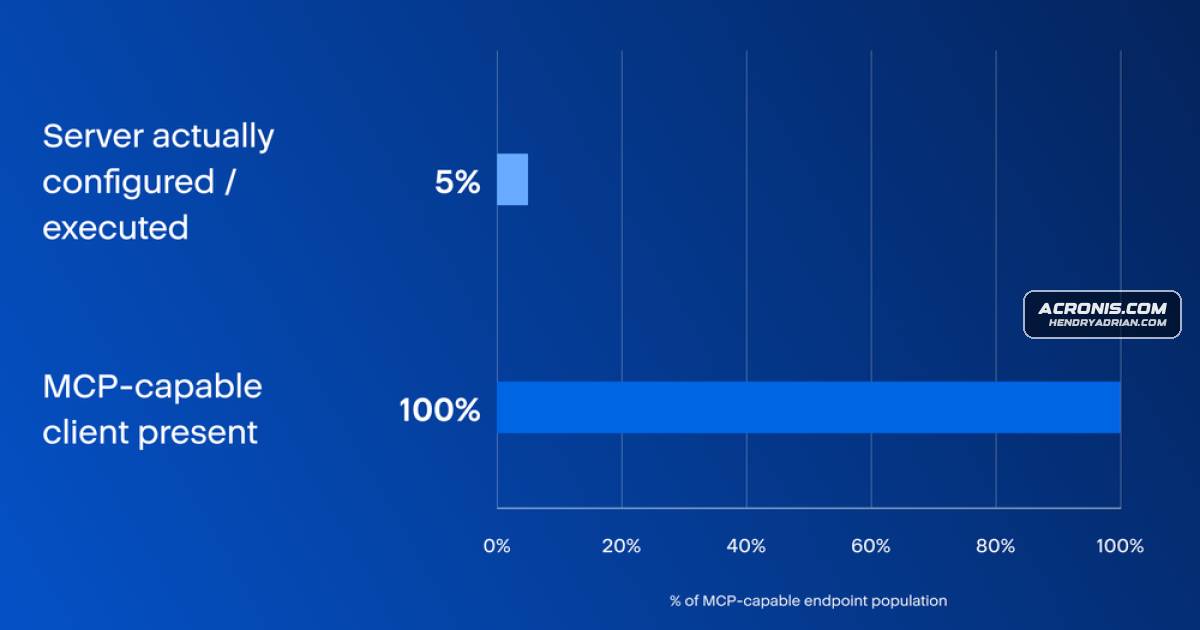
- Although MCP-capable tools were widespread, connections were configured or used on 4.9% of the relevant machines. Acronis could identify connection methods and channels, but not the destination service.
- Personal AI agents appeared on about 0.018% of endpoints; Hermes and OpenClaw accounted for nearly all observed activity. Acronis says these figures are minimum estimates because coverage has gaps.
- Confirmed MSP customers had a 7.9% adoption rate, compared with 4.7% for direct partners; MSPs made up 78.2% of adopting customers.
- The report warns that MCP connections can be enabled without admin rights or approval, so an inventory of installed tools may not reveal subsequent changes in access.
Article Details
- Publisher
- Acronis Threat Research Unit
- Report Period
- June–September 2026; approximately 12 weeks of observed activity
- Scope
- Installed AI agent applications and MCP connections on Acronis-protected business endpoints; browser-based use was excluded.
- Sample Size
- More than 100,000 tool instances across the top 20 countries; the total number of observed endpoints was not disclosed.
- Key Statistics
- About 9.4% of Windows computers with Acronis EDR enabled ran an AI agent tool during the observation period.
- Across the top 20 countries, 72.7% of observed tool instances were graphical applications and 27.3% were command-line tools.
- MCP connections were configured or used on 4.9% of machines with an MCP-capable tool.
- Confirmed MSPs represented 78.2% of adopting customers and had a 7.9% adoption rate, versus 4.7% for direct partners without confirmed MSP tooling.
- About 0.018% of Acronis-protected business endpoints were observed running a personal AI agent; the report describes this as a minimum observed level.
- Recommendations
- Continuously monitor AI agent use and outside connections rather than relying on a one-time inventory of installed applications.
- Identify which outside connections exist on managed endpoints and when they change.
People
Vendors
AcronisAcronis Threat Research UnitAnthropicOf those tool instances, Anthropic accounts for 44.8% and Microsoft for 35.4%.Googleat the last look, largely because this refresh recognizes several newly added desktop and IDE tools (Google Antigravity, JetBrains IDE, Microsoft Copilot and others) that the previous count could not yet see.Microsoftproducts Codex CLI, a fast command-line assistant, and its IDE/desktop counterpart Codex, tied at 8.0%. Microsoft Visual Studio, is in sixth place at 6.8%, just ahead of ChatGPT itself (5.7%). The remaining namedOpenAIis in second place (18.3%). In third place at 13.5% is Claude Code, a command-line coding assistant. OpenAI products Codex CLI, a fast command-line assistant, and its IDE/desktop counterpart Codex, tied at 8.0%.
Products
Acronis Cyber Platformcontinuous monitoring in addition to policy. This is the problem Acronis GenAI Protection in Acronis Cyber Platform, is built to address: It gives MSPs and IT teams visibility into which endpoints are usingAcronis EDRAbout 9.4% of the Windows computers with Acronis EDR enabled are running some kind of AI agent tool, based on activity observed from June to September 2026. These are coding helpers, command-line assistants andAcronis GenAI Protectionthis visibility gap requires continuous monitoring in addition to policy. This is the problem Acronis GenAI Protection in Acronis Cyber Platform, is built to address: It gives MSPs and IT teams visibility into whichAcronis RMMand management (RMM) software on its machines, any vendor, 10 or more machines, or 10 or more Acronis RMM units, rather than simply counting how many customers a partner happens to hold. Only companies thatChatGPTcounterpart Codex, tied at 8.0%. Microsoft Visual Studio, is in sixth place at 6.8%, just ahead of ChatGPT itself (5.7%). The remaining named specialist tools each accounted for less than 3% of observed usage.Claude CodeVisual Studio Code, a popular free code editor, is in second place (18.3%). In third place at 13.5% is Claude Code, a command-line coding assistant. OpenAI products Codex CLI, a fast command-line assistant, and itsClaude DesktopFigure 1. Share of agent tool machines running each tool.One tool leads by a wide margin: Claude Desktop (26.6%), a general-purpose AI desktop app. Visual Studio Code, a popular free code editor, is in second placeCodexplace (18.3%). In third place at 13.5% is Claude Code, a command-line coding assistant. OpenAI products Codex CLI, a fast command-line assistant, and its IDE/desktop counterpart Codex, tied at 8.0%. Microsoft VisualCodex CLIplace (18.3%). In third place at 13.5% is Claude Code, a command-line coding assistant. OpenAI products Codex CLI, a fast command-line assistant, and its IDE/desktop counterpart Codex, tied at 8.0%. Microsoft VisualGoogle Antigravitythe last look, largely because this refresh recognizes several newly added desktop and IDE tools (Google Antigravity, JetBrains IDE, Microsoft Copilot and others) that the previous count could not yet see.Hermesbusiness endpoints, about 0.018% are running one: roughly 1 in 5,600 machines. Two agents, Hermes and OpenClaw, account for nearly all the activity found; four of the eight tools tracked have never beenMicrosoft Copilotrefresh recognizes several newly added desktop and IDE tools (Google Antigravity, JetBrains IDE, Microsoft Copilot and others) that the previous count could not yet see.Nanobotthem, effectively the whole picture (a small number of machines run both at once). Two much rarer tools, Nanobot and NanoClaw, each turned up on a single machine. The other four tracked agents have not been seen at all.NanoClawthe whole picture (a small number of machines run both at once). Two much rarer tools, Nanobot and NanoClaw, each turned up on a single machine. The other four tracked agents have not been seen at all.OpenClawbusiness endpoints, about 0.018% are running one: roughly 1 in 5,600 machines. Two agents, Hermes and OpenClaw, account for nearly all the activity found; four of the eight tools tracked have never been seen at all.Visual Studioeach tool.One tool leads by a wide margin: Claude Desktop (26.6%), a general-purpose AI desktop app. Visual Studio Code, a popular free code editor, is in second place (18.3%). In third place at 13.5% is Claude Code,Visual Studio Codetool.One tool leads by a wide margin: Claude Desktop (26.6%), a general-purpose AI desktop app. Visual Studio Code, a popular free code editor, is in second place (18.3%). In third place at 13.5% is Claude Code, a
Countries
Australiaapp and the free code editor — sometimes in one order, sometimes the other. The one exception is Australia, where Claude Code has displaced it there entirely, though the top spot is unchanged. ThatBrazilBrazil, the United States and Taiwan lead, but each is still a modest slice of the total, a pattern that looks like scattered, independent adoption rather than one deployment spreading through a single largeCanadaCanadaColombiaColombiaFranceFranceGermanyGermanyIndiaIndiaItalyItalyJapanJapanMalaysiaMalaysiaMexicoMexicoPeruPeruSingaporeSingaporeSouth AfricaSouth AfricaSpainSpainSwitzerlandSwitzerlandTaiwanBrazil, the United States and Taiwan lead, but each is still a modest slice of the total, a pattern that looks like scattered, independent adoption rather than one deployment spreading through a single largeTürkiyeTürkiyeUnited Arab EmiratesUnited Arab EmiratesUnited KingdomUnited KingdomUnited StatesBrazil, the United States and Taiwan lead, but each is still a modest slice of the total, a pattern that looks like scattered, independent adoption rather than one deployment spreading through a single large