Microsoft VSS: Key Limitations and Best Practices for Data Resilience
Summary
An overview of Microsoft VSS explains how it creates application-consistent snapshots, where its 64TB limit and copy-on-write overhead constrain it, and why snapshots alone do not provide ransomware-proof recovery.
Key points
- VSS coordinates requesters, application writers, and storage providers to create consistent point-in-time volume snapshots.
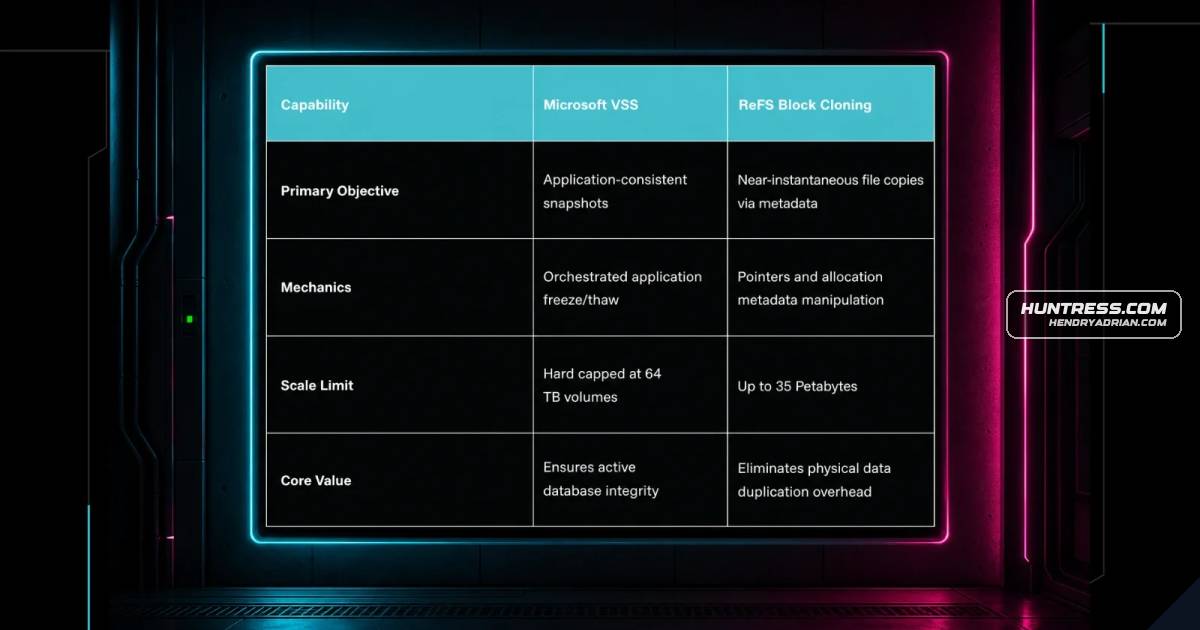
- VSS is useful for traditional Windows workloads and granular recovery, but does not support volumes above 64TB.
- The default software provider's copy-on-write process can add overhead and write latency in write-heavy environments.
- VSS snapshots do not replace restore planning, retention policies, or off-site immutable backups.
- Ransomware may target and attempt to delete local VSS snapshots, so they are not a definitive defense.
- ReFS block cloning can speed file copies but does not provide VSS's application-writer coordination; backup suites may use both.
Article Details
- Topic
- Microsoft Volume Shadow Copy Service (VSS), its architecture and limitations, and its role in Windows backup and recovery strategies.
Vendors
Products
Active DirectoryThe Writer: An application-specific component (built into workloads like SQL Server, Exchange, or Active Directory) that prepares its live data by flushing memory buffers to disk and momentarily pausing write I/O.Azure BackupThe Requester: A backup software or agent (such as Azure Backup or Veeam) that starts the snapshot request.Microsoft Exchange ServerThe Writer: An application-specific component (built into workloads like SQL Server, Exchange, or Active Directory) that prepares its live data by flushing memory buffers to disk and momentarily pausing write I/O.Microsoft Windows(VSS). Introduced to eliminate the "file-in-use" errors and corrupted data copies that plagued early Windows environments, VSS became an undisputed cornerstone of data protection.ReFS Block CloningVSS vs. ReFS Block CloningSQL ServerThe Writer: An application-specific component (built into workloads like SQL Server, Exchange, or Active Directory) that prepares its live data by flushing memory buffers to disk and momentarily pausing write I/O.VeeamThe Requester: A backup software or agent (such as Azure Backup or Veeam) that starts the snapshot request.Volume Shadow Copy Service (VSS)For over two decades, the answer has been Microsoft's Volume Shadow Copy Service (VSS). Introduced to eliminate the "file-in-use" errors and corrupted data copies that plagued early Windows environments, VSS became an