
How Security Control Validation Supports Continuous Threat Exposure Management
Summary
The article explains how breach-and-attack simulations test whether controls prevent, detect, or miss techniques, and how results inform CTEM prioritization, mitigation, retesting, and change-triggered validation.
Key points
- Security control validation takes place in CTEM’s fourth stage; its results inform prioritization and mobilization.
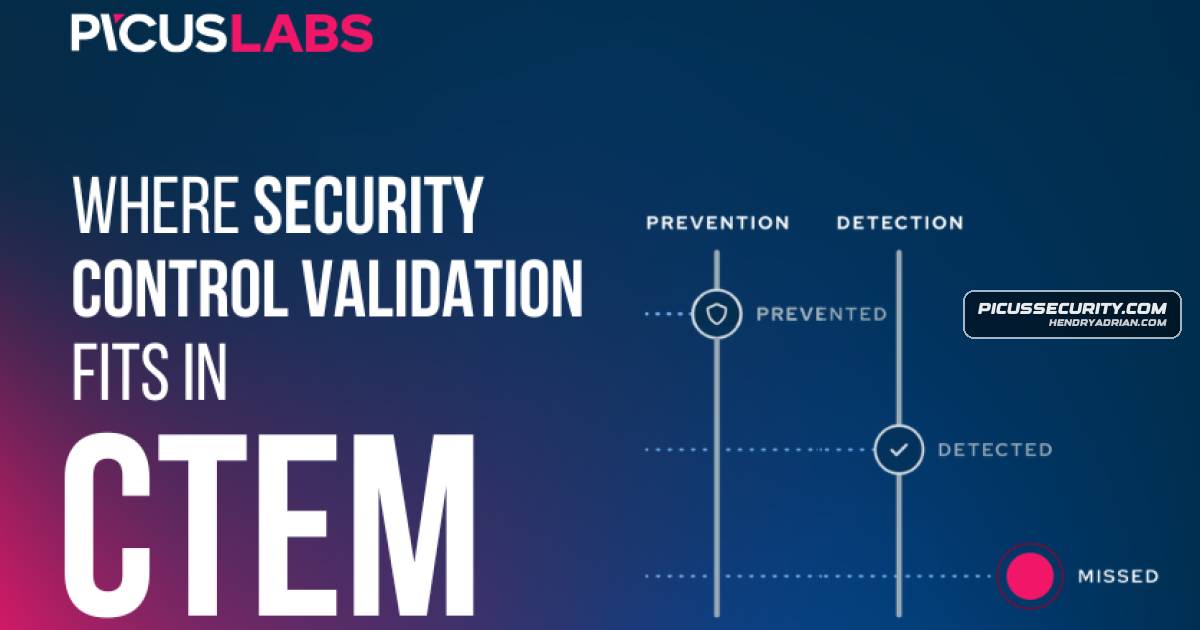
- Breach-and-attack simulation runs attacker techniques against controls and records whether each is prevented, detected, or missed.
- The article recommends triggering tests after a new vulnerability, a new attack campaign, or a control configuration change rather than relying only on a fixed schedule.
- A missed technique can guide a prevention signature or detection rule; retesting checks whether the fix works.
- The article distinguishes control validation from exploitability validation, which assesses affected assets without running a real exploit, and agentic pentesting, which chains real exploits on in-scope assets.
- Picus Blue Report 2026 reports that Picus Labs analyzed more than 338 million customer-run simulations from January to June 2026; it reports 69% were prevented, 58% logged, and 14% raised an alert.
Article Details
- Topic
- Security control validation within the Continuous Threat Exposure Management (CTEM) validation stage, including how it informs prioritization and mobilization.
Vendors
Products
AI Threat BuilderCurrent threats: AI Threat Builder turns a threat intelligence report into a runnable simulation in about nine minutes.Numi AIFive specialist agents, orchestrated by Numi AI, run the loop from the signal to the mitigation.Picus Autonomous Exposure Validation PlatformPicus supports security control validation in CTEM with Picus Breach and Attack Simulation (BAS), part of the Picus Autonomous Exposure Validation Platform.Picus Autonomous Penetration TestingIt uses the control evidence from Picus BAS and the findings from Picus Autonomous Penetration Testing.Picus Breach and Attack Simulation (BAS)Picus supports security control validation in CTEM with Picus Breach and Attack Simulation (BAS), part of the Picus Autonomous Exposure Validation Platform.Picus Exposure ValidationPrioritization: Picus Exposure Validation re-ranks the exposures by what your controls already block.Picus SwarmPicus Swarm Automates the Loop