
Analysis of CISA IoCs Identifies Thousands of Potential Victim IPs
Summary
An analysis of 731 network IoCs in a CISA advisory on Chinese-linked, Integrity Technology Group-backed actors identified 4,827 potential victim IPs and 5,531 email-connected domains; the authors caution that threat classifications may need corroboration.
Key points
- The authors analyzed 731 network IoCs from a CISA advisory after excluding 14 domain IoCs they considered legitimate or lacking WHOIS details.
- Sample traffic data showed 4,827 unique potential victim IP addresses communicating with 326 IP IoCs between April 29 and October 25, 2026.
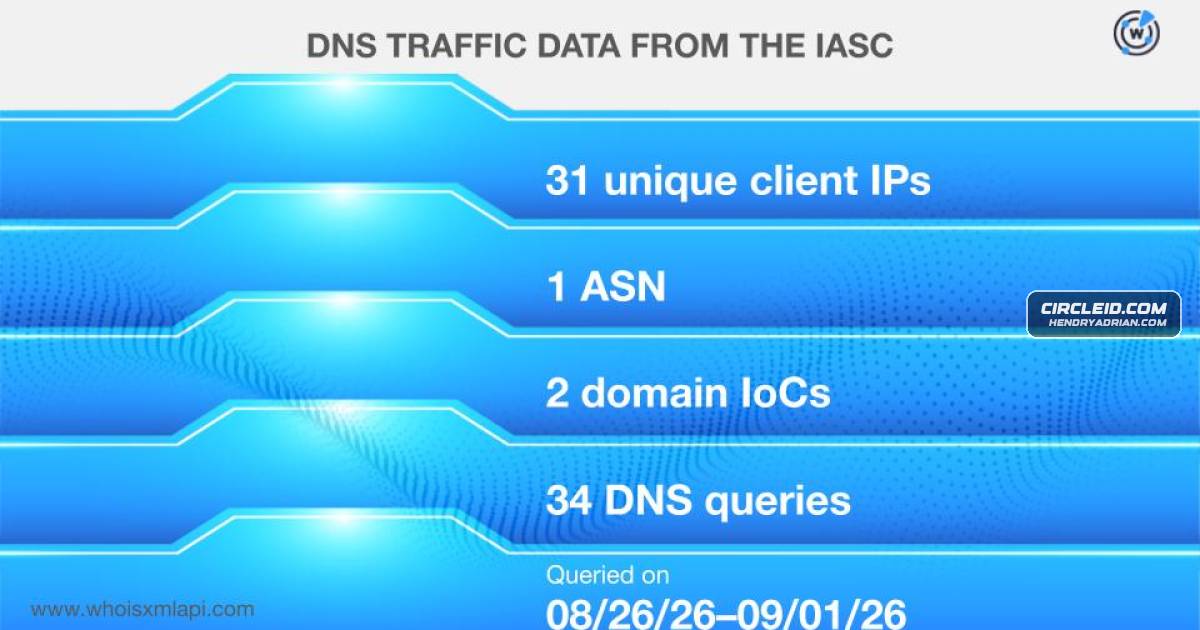
- Thirty-one client IP addresses made 34 DNS queries involving dsdsei[.]com and tsedws[.]com between August 26 and September 1, 2026.
- Historical WHOIS records for IoC domains led to 5,531 email-connected domains; the authors’ Threat Intelligence API classified five as malicious, including one associated with phishing.
- The analysis found 56,740 historical IP-to-domain resolutions across 316 IP IoCs.
- The authors reported 13 additional IP addresses, of which 10 were classified as confirmed malicious, and recommend further investigation to corroborate threat classifications.
Article Details
- Attack Vectors
- Chinese-linked threat actors reportedly combined automated scanning, large-scale botnets, and hands-on exploitation to target organizations worldwide.
- The reported activity involved theft of sensitive data, including from organizations in the U.S. critical infrastructure sector.
- Defensive Notes
- The article recommends supplementary investigation to corroborate entities identified as malicious, noting that assessments may change with additional evidence or context.
Indicators of compromise
| Type | Indicator | Context |
|---|---|---|
| DOMAIN | antai-contravention-paiement[.]fr | The article identifies this email-connected domain as malicious and reports it was associated with phishing. |
| DOMAIN | arforcex[.]com | Listed among the attack domain IoCs; the article reports historical domain-to-IP resolutions. |
| DOMAIN | dsdsei[.]com | Domain IoC; the article reports it was likely registered with malicious intent and that client IP addresses communicated with it. |
| DOMAIN | sexytube0[.]com | Listed among the attack domain IoCs; the article reports historical domain-to-IP resolutions. |
| DOMAIN | shifuj[.]com | Listed among the attack domain IoCs; the article reports historical domain-to-IP resolutions. |
| DOMAIN | tsedws[.]com | Domain IoC; the article reports client IP addresses communicated with it and records historical domain-to-IP resolutions. |
| IPV4 | 103[.]233[.]253[.]197 | Listed among the attack IP IoCs; the article reports historical IP-to-domain resolutions. |
| IPV4 | 125[.]227[.]1[.]220 | Listed among the attack IP IoCs; the article reports historical IP-to-domain resolutions. |
| IPV4 | 125[.]227[.]218[.]2 | Listed among the attack IP IoCs; the article reports historical IP-to-domain resolutions. |
| IPV4 | 210[.]66[.]220[.]39 | Listed among the attack IP IoCs; the article reports historical IP-to-domain resolutions. |
| IPV4 | 211[.]21[.]19[.]11 | Listed among the attack IP IoCs; the article reports historical IP-to-domain resolutions. |
MITRE ATT&CK
Countries
ChinaThey were geolocated in 18 countries, six of which appeared as a domain IoC registrant country—China, Taiwan, the U.S., the Netherlands, Malaysia, and France.FranceThey were geolocated in 18 countries, six of which appeared as a domain IoC registrant country—China, Taiwan, the U.S., the Netherlands, Malaysia, and France.MalaysiaThey were geolocated in 18 countries, six of which appeared as a domain IoC registrant country—China, Taiwan, the U.S., the Netherlands, Malaysia, and France.NetherlandsThey were geolocated in 18 countries, six of which appeared as a domain IoC registrant country—China, Taiwan, the U.S., the Netherlands, Malaysia, and France.TaiwanThey were geolocated in 18 countries, six of which appeared as a domain IoC registrant country—China, Taiwan, the U.S., the Netherlands, Malaysia, and France.United StatesThey combined automated scanning tools, large-scale botnets, and hands-on exploitation techniques to target and steal sensitive data from organizations worldwide, including the U.S.