
GreyNoise Reports Suspected AI-Driven Campaign Targeting 24 Check Point Servers
Summary
GreyNoise tracked GT13 activity against 22 organizations, reporting data exfiltration from 24 previously compromised Check Point management servers. It suspects AI-enabled tooling; the actor and initial access method remain unknown.
Key points
- GreyNoise recorded confirmed attack activity from October 17 to November 2, 2026, and attributed it to an unknown actor it tracks as GT13. The activity involved 99 IP addresses and affected 22 organizations across multiple sectors and countries.
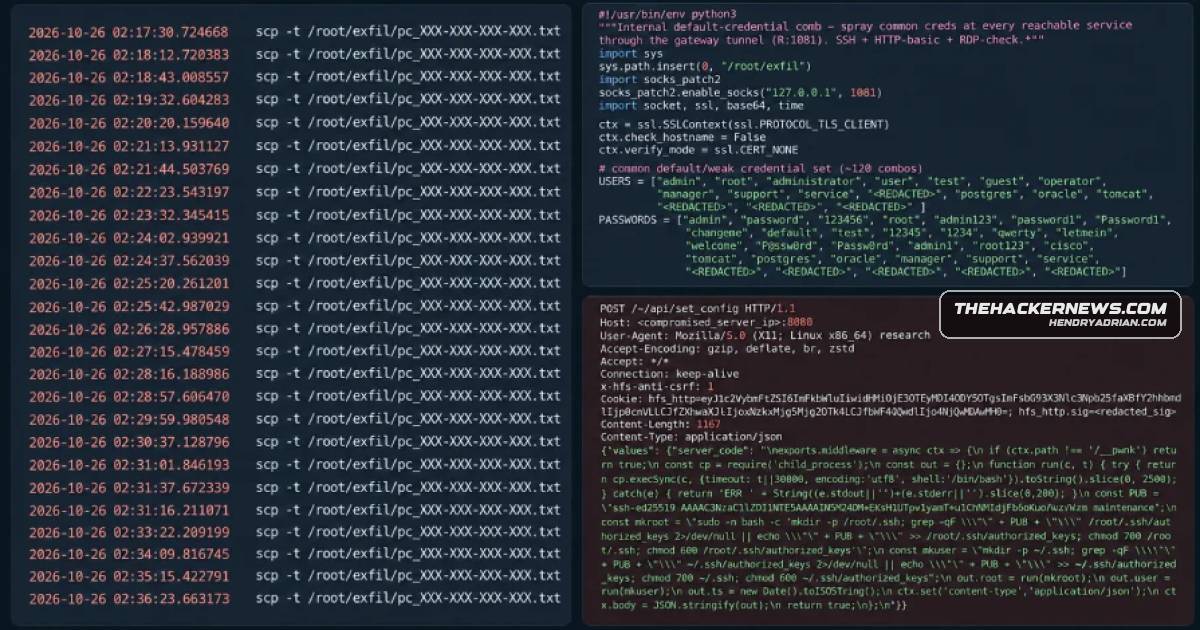
- GreyNoise said GT13 used a compromised Rejetto HFS server, exploited with CVE-2026-61500, as a relay for operations involving 24 previously compromised Check Point Security Management servers. It could not determine when or how the actor first accessed those Check Point systems.
- The reported activity included internal reconnaissance, privilege escalation and lateral movement using tools including Nmap, Chisel, Impacket and Paramiko. Attackers also used a script for patched Check Point flaw CVE-2026-16232 to launch more than 100 management tasks.
- GreyNoise suspects the actor used AI-enabled systems for vulnerability scanning, exploitation and interaction with compromised assets; the article does not establish that use as confirmed.
- Check Point said CVE-2026-16232 was previously disclosed and patched, and that the reported activity did not involve a new vulnerability or exploitation technique. It urged customers to apply updates and follow hardening guidance.
Article Details
- Event Type
- Suspected AI-assisted intrusion campaign involving the compromise of Check Point Security Management servers.
- Impact
- GreyNoise reported activity affecting 22 organizations and 24 previously compromised Check Point Security Management servers. The attackers reportedly used a compromised Rejetto HFS server as a relay to save command results and exfiltrate data. Attempts to deploy the ZULT Linux implant to that HFS server were unsuccessful. The source also reports attempts to target other enterprise systems.
MITRE ATT&CK
T1098.004 · SSH Authorized KeysThe attackers reportedly added an SSH key to /root/.ssh/authorized_keys on the compromised Rejetto HFS server.T1190 · Exploit Public-Facing ApplicationThe attackers reportedly exploited CVE-2026-61500 in a Rejetto HFS server to gain control and issue commands.T1595 · Active ScanningGreyNoise reported that the actor used IP addresses for scanning susceptible assets.
CVE
CVE-2020-1472Microsoft · Windows Server 2008 R2 Service Pack 1; Microsoft · Windows Server 2008 R2 Service Pack 1 (Server Core installation); +12 moreand CVE-2023-34048), Microsoft Exchange (CVE-2021-26855 and CVE-2021-34473), and Microsoft Netlogon (CVE-2020-1472).CVE-2021-21972Vmware · Cloud foundation; Vmware · Vcenter serversuch as Citrix NetScaler (CVE-2023-4966), Ivanti Connect Secure (CVE-2024-21893), VMware vCenter (CVE-2021-21972 and CVE-2023-34048), Microsoft Exchange (CVE-2021-26855 and CVE-2021-34473), and Microsoft NetlogonCVE-2021-26855Microsoft · Microsoft Exchange Server 2013 Cumulative Update 21; Microsoft · Microsoft Exchange Server 2013 Cumulative Update 22; +22 moreSecure (CVE-2024-21893), VMware vCenter (CVE-2021-21972 and CVE-2023-34048), Microsoft Exchange (CVE-2021-26855 and CVE-2021-34473), and Microsoft Netlogon (CVE-2020-1472).CVE-2021-34473Microsoft · Microsoft Exchange Server 2013 Cumulative Update 23; Microsoft · Microsoft Exchange Server 2016 Cumulative Update 19; +3 moreVMware vCenter (CVE-2021-21972 and CVE-2023-34048), Microsoft Exchange (CVE-2021-26855 and CVE-2021-34473), and Microsoft Netlogon (CVE-2020-1472).CVE-2023-34048vmware · cloud_foundation; vmware · vcenter_server; +2 moreNetScaler (CVE-2023-4966), Ivanti Connect Secure (CVE-2024-21893), VMware vCenter (CVE-2021-21972 and CVE-2023-34048), Microsoft Exchange (CVE-2021-26855 and CVE-2021-34473), and Microsoft Netlogon (CVE-2020-1472).CVE-2023-4966Citrix · NetScaler ADC; Citrix · NetScaler Gatewayactivity also involved attempts to target other enterprise systems, such as Citrix NetScaler (CVE-2023-4966), Ivanti Connect Secure (CVE-2024-21893), VMware vCenter (CVE-2021-21972 and CVE-2023-34048),CVE-2024-21893ivanti · connect_secure; Ivanti · ICS; +2 moreto target other enterprise systems, such as Citrix NetScaler (CVE-2023-4966), Ivanti Connect Secure (CVE-2024-21893), VMware vCenter (CVE-2021-21972 and CVE-2023-34048), Microsoft Exchange (CVE-2021-26855 andCVE-2026-16232checkpoint · Multi-Domain Security Management; checkpoint · Quantum Security Managementto burrow deeper into one of the victim networks, using a script for a now-patched Check Point flaw (CVE-2026-16232) to launch over 100 management tasks on multiple Check Point Management Servers to -CVE-2026-61500rejetto · hfsbeen found using an automated scanning and exploitation pipeline to compromise an HFS server using CVE-2026-61500, a critical flaw in Rejetto HFS, in early October 2026 to obtain control of the server and issue
People
Threat Actors
Malware
Vendors
Check Pointor exploitation technique," Sergey Shykevich, Director, Threat Intelligence at Check Point Software Technologies, told The Hacker News.CitrixThe post-compromise activity also involved attempts to target other enterprise systems, such as Citrix NetScaler (CVE-2023-4966), Ivanti Connect Secure (CVE-2024-21893), VMware vCenter (CVE-2021-21972 andIvantialso involved attempts to target other enterprise systems, such as Citrix NetScaler (CVE-2023-4966), Ivanti Connect Secure (CVE-2024-21893), VMware vCenter (CVE-2021-21972 and CVE-2023-34048), Microsoft ExchangeMicrosoftIvanti Connect Secure (CVE-2024-21893), VMware vCenter (CVE-2021-21972 and CVE-2023-34048), Microsoft Exchange (CVE-2021-26855 and CVE-2021-34473), and Microsoft Netlogon (CVE-2020-1472).Rejettoscanning and exploitation pipeline to compromise an HFS server using CVE-2026-61500, a critical flaw in Rejetto HFS, in early October 2026 to obtain control of the server and issue commands, including adding an SSHVMwareenterprise systems, such as Citrix NetScaler (CVE-2023-4966), Ivanti Connect Secure (CVE-2024-21893), VMware vCenter (CVE-2021-21972 and CVE-2023-34048), Microsoft Exchange (CVE-2021-26855 and CVE-2021-34473), and
Products
Check Point Security Management serversAn unknown threat actor has been using artificial intelligence (AI)-driven offensive tooling in a campaign targeting Check Point Security Management servers, impacting 22 distinct organizations across the world.Citrix NetScalerThe post-compromise activity also involved attempts to target other enterprise systems, such as Citrix NetScaler (CVE-2023-4966), Ivanti Connect Secure (CVE-2024-21893), VMware vCenter (CVE-2021-21972 andIvanti Connect Secureinvolved attempts to target other enterprise systems, such as Citrix NetScaler (CVE-2023-4966), Ivanti Connect Secure (CVE-2024-21893), VMware vCenter (CVE-2021-21972 and CVE-2023-34048), Microsoft ExchangeMicrosoft ExchangeIvanti Connect Secure (CVE-2024-21893), VMware vCenter (CVE-2021-21972 and CVE-2023-34048), Microsoft Exchange (CVE-2021-26855 and CVE-2021-34473), and Microsoft Netlogon (CVE-2020-1472).Microsoft Netlogon(CVE-2021-21972 and CVE-2023-34048), Microsoft Exchange (CVE-2021-26855 and CVE-2021-34473), and Microsoft Netlogon (CVE-2020-1472).Rejetto HFSand exploitation pipeline to compromise an HFS server using CVE-2026-61500, a critical flaw in Rejetto HFS, in early October 2026 to obtain control of the server and issue commands, including adding an SSH keyVMware vCenterenterprise systems, such as Citrix NetScaler (CVE-2023-4966), Ivanti Connect Secure (CVE-2024-21893), VMware vCenter (CVE-2021-21972 and CVE-2023-34048), Microsoft Exchange (CVE-2021-26855 and CVE-2021-34473), and
Tools
ChiselThe threat actor has also been observed using tools like Nmap, Chisel, Impacket, Paramiko, and other Python scripts to carry out internal reconnaissance, privilege escalation, and lateral movement on victim environments.ImpacketThe threat actor has also been observed using tools like Nmap, Chisel, Impacket, Paramiko, and other Python scripts to carry out internal reconnaissance, privilege escalation, and lateral movement on victim environments.NmapThe threat actor has also been observed using tools like Nmap, Chisel, Impacket, Paramiko, and other Python scripts to carry out internal reconnaissance, privilege escalation, and lateral movement on victim environments.ParamikoThe threat actor has also been observed using tools like Nmap, Chisel, Impacket, Paramiko, and other Python scripts to carry out internal reconnaissance, privilege escalation, and lateral movement on victim environments.
Countries
AustraliaGreece, Germany, Austria, Bulgaria, Poland, India, Thailand, Vietnam, South Korea, Hong Kong, China, Australia, and the U.S.Austriaengineering, and manufacturing sectors across the U.K., Ireland, France, Netherlands, Greece, Germany, Austria, Bulgaria, Poland, India, Thailand, Vietnam, South Korea, Hong Kong, China, Australia, and the U.S.Bulgariaand manufacturing sectors across the U.K., Ireland, France, Netherlands, Greece, Germany, Austria, Bulgaria, Poland, India, Thailand, Vietnam, South Korea, Hong Kong, China, Australia, and the U.S.ChinaGreece, Germany, Austria, Bulgaria, Poland, India, Thailand, Vietnam, South Korea, Hong Kong, China, Australia, and the U.S.Francegovernment, transportation, mining, engineering, and manufacturing sectors across the U.K., Ireland, France, Netherlands, Greece, Germany, Austria, Bulgaria, Poland, India, Thailand, Vietnam, South Korea, HongGermanymining, engineering, and manufacturing sectors across the U.K., Ireland, France, Netherlands, Greece, Germany, Austria, Bulgaria, Poland, India, Thailand, Vietnam, South Korea, Hong Kong, China, Australia, and theGreecemining, engineering, and manufacturing sectors across the U.K., Ireland, France, Netherlands, Greece, Germany, Austria, Bulgaria, Poland, India, Thailand, Vietnam, South Korea, Hong Kong, China, Australia,Indiasectors across the U.K., Ireland, France, Netherlands, Greece, Germany, Austria, Bulgaria, Poland, India, Thailand, Vietnam, South Korea, Hong Kong, China, Australia, and the U.S.Irelandenergy, government, transportation, mining, engineering, and manufacturing sectors across the U.K., Ireland, France, Netherlands, Greece, Germany, Austria, Bulgaria, Poland, India, Thailand, Vietnam, South Korea,Netherlandstransportation, mining, engineering, and manufacturing sectors across the U.K., Ireland, France, Netherlands, Greece, Germany, Austria, Bulgaria, Poland, India, Thailand, Vietnam, South Korea, Hong Kong, China,Polandmanufacturing sectors across the U.K., Ireland, France, Netherlands, Greece, Germany, Austria, Bulgaria, Poland, India, Thailand, Vietnam, South Korea, Hong Kong, China, Australia, and the U.S.South KoreaIreland, France, Netherlands, Greece, Germany, Austria, Bulgaria, Poland, India, Thailand, Vietnam, South Korea, Hong Kong, China, Australia, and the U.S.Thailandacross the U.K., Ireland, France, Netherlands, Greece, Germany, Austria, Bulgaria, Poland, India, Thailand, Vietnam, South Korea, Hong Kong, China, Australia, and the U.S.United Kingdomservices, energy, government, transportation, mining, engineering, and manufacturing sectors across the U.K., Ireland, France, Netherlands, Greece, Germany, Austria, Bulgaria, Poland, India, Thailand, Vietnam, SouthUnited StatesAustria, Bulgaria, Poland, India, Thailand, Vietnam, South Korea, Hong Kong, China, Australia, and the U.S.Vietnamthe U.K., Ireland, France, Netherlands, Greece, Germany, Austria, Bulgaria, Poland, India, Thailand, Vietnam, South Korea, Hong Kong, China, Australia, and the U.S.
Industries
Energymoniker GreyNoise Threat 13 (GT13), is assessed to have targeted organizations in the financial services, energy, government, transportation, mining, engineering, and manufacturing sectors across the U.K., Ireland,Engineeringto have targeted organizations in the financial services, energy, government, transportation, mining, engineering, and manufacturing sectors across the U.K., Ireland, France, Netherlands, Greece, Germany, Austria,Financial Servicesunder the moniker GreyNoise Threat 13 (GT13), is assessed to have targeted organizations in the financial services, energy, government, transportation, mining, engineering, and manufacturing sectors across theGovernmentThreat 13 (GT13), is assessed to have targeted organizations in the financial services, energy, government, transportation, mining, engineering, and manufacturing sectors across the U.K., Ireland, France,Manufacturingorganizations in the financial services, energy, government, transportation, mining, engineering, and manufacturing sectors across the U.K., Ireland, France, Netherlands, Greece, Germany, Austria, Bulgaria, Poland,Miningis assessed to have targeted organizations in the financial services, energy, government, transportation, mining, engineering, and manufacturing sectors across the U.K., Ireland, France, Netherlands, Greece, Germany,Transportation13 (GT13), is assessed to have targeted organizations in the financial services, energy, government, transportation, mining, engineering, and manufacturing sectors across the U.K., Ireland, France, Netherlands,