
Remus Stealer Uses a Malicious Chrome Extension to Intercept Gmail
Summary
Researchers found Remus Stealer’s email feature installs a malicious Chrome extension that uses the victim’s existing Gmail session to collect and exfiltrate new messages—not a Gmail zero-day. Access stops when the session is revoked, but resumes after sign-in if the”
Key points
- Researchers reverse-engineered Remus Stealer’s interception module and found it installs a malicious extension in Chrome profiles by modifying browser preference files and enabling Developer Mode.
- The extension is disguised as Google Sheets and requests access to all URLs.
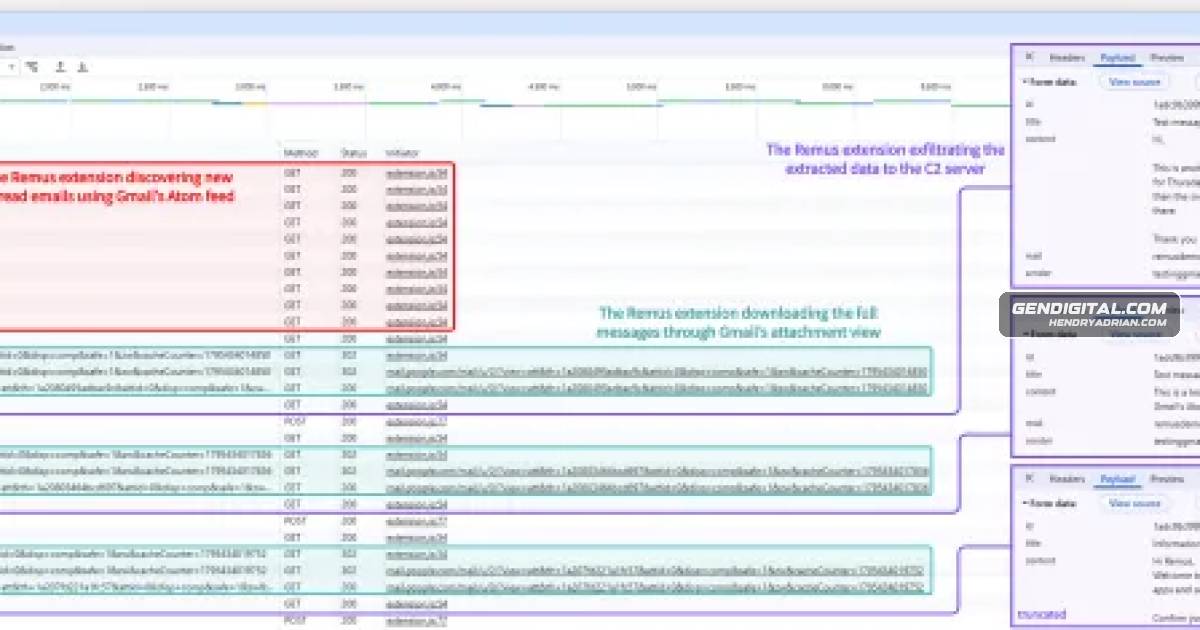
- Every minute, it checks Gmail’s Atom feed for unread messages, downloads full message content, and sends the data to the malware’s command-and-control server.
- The extension uses the victim’s existing Gmail session; the researchers found no Gmail zero-day or bypass of password changes and session revocation.
- Revoking sessions or signing out stops interception, but the extension can regain access to new messages when the victim signs in again while it remains installed.
- The extension records attachment filenames but does not send the filenames or attachment contents to the command-and-control server.
Article Details
- Attack Vectors
- Remus Stealer retrieves an email-interception module from its C2 server as part of its dynamic configuration, then manually maps and executes the module in its own address space.
- The module writes an embedded extension archive to a temporary directory and uses PowerShell to extract it.
- The module modifies Chrome profile preference files to register the extension, enable Developer Mode, and recompute preference integrity values; it then attempts to restart Chrome.
- The extension queries Gmail's Atom feed and attachment-view endpoint using the victim's existing signed-in session, then sends extracted email content to the C2 server over HTTPS.
- Defensive Notes
- The article states that changing a password or revoking sessions does not remove the extension; interception can resume when the victim signs in again. Revoking sessions or signing out does stop requests authenticated by the existing session.
- Inspect Chrome extensions and Developer Mode settings for an unexpected unpacked extension disguised as Google Sheets.
Indicators of compromise
| Type | Indicator | Context |
|---|---|---|
| SHA256 | 2d92fe0b3b918bdbca318879a65bd5a00e63e00b181085afdeed6922c85f90bd | SHA-256 hash of Remus' email-interception module, an x64 DLL. |
| SHA256 | 39cb29f0985fa58d6b4f632948d543c3633e0a8ab1a51a360a813f2752eb082f | SHA-256 hash of the malicious extension archive in ZIP format. |
| SHA256 | 75e5225cb2fca8b62718648e0c663b9003048a19860ae9f0458f7d904220e693 | SHA-256 hash of the malicious extension archive in ZIP format. |
| SHA256 | acf1b83914aca2944f55be6ff269cc984f35e3a757a12d9cd036e428c93087bc | SHA-256 hash of the malicious extension's extension.js file. |
| SHA256 | ae9556b371d29e5fd1f7ff45c00fb60644d6cd8c5bfc1b78a565c1f6296f3a81 | SHA-256 hash of the malicious extension's extension.js file. |
| SHA256 | e13e019dae958f20d7a252adf64888ab6e6c427622b67c5bf7ae6ffa4a0e25f3 | SHA-256 hash of Remus' email-interception module, an x64 DLL. |
MITRE ATT&CK
T1027 · Obfuscated Files or InformationThe extension's JavaScript is obfuscated, and configuration values are further encoded with Base64 and XOR after ChaCha20 decryption.T1041 · Exfiltration Over C2 ChannelThe extension exfiltrates extracted email content to the Remus C2 server in HTTPS POST requests.T1059.001 · PowerShellThe module invokes PowerShell with Expand-Archive to extract the embedded extension ZIP file.T1059.007 · JavaScriptThe malicious Chrome extension executes its email-interception logic in JavaScript in a background service worker.T1105 · Ingress Tool TransferRemus downloads its dynamically configured modules, including the email-interception module, from its C2 server.T1114.002 · Remote Email CollectionThe extension collects email from the victim's signed-in Gmail accounts by querying the Atom feed and downloading full messages through Gmail's attachment view.T1176 · Software ExtensionsThe module installs a malicious extension by modifying Chrome profile preferences, registering the extension, and enabling Developer Mode.
People
Malware
Products
GmailOn November 8, 2026, the developers behind Remus Stealer began promoting a new Gmail interception feature, promising access to victims' mailboxes independently of any stolen cookies, even after the victim changes theirGoogle ChromeGen Threat Labs has tracked down the module behind the feature and found that, rather than exploiting a Gmail vulnerability, it silently installs a malicious extension into the victim's Google Chrome browser.