
Researchers Reproduce Unauthenticated RCE in nginx HTTP/2 Flaw CVE-2026-123007
Summary
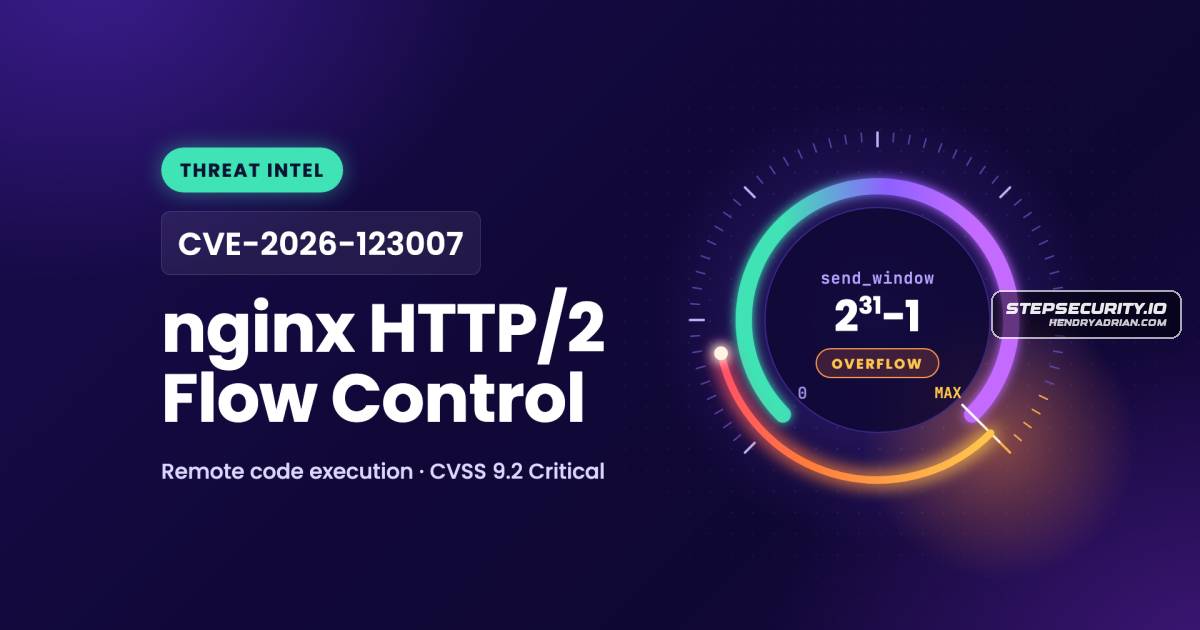
Researchers reproduced worker crashes and code execution through CVE-2026-123007, an nginx HTTP/2 flow-control flaw. nginx 1.31.9 and 1.30.7 fix it; no in-the-wild exploitation was reported as of November 20, 2026.
Key points
- A double refund of queued HTTP/2 data can push nginx’s connection window past its maximum; unsigned arithmetic then permits an oversized memory copy that corrupts memory.
- The public exploit ran commands as the nginx worker without credentials. It requires reachable HTTP/2, substantial bandwidth, an idle server, and an x86-64 CPU with AVX-512; a separate PoC crashed workers without AVX-512.
- Testing reproduced crashes and code execution against nginx 1.31.8. The PoC could not trigger the overflow on fixed version 1.31.9.
- Affected upstream versions are nginx 1.9.5 through 1.31.8 with HTTP/2 enabled. Upstream fixes are in 1.31.9 and 1.30.7, with distribution-specific backports also listed.
- If patching is not possible, disabling HTTP/2 blocks this flaw, though it also breaks gRPC through nginx. The article says RHEL 8, 9, and 10 had no fixed nginx packages as of November 20, 2026.
- The article identifies possible exploitation indicators, including large single-connection traffic, bursts of HEAD requests, and nginx worker exits on signals 6 or 11.
Article Details
- Attack Vectors
- An unauthenticated attacker can send crafted HTTP/2 flow-control frames to a reachable nginx server with HTTP/2 enabled, triggering an integer underflow and memory corruption.
- The published exploit requires a direct connection, an otherwise idle server, and about 119 GiB of bandwidth within nginx's one-hour connection limit; the demonstrated code-execution exploit also requires an x86-64 CPU with AVX-512. AVX-512 is not required to trigger a worker crash.
- The article reports that the bug can be triggered over unencrypted HTTP/2 and does not require TLS. A reverse proxy that terminates HTTP/2 may disrupt the published exploit's expected frame behavior.
- Defensive Notes
- Upgrade nginx to 1.31.9 or 1.30.7, or install the fixed package from the relevant distribution. Restart nginx after upgrading; a configuration reload alone does not replace the running binary.
- If patching is not possible, disable HTTP/2 and verify that the server negotiates HTTP/1.1. The article says this blocks both HTTP/2 nginx2root bugs, but also breaks gRPC through nginx.
- For affected RHEL 8, 9, and 10 packages with no fix reported as of November 20, 2026, the article recommends disabling HTTP/2 until fixed packages are available.
- Monitor nginx error logs for worker exits on signals 11 or 6, unusually large bytes_received on a single connection, bursts of HEAD requests, and programs started by the nginx worker. Treat these as possible exploitation indicators, not confirmation.
- The article says per-IP connection limits and reverse proxies are not fixes. It also notes that distribution backports may retain upstream version strings, so verify package versions against distribution advisories.
MITRE ATT&CK
T1190 · Exploit Public-Facing ApplicationThe public exploit remotely targets the nginx HTTP/2 service through CVE-2026-123007 to run a command as the nginx worker user.T1499.004 · Application or System ExploitationThe article's proof of concept exploits the flaw to crash the nginx worker through memory corruption.
CVE
Vendors
F5F5's advisory credits four research teams for reporting the bug. Three of them have demonstrated remote code execution, and one published a working exploit with step-by-step instructions. Under the conditions listedRed HatRed Hat Enterprise Linux 8, 9, 10 nginx packages No fix as of November 20StepSecurityCheck package versions instead. On developer machines, Dev Machine Guard reports them for you (see How StepSecurity Helps).
Products
Ingress-NGINXKubernetes ingress-nginx enables HTTP/2 by default (use-http2: "true" in its ConfigMap). Kubernetes ended maintenance of ingress-nginx in March 2026 and no longer ships releases or security fixes for it, so no patchedNGINXOn November 18, 2026, nginx released versions 1.31.9 and 1.30.7 with fixes for ten vulnerabilities. Five of them were disclosed together as nginx2root. This post covers CVE-2026-123007, an integer underflow in nginx'sNGINX PlusNGINX Plus See F5 K000163926 37.0.8.1, 37.3.0.1. No fix for R34 to R36.StepSecurity Dev Machine Guardsome patched servers still look vulnerable. Check package versions instead. On developer machines, Dev Machine Guard reports them for you (see How StepSecurity Helps).
Tools
auditdnginx worker. An nginx worker should not start other programs. The researchers' write-up recommends an auditd rule that logs every program started under the worker's user ID. Debian and Ubuntu packages run theShodannginx 1.31.8, the version the public exploit was built for, and offer HTTP/2. We ran the count with Shodan at 08:15 UTC on November 20. Shodan counts services, where each service is one IP address and port.
Countries
AustraliaBy country: United States, then Ireland, Germany, Japan, the United Kingdom, and Australia.GermanyBy country: United States, then Ireland, Germany, Japan, the United Kingdom, and Australia.IrelandBy country: United States, then Ireland, Germany, Japan, the United Kingdom, and Australia.JapanBy country: United States, then Ireland, Germany, Japan, the United Kingdom, and Australia.United KingdomBy country: United States, then Ireland, Germany, Japan, the United Kingdom, and Australia.United StatesBy country: United States, then Ireland, Germany, Japan, the United Kingdom, and Australia.