
Operation ArgonHunt Exposes Crypto Exchange Intrusion and AI API Key Theft
Summary
SOCRadar researchers found an exposed server containing evidence of an intrusion into an unnamed Turkish crypto exchange and automated harvesting of 44,096 AI API keys. Forged withdrawals were attempts, not verified losses.
Key points
- A Linux server exposed its temporary directory over HTTP port 8099, revealing about 700 MB of scripts, execution logs, and credentials.
- Files indicated the operator gained read/write access to an unnamed Turkish cryptocurrency exchange’s production database; the exchange has not publicly confirmed the breach.
- The operator’s scripts logged more than 200 forged withdrawal requests, but researchers did not verify on-chain settlement, so the amounts are not confirmed losses.
- The server contained 44,096 unique AI API keys, 519 Google Cloud tokens, and logs indicating live service-account tokens were sniffed; recheck logs marked 2,686 keys active.
- Researchers linked the exchange access to unsalted MD5 password hashes, 17 cracked staff passwords, Hydra brute forcing, and attempts to cycle through SMS one-time codes.
- Custom tools reportedly used the MySQL general query log to write a PHP web shell and an InfluxDB subscription to attempt SSRF against internal panels.
- SOCRadar shared victim-specific indicators privately; the article recommends auditing database access and withdrawals, replacing weak password hashes, and revoking potentially exposed API keys.
Article Details
- Attack Vectors
- An unsecured Linux server exposed its temporary directory over HTTP on port 8099, leaking scripts, execution logs, credentials, and other files.
- The operator cracked 17 unsalted MD5 staff-password hashes and used Hydra to brute-force the exchange admin panel.
- Scripts tried four- and six-digit SMS one-time codes across 12 parallel threads.
- After gaining access, the operator used MySQL's general query log to write a PHP web shell into the web root.
- An InfluxDB subscription was used to trigger server-side request forgery against internal panels.
- The operator sniffed live service-account tokens and stored harvested AI API keys on the exposed server.
- Drainer scripts changed withdrawal addresses in the database and forged requests from localhost to bypass application checks.
- Defensive Notes
- Audit databases for unauthorized withdrawal modifications and rogue MySQL accounts.
- Replace legacy MD5 password hashes and enforce rate limits on SMS one-time codes.
- Restrict database file privileges and block outbound InfluxDB subscription requests.
- Scan public repositories and traffic logs for exposed API tokens; revoke suspected leaked keys and review billing logs for unauthorized compute usage.
- Enforce strict IP allowlists and scope limits on cloud service tokens.
MITRE ATT&CK
T1040 · Network SniffingAn intercepted traffic log showed the operator sniffed live service-account tokens.T1059.006 · PythonThe operator used Python scripts for activity including forged withdrawal requests.T1078 · Valid AccountsThe operator used obtained staff credentials to access the exchange admin panel.T1110.001 · Password GuessingHydra brute-forced the exchange admin panel, and scripts cycled through four- and six-digit SMS codes.T1110.002 · Password CrackingThe operator cracked 17 staff passwords stored as unsalted MD5 hashes.T1505.003 · Web ShellA script abused the MySQL general query log to write a PHP web shell into the web root.T1565.001 · Stored Data ManipulationThe drainer scripts modified withdrawal addresses in the exchange database.
Vendors
AnthropicSecond, the server stored 44,096 unique API keys for Gemini, OpenAI, OpenRouter, Anthropic, and xAI.GoogleThese harvested secrets included 519 Google Cloud tokens and administrative credentials.OpenAISecond, the server stored 44,096 unique API keys for Gemini, OpenAI, OpenRouter, Anthropic, and xAI.OpenRouterSecond, the server stored 44,096 unique API keys for Gemini, OpenAI, OpenRouter, Anthropic, and xAI.xAISecond, the server stored 44,096 unique API keys for Gemini, OpenAI, OpenRouter, Anthropic, and xAI.
Products
GeminiSecond, the server stored 44,096 unique API keys for Gemini, OpenAI, OpenRouter, Anthropic, and xAI.Google CloudThese harvested secrets included 519 Google Cloud tokens and administrative credentials.InfluxDBAnother tool created an InfluxDB subscription to trigger server-side request forgery against internal panels.MySQLThe directory contained stolen admin panel source code, CRM files, and credentials for over a dozen MySQL accounts.
Tools
Countries
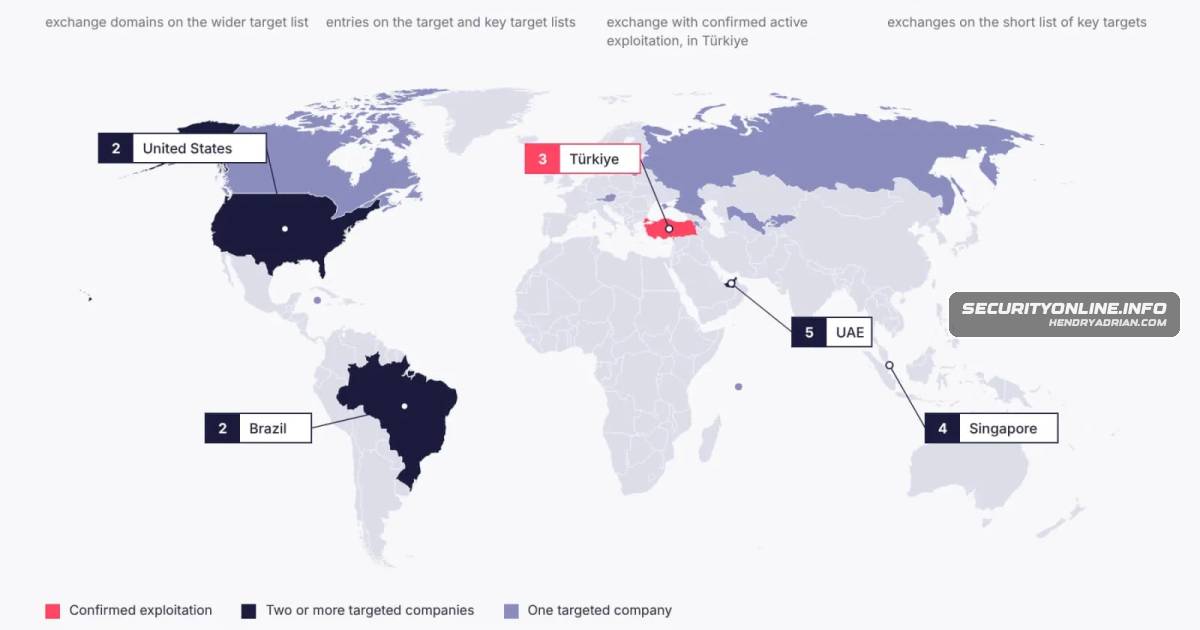
BrazilResearchers found reconnaissance lists covering 281 exchange domains and 56 priority targets across the United Arab Emirates, Singapore, Turkiye, Brazil, and the United States.SingaporeResearchers found reconnaissance lists covering 281 exchange domains and 56 priority targets across the United Arab Emirates, Singapore, Turkiye, Brazil, and the United States.TürkiyeThe exposed directory revealed a deep compromise of a Turkish cryptocurrency exchange alongside an automated pipeline harvesting 44,096 AI API keys.United Arab EmiratesResearchers found reconnaissance lists covering 281 exchange domains and 56 priority targets across the United Arab Emirates, Singapore, Turkiye, Brazil, and the United States.United StatesResearchers found reconnaissance lists covering 281 exchange domains and 56 priority targets across the United Arab Emirates, Singapore, Turkiye, Brazil, and the United States.