
Varonis Explains How AI Data Classification Can Support Data Security
Summary
Varonis describes its AI data-classification approach, combining content, subject, topic, access and activity context to identify sensitive data, prioritize exposure, support detection and remediation, and offer cloud or local processing options.
Key points
- Varonis says its classification scans structured, unstructured and semi-structured data without sampling, and incrementally analyzes new or changed content in near real time.
- Its four classification components are Data Class, Data Subject, Data Topic and Classification Enrichment, which adds access, activity and risk signals.
- The vendor says the system can identify sensitive information and exposed secrets, including credentials and API keys embedded in unstructured content.
- Varonis says results include highlighted source text and human-readable reasoning, including whether classification came from AI inference, deterministic matching or both.
- The platform connects classification with exposure analysis, behavioral threat detection, governance workflows and automated remediation.
- For cloud analysis, Varonis says content samples are encrypted in transit, processed for classification and not stored or used to train its models; local deployment is also available.
Article Details
- Topic
- Varonis AI Classification and how contextual data classification can support risk prioritization, threat detection, and automated remediation.
Vendors
Products
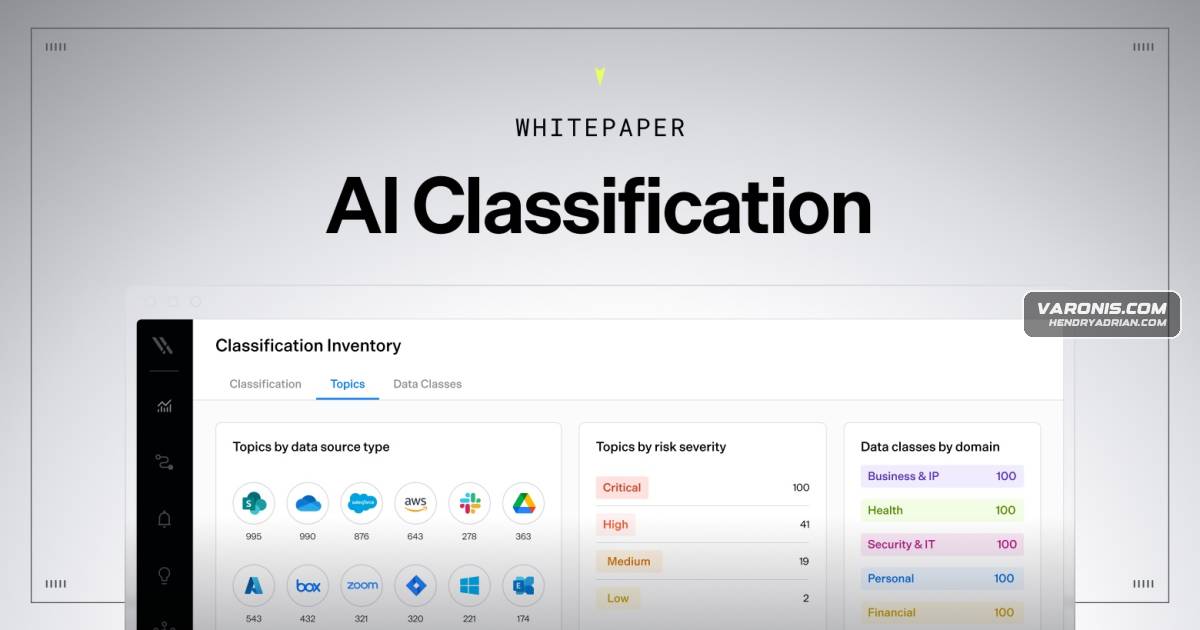
Data Classification InventoryVaronis' Data Classification Inventory combines all four components — Subject, Topic, Class, and Classification Enrichment — into one data-centric view of what data is, why it matters, who can access it, and how it'sVaronis AI ClassificationCompleteness also extends across content types. Varonis AI Classification spans structured, unstructured, and semi-structured data, including logs, exports, configuration files, chat transcripts, and other formats that