
Actively Exploited Apache Roller Flaw Enables Unauthenticated Remote Code Execution
Summary
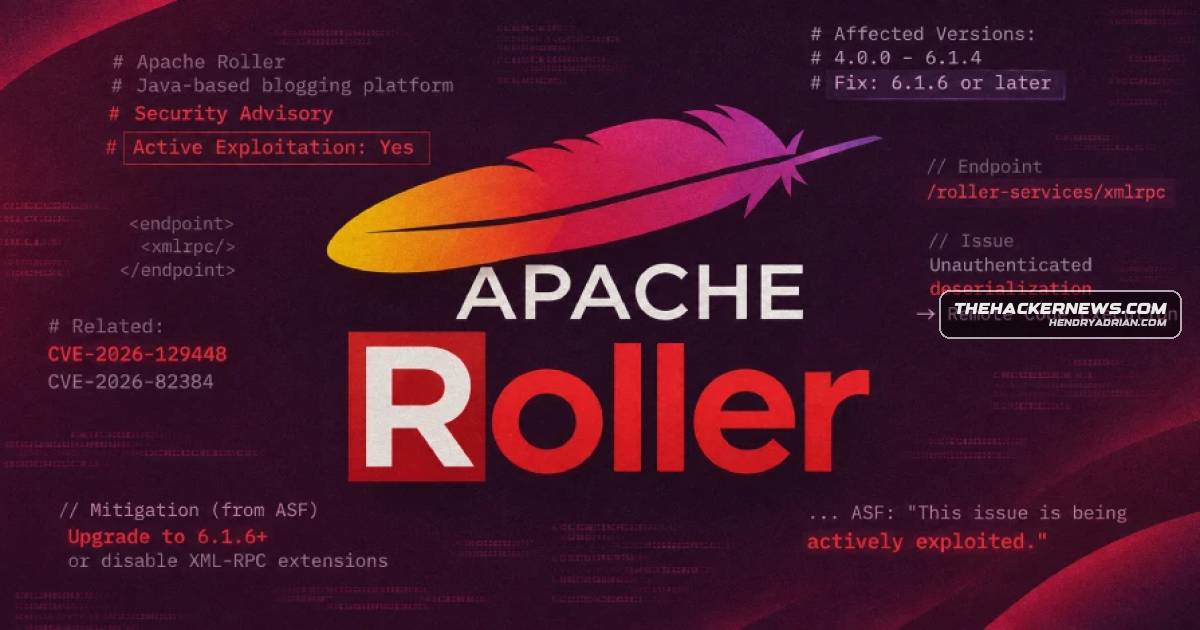
Apache says CVE-2026-129448 affects Roller 4.0.0–6.1.4 and is actively exploited. The unauthenticated XML-RPC deserialization flaw can enable remote code execution; upgrade to 6.1.6 or later or apply the stated workarounds.
Key points
- Apache identifies CVE-2026-129448 as an unauthenticated deserialization flaw in the XML-RPC endpoint that can allow remote code execution.
- The affected versions are Apache Roller 4.0.0 through 6.1.4; the flaw has a CVSS score of 9.8.
- The Apache Software Foundation says the vulnerability is being actively exploited but provided no details about exploitation methods or targets.
- Apache says the issue is the same as CVE-2026-82384, which was patched in September 2026.
- Upgrade to Apache Roller 6.1.6 or later, which disables the extension types and rejects XML-RPC requests when that feature is disabled.
- If immediate patching is not possible, set "enabledForExtensions" to "false" in WEB-INF/web.xml or remove the "/roller-services/xmlrpc" servlet mapping, then restart Roller.
- Disabling XML-RPC in the administration UI alone is insufficient because older versions deserialize requests before checking that setting.
Article Details
- Vulnerability Types
- Unauthenticated deserialization of untrusted data leading to remote code execution
- Severity
- Critical (CVSS 9.8)
- Affected Versions
- Apache Roller 4.0.0 through 6.1.4
- Exploitation Status
- active
- Exploit Availability
- unknown
- Patch Status
- available
- Workarounds
- Set "enabledForExtensions" to "false" in WEB-INF/web.xml.
- Remove the "/roller-services/xmlrpc" servlet mapping and restart Roller.
CVE
CVE-2026-129448Apache Software Foundation · Apache RollerThe vulnerability, tracked as CVE-2026-129448 (CVSS score: 9.8), is a case of unauthenticated deserialization in the XML-RPC endpoint that could lead to remote code execution.CVE-2026-82384Apache Software Foundation · Apache RollerASF also noted that the vulnerability is the same as CVE-2026-82384 (CVSS score: 9.8), which was patched in September 2026 and listed only Apache Roller 6.1.5 as affected.