
OpenJDK Base64 Decoder Flaw Can Enable Out-of-Bounds Writes and RCE
Summary
Datadog researchers explain how malformed Base64 input triggers out-of-bounds writes in OpenJDK’s AVX-512 VBMI decoder. Denial of service is more readily achievable than tailored RCE; fixed Java builds or JVM flags mitigate the flaw.
Key points
- CVE-2026-114938 is an out-of-bounds write in OpenJDK’s optimized Base64 decoder, rated 9.2 Critical under CVSS 4.0.
- Exploitation requires a vulnerable Java runtime, a CPU supporting AVX-512 VBMI, and attacker-controlled input reaching the affected decoder; native ARM64 runtimes are not affected.
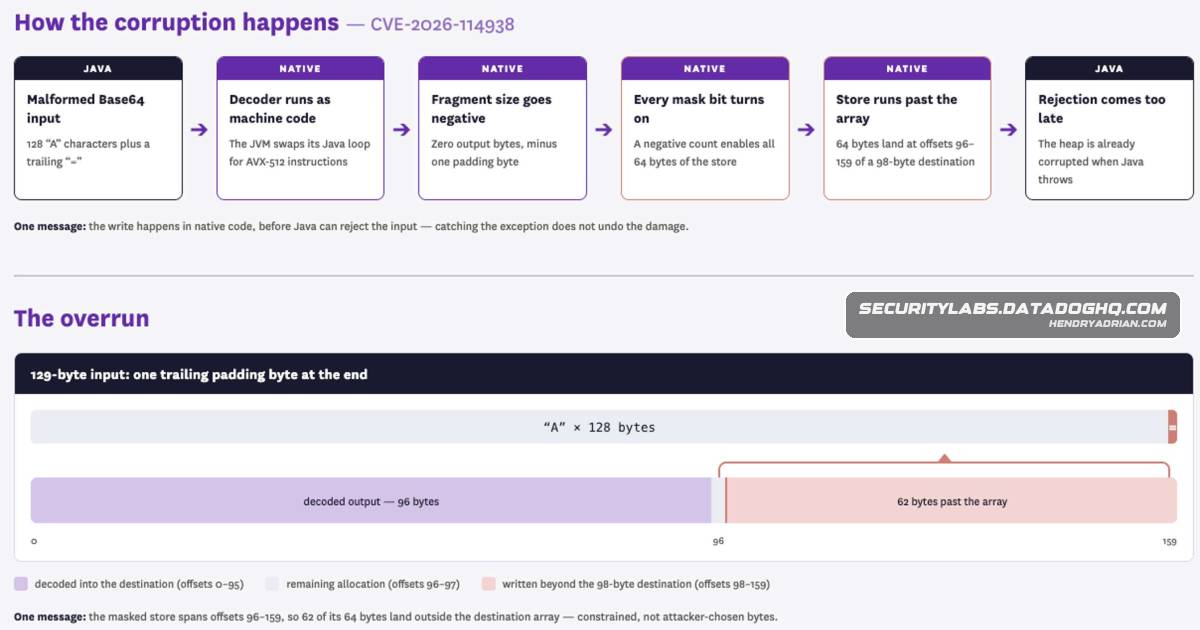
- In the tested case, malformed trailing padding produces a negative output length and a full-width vector store, writing 62 bytes beyond a 98-byte array.
- The resulting memory corruption can cause a later JVM crash; reliable remote code execution requires additional application- and JVM-specific exploit work.
- The article lists affected Java 17, 21, 25, and 27 releases and their first fixed versions.
- Update affected runtimes, including bundled and containerized Java. Temporary workarounds are -XX:-UseBASE64Intrinsics or, on x86-64 only, -XX:UseAVX=2.
Article Details
- Attack Vectors
- Malformed Base64 input can trigger an out-of-bounds write when attacker-controlled data reaches the affected OpenJDK decoder. The vulnerable AVX-512 decoding path requires an x86-64 CPU with AVX-512 VBMI support; reliable remote code execution would require additional exploitation work tailored to the application and JVM environment.
- The article describes denial of service as more readily achievable than reliable code execution. In a standalone test, the write corrupted a neighboring array header and the JVM later crashed during garbage collection.
- Defensive Notes
- Update affected Java runtimes to vendor-fixed builds, including runtimes bundled with applications and container images; rebuild and redeploy updated application images and restart affected Java processes.
- If an update cannot be deployed immediately, disable Base64 intrinsics with -XX:-UseBASE64Intrinsics. Alternatively, on x86-64 only, use -XX:UseAVX=2 to disable AVX-512 execution; assess potential performance impact.
- Do not apply -XX:UseAVX=2 to native ARM64 JVMs, which do not recognize the option and may fail to start.
- Check whether CPUs support AVX-512 VBMI and whether applications pass attacker-controlled values to the affected basic or URL Base64 decoder. The MIME decoder bypasses the vulnerable path in the tested OpenJDK 17.0.6 build.
- Review the running process and bundled runtime rather than relying on the Java installation on the shell path; where available, use jcmd to inspect the runtime version and effective JVM flags.
CVE
Vendors
Products
Datadog Cloud Security ManagementDatadog Cloud Security Management reports findings for CVE-2026-114938.Datadog Live ProcessesDatadog Live Processes provide real-time visibility into the processes running on your infrastructure.OpenJDKCVE-2026-114938 is an out-of-bounds write in OpenJDK's optimized Base64 decoder.