
Phishing Kit Harvests Victims’ MX Records Alongside Credentials
Summary
Analysis of a phishing kit found it collected passwords and victim metadata, including email-domain MX records queried via DNS-over-HTTPS, and sent the information to the attacker. Whether the MX data was used for further attacks is unknown.
Key points
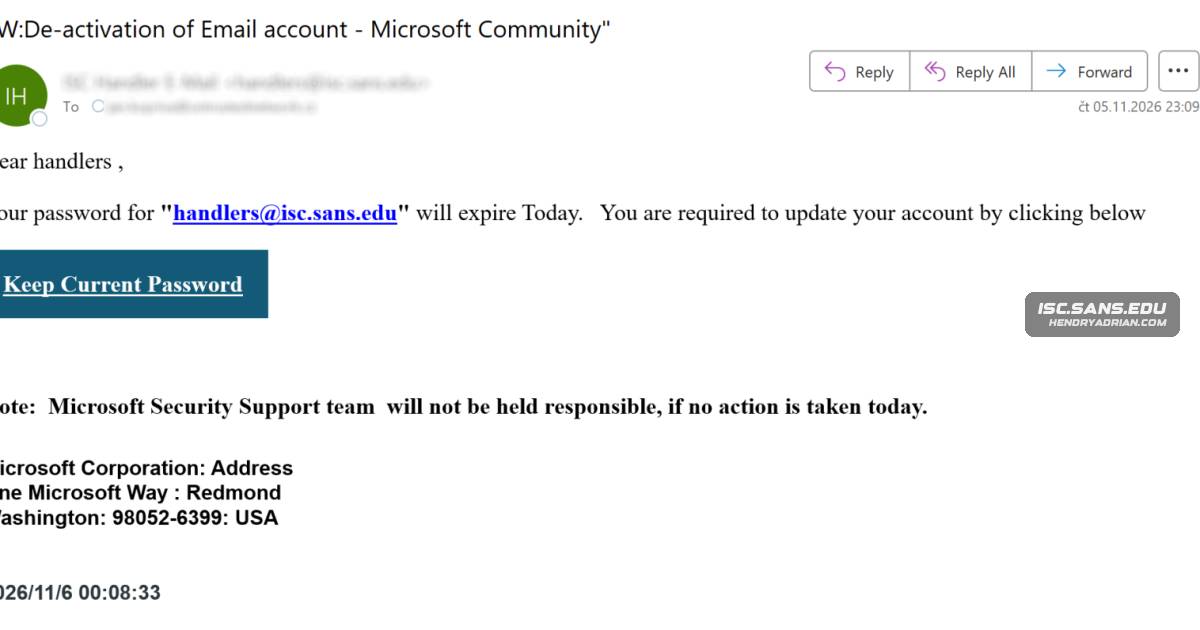
- A password-expiry phishing lure led to a personalized login page hosted on Google Cloud Storage.
- After decoding obfuscated JavaScript, the researcher found the page collected passwords, public IP addresses, geolocation, browser and language information, and a timestamp.
- The page queried MX records for the victim’s email domain using DNS-over-HTTPS and Google Public DNS.
- The MX records were included with the stolen credentials in information sent to the attacker through the Telegram Bot API.
- The MX data could help identify an organization’s email infrastructure or prioritize credentials, but the researcher could not determine whether the actor used it that way.
Article Details
- Attack Vectors
- A phishing email using a password-expiration pretext linked to a credential-harvesting page hosted on Google Cloud Storage.
- The page presented a login form personalized with the recipient's email domain and collected the submitted password, public IP address, geographic location, browser information, and language.
- The page queried MX records for the victim's email domain through Google's public DNS service and included the results with the stolen credentials in data intended for the attacker via the Telegram Bot API.
Indicators of compromise
| Type | Indicator | Context |
|---|---|---|
| URL | hxxps[:]//storage[.]googleapis[.]com/alx2/03/1a/we.html#[recipient_e-mail_address] | Specific Google Cloud Storage URL hosting the phishing page and credential-harvesting kit. |
MITRE ATT&CK
T1056.003 · Web Portal CaptureThe phishing page presented a login form to capture submitted email credentials.T1566.002 · Spearphishing LinkA password-expiration phishing email directed recipients to a credential-harvesting page through a link.T1567 · Exfiltration Over Web ServiceThe page was configured to send stolen credentials and collected visitor information to the attacker through the Telegram Bot API.T1590.002 · DNSJavaScript queried DNS MX records for the victim's email domain to identify its email infrastructure.