
Genians Details NodeLinkRAT Campaign and Assesses a Moderate-Confidence Kimsuky Link
Summary
Genians traced a spearphishing campaign using a public note page to rotate payloads, from XenoRAT and data-theft scripts to NodeLinkRAT. It assesses a Kimsuky link with moderate confidence and recommends behavior-based detection.
Key points
- The campaign used reply-based spearphishing themed around a seminar honorarium to deliver an archive containing an HWP-disguised LNK file.
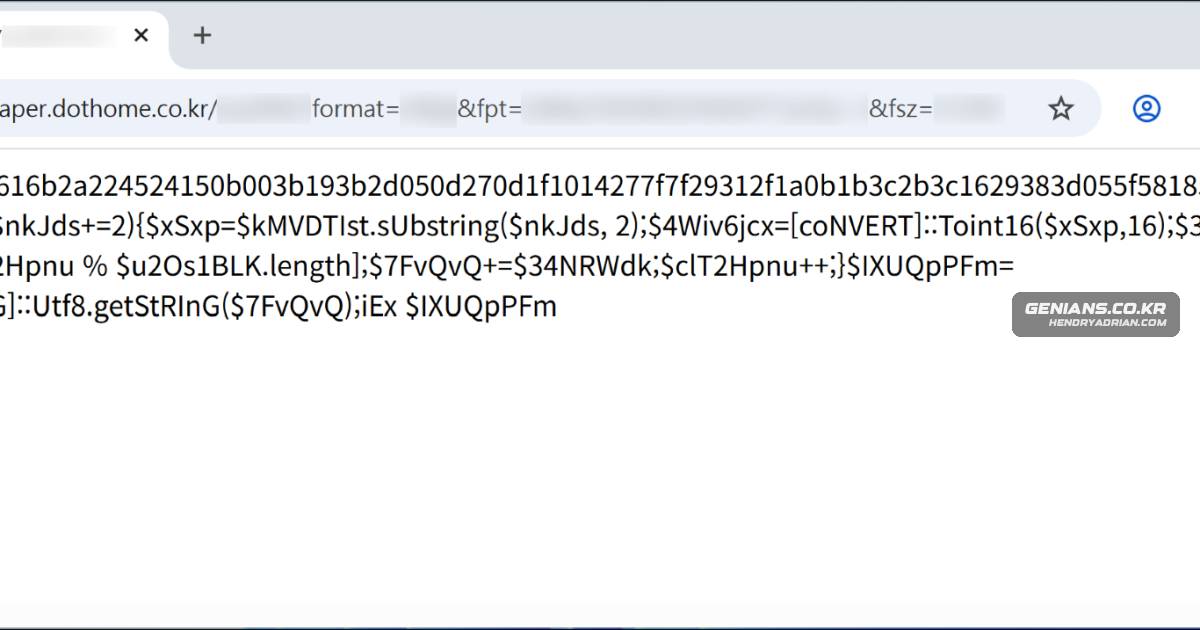
- The LNK launched obfuscated PowerShell, which established scheduled-task persistence and repeatedly retrieved and executed changing code from a public note page.
- Payloads observed from June to October 2026 included XenoRAT, system-information collection and document-theft scripts, and NodeLinkRAT.
- NodeLinkRAT runs JavaScript on an installed Node.js runtime and supports remote command execution, file operations, folder exfiltration, and screen capture.
- Genians assesses a Kimsuky connection with moderate confidence, citing overlapping account assets, phishing infrastructure, malware build characteristics, and targeting; it notes that imitation cannot be ruled out.
- The article recommends correlating process activity, scheduled tasks, file creation, and network behavior, and retaining initial-execution logs to reconstruct activity.
Article Details
- Attack Vectors
- Reply-based spearphishing impersonated a senior aide and delivered a ZIP archive containing an HWP-disguised LNK file.
- The LNK launched hidden PowerShell through cmd.exe; obfuscated commands downloaded and executed scripts in memory.
- A PowerShell script established scheduled-task persistence and repeatedly retrieved commands from a public note page.
- The changing third-stage code deployed XenoRAT, collected system information, or exfiltrated documents through cloud storage and free web hosting.
- NodeLinkRAT installed Node.js and JavaScript packages, then used a hidden JavaScript file for remote control, file transfer, and screen capture.
- Defensive Notes
- Retain endpoint logs from initial LNK execution so activity can be reconstructed even after the shortcut is deleted.
- Correlate process trees, command lines, file creation, scheduled tasks, and network connections as one attack sequence.
- Monitor repeated script retrieval and in-memory execution, including hidden PowerShell and VBScript launched by wscript.
- Investigate unexpected Node.js installations under public folders, hidden node.exe execution, and unusual MEGAcmd activity.
- Assess the process, installation path, scripts, API use, and follow-on behavior rather than trusting legitimate signatures or blocking shared services solely by domain.
Indicators of compromise
| Type | Indicator | Context |
|---|---|---|
| DOMAIN | epaper[.]dothome[.]co[.]kr | Free-hosting domain used to deliver a PowerShell stage from the LNK command. |
| DOMAIN | inmain[.]22web[.]org | Domain used in the earlier phishing infrastructure discussed as overlapping with this case. |
| DOMAIN | nid[.]weffm[.]p-e[.]kr | Free-domain-service address reported as an occasional C2 address. |
| DOMAIN | oppsite[.]dothome[.]co[.]kr | Free-hosting domain used to receive stolen document and image files. |
| DOMAIN | owna[.]loveslife[.]biz | Domain used in the earlier phishing infrastructure discussed as overlapping with this case. |
c0653159@gmail[.]com | Registration email for a Dropbox account identified in a related case; the article says it was also used in phishing targeting people working on North Korean affairs. | |
| IPV4 | 103[.]81[.]116[.]10 | XenoRAT C2 server used by two reported variants. |
| IPV4 | 185[.]27[.]134[.]120 | Infrastructure used for a 2024 phishing page that the article says closely matched the page observed in this case. |
| IPV4 | 185[.]27[.]134[.]207 | Infrastructure used for a 2024 phishing page that the article says closely matched the page observed in this case. |
| IPV4 | 207[.]148[.]112[.]166 | NodeLinkRAT C2 server identified in the article. |
| IPV4 | 211[.]223[.]14[.]75 | C2 server used by a reported XenoRAT variant. |
| MD5 | 6985f297c03520a5852734a385322d8d | MD5 hash of a XenoRAT variant listed in the article's variant comparison. |
| MD5 | 7575d230350299cfde0c4f993d761333 | MD5 hash listed in the article's campaign IOC section; its specific sample role is not stated. |
| MD5 | a151531b792b1df1eec8d3a6a8e1ded5 | MD5 hash of a XenoRAT variant listed in the article's variant comparison. |
| MD5 | a15df586bf29e7c1a5db64d603cee382 | MD5 hash of a XenoRAT variant listed in the article's variant comparison. |
| MD5 | cbcb66b530fb4f03d7dc9d55271b2ce4 | MD5 hash listed in the article's campaign IOC section; its specific sample role is not stated. |
| MD5 | ef317291bf88651666133abe84f115f0 | MD5 hash listed in the article's campaign IOC section; its specific sample role is not stated. |
MITRE ATT&CK
T1005 · Data from Local SystemThe campaign collected local system information and stole document and image files from victim profiles.T1027 · Obfuscated Files or InformationThe attack used character substitution, XOR, Base64, and HTML decoding to conceal commands and code.T1041 · Exfiltration Over C2 ChannelNodeLinkRAT followed C2 commands to upload files and compressed folders to the remote controller.T1053.005 · Scheduled TaskThe second-stage script created a scheduled task named CommonMaintenanceHost to run repeatedly.T1059.001 · PowerShellPowerShell reconstructed obfuscated commands, downloaded scripts, and executed them in memory.T1059.003 · Windows Command ShellThe LNK used cmd.exe to launch hidden PowerShell.T1059.005 · Visual BasicA scheduled task launched a VBScript file through wscript; the VBScript then ran a PowerShell script.T1059.007 · JavaScriptNode.exe executed the JavaScript-based NodeLinkRAT script.T1082 · System Information DiscoveryCollection scripts gathered operating-system and system information from infected machines.T1083 · File and Directory DiscoveryScripts searched user-profile folders and enumerated documents and other files for collection or transfer.T1105 · Ingress Tool Transfercurl.exe and later scripts downloaded payloads, scripts, and the Node.js runtime.T1113 · Screen CaptureNodeLinkRAT used screenshot-desktop to capture the victim's screen.T1204.002 · Malicious FileThe attack began when the victim extracted and executed the HWP-disguised LNK file.T1566.001 · Spearphishing AttachmentThe spearphishing email led the recipient to a ZIP archive containing a malicious LNK file.T1567.002 · Exfiltration to Cloud StorageCollection results were uploaded through Dropbox and MEGA cloud storage.
Threat Actors
Malware
Products
aNotepadA multistage fileless chain involving LNK, PowerShell, free web hosting, and aNotepadDropbox DocSendThe code posted on the note page evolved from running XenoRAT in memory to collecting information through cloud storage services such as Dropbox and MEGA and exfiltrating document files.Genian Insights EIntegrated Response Strategy with "Genian Insights E"MEGAThe code posted on the note page evolved from running XenoRAT in memory to collecting information through cloud storage services such as Dropbox and MEGA and exfiltrating document files.MEGAcmdThe attacker focused on its official command-line tool, MEGAcmd.Node.jsIt ultimately shifted to installing the Node.js runtime and running a JavaScript-based remote access tool.
Countries
IndiaTwo use 103.81.116[.]10 in India as their command server, while the third uses 211.223.14[.]75 in South Korea.JapanNodeLinkRAT uses the Japan-based host 207.148.112[.]166 as C2.North KoreaThe attack resembles the activities of North Korea-backed hacking groups in its TTPs, infrastructure preferences, and lure themes.South KoreaIn South Korea, "vaccine" is a commonly used term for security products.