
SOCRadar Details CyberXero’s AI-Assisted Intrusions and Web Exploitation
Summary
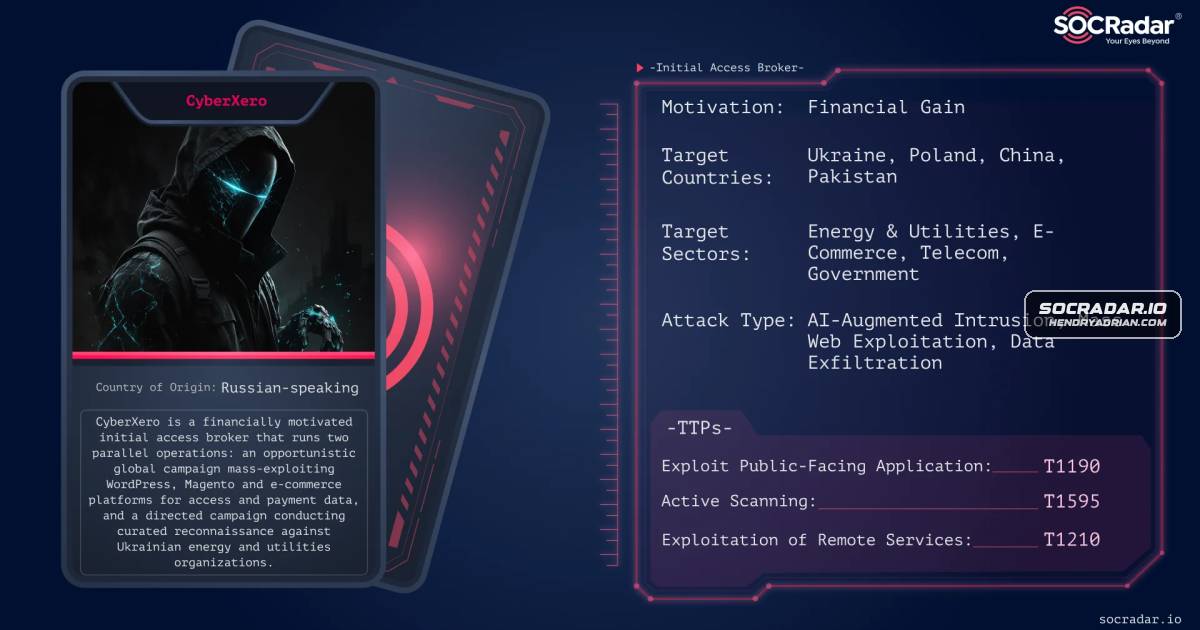
SOCRadar researchers detail CyberXero, an active Russian-speaking initial access broker using mass web-app exploitation and targeted intrusions, including against Ukrainian utilities. The profile documents its AI tooling, techniques, victim impact and defenses.
Key points
- SOCRadar says it identified more than 40 affected organizations across several countries, excluding more than 4,500 WordPress sites targeted through mass exploitation.
- The in-house wp2shell tool exploits a WordPress REST API batch-endpoint authorization desynchronization to use SQL injection, create administrator accounts and deploy a webshell.
- The report documents targeted intrusions involving Ukrainian organizations, including alleged theft of subscriber records and credentials; it also describes reconnaissance against Ukrainian energy and utilities entities.
- Researchers found a setup involving 51 Claude Code agents and PentAGI connected to a Cobalt Strike Team Server through the Anthropic API.
- In a Chinese corporate network, the report describes Redis master-replication abuse to plant an SSH key, followed by lateral movement; successful EternalBlue exploitation was not confirmed.
- The article recommends checking for wp2shell artifacts, patching exposed applications, removing default credentials, securing Redis, and protecting AI-agent session logs.
Article Details
- Attack Vectors
- Mass exploitation of WordPress REST API batch endpoint authorization desynchronization using adaptive SQL injection, followed by creation of rogue administrator accounts and deployment of WSO-family webshells.
- Targeted intrusions used blind SQL injection, password-reset token extraction, and PHP deserialization to obtain remote code execution and dump databases.
- Compromised exposed Magento configuration and used hardcoded administrator credentials to access victim systems and data.
- Abused a misconfigured Redis server with rogue master replication to plant an SSH key, then moved laterally using WMI through a passwordless account.
- Attempted password spraying against Pakistani government entities and brute-forced a ZTE gateway using default credentials.
- Used a card-skimmer endpoint against a production payment flow and delivered Cobalt Strike beacons, staging, and PowerShell stagers from the Team Server.
- Defensive Notes
- Review WordPress user tables for usernames matching wp2_ followed by eight hexadecimal characters, and plugin paths matching wp2shell_ with the same suffix; treat either artifact as evidence of compromise.
- Prioritize patching CVE-2026-63030, CVE-2026-60137, and CVE-2026-4815; verify that Magento configuration files such as app/etc/env.php are not publicly reachable.
- Audit administration panels for hardcoded or shared credentials, replace default network-device passwords, and remove local accounts with blank passwords.
- Do not expose Redis to the internet; require authentication, disable or rename SLAVEOF/REPLICAOF where unnecessary, and monitor authorized_keys for unexpected changes.
- Block the listed C2 infrastructure and search historical logs for connections to 42.193.227.214 on ports 1002, 8044, and 8033; hunt for the UpdSvc service and PowerShell download cradles.
- Protect AI-agent session logs with retention, encryption, and access controls comparable to those used for credential stores.
Indicators of compromise
| Type | Indicator | Context |
|---|---|---|
| IPV4 | 212[.]193[.]31[.]189 | Attacker-operated cryptocurrency payment gateway. |
| IPV4 | 42[.]193[.]100[.]94 | Attacker Redis-exploitation node and PentAGI agent infrastructure. |
| IPV4 | 42[.]193[.]227[.]214 | Cobalt Strike Team Server and PentAGI infrastructure; receives HTTPS beacons on port 1002, serves HTTP staging on port 8044, and delivers PowerShell stagers on port 8033. |
| IPV4 | 45[.]88[.]106[.]2 | Attacker provisioning server, reported on port 1500. |
| IPV4 | 45[.]88[.]106[.]78 | Attacker mass-scanning server. |
| IPV4 | 46[.]21[.]250[.]135 | Attacker-controlled primary workstation and open-directory seed node. |
| IPV4 | 49[.]234[.]12[.]182 | Attacker staging and payload-delivery server used in the Chinese network cluster. |
| IPV4 | 91[.]208[.]184[.]148 | Attacker-controlled secondary workstation. |
| MD5 | 3870a559b5b6ea6076f5f90029c180b7 | Hash of the Cobalt Strike x86 stager32.bin. |
| SHA256 | 59c535f47ab4d35f6d9fc8b8aec4a72438ea0b89e5a4dcea74b05d2d32cfa483 | Hash of config.bin, identified as a Chinese-cluster staging payload. |
| SHA256 | 71e21094c1ac1cf0275c91ed377965e248bca1c12711f6dd20e2682681fc1192 | Hash of 1.bin, identified as a Chinese-cluster staging payload. |
| SHA256 | 92a789444708fa1cb4cc5a89e0aa6cc7a279b62a7b8a4d2857255a18197d0090 | Hash of the Cobalt Strike x86 stager32.bin from the pirated 4.9.1 build. |
| SHA256 | a5ae0aab352871bc0b038b3aa43b03eb223425628c884af7b9fc592cd34eb86c | Hash of an obfuscated WSO webshell deployed by the actor. |
MITRE ATT&CK
T1046 · Network Service DiscoveryAfter gaining access to the Chinese corporate network, beacons enumerated the network.T1047 · Windows Management InstrumentationThe actor moved laterally through a Chinese corporate network over WMI using a passwordless account.T1056.003 · Web Portal CaptureThe actor built and tested a card-skimmer endpoint against a production payment flow.T1059.001 · PowerShellThe Cobalt Strike infrastructure delivered PowerShell stagers.T1071.001 · Web ProtocolsThe Cobalt Strike Team Server received HTTPS beacons on port 1002.T1098.004 · SSH Authorized KeysThe actor abused Redis master replication to plant an SSH key.T1110.003 · Password SprayingThe actor attempted credential spraying against two Pakistani government entities.T1190 · Exploit Public-Facing ApplicationThe actor exploited internet-facing WordPress applications through SQL injection and abused vulnerabilities in other exposed web applications.T1505.003 · Web ShellAfter compromising WordPress sites, the actor deployed a WSO-family webshell registered as an active plugin.T1543.003 · Windows ServiceThe actor created the UpdSvc Windows service for persistence in the Chinese network cluster.T1588.005 · ExploitsThe actor had functional exploits for disclosed vulnerabilities, including an exploit for CVE-2026-4815 developed within 30 days of publication.T1595.002 · Vulnerability ScanningThe actor scanned more than 56,000 URLs and ran an automated scan against 4,708 targets to find exploitable WordPress panels.
CVE
CVE-2015-1397Magento · MagentoThe arsenal also includes CVE-2026-63030 and CVE-2026-60137 in WordPress and CVE-2015-1397 in Magento.CVE-2026-4815Schiocco · Support BoardCVE-2026-4815 in Support Board 3.8.7 was published in June 2026, and a functional exploit with proxy rotation and automatic timing calibration appears in files dated July 2026, a cycle of less than 30 days.CVE-2026-60137WordPress · WordPressThe arsenal also includes CVE-2026-63030 and CVE-2026-60137 in WordPress and CVE-2015-1397 in Magento.CVE-2026-63030WordPress · WordPressThe arsenal also includes CVE-2026-63030 and CVE-2026-60137 in WordPress and CVE-2015-1397 in Magento.
Threat Actors
Malware
Vendors
Products
Claude CodeWhat sets CyberXero apart is its AI layer, with up to 51 specialized Claude Code agents on its primary workstation and a PentAGI deployment wired into a Cobalt Strike Team Server through the Anthropic API.MagentoThe actor runs two parallel operations: an opportunistic global campaign that mass-exploits WordPress, Magento and other e-commerce platforms for access and payment data, and a directed campaign that conducts curatedPrestaShopWith a weaponization cycle under 30 days, patch windows measured in months leave WordPress, Magento, PrestaShop and Support Board deployments exposed.Redisdeserialization chain built with phpggc, reaching remote code execution and dumping MySQL, MongoDB and Redis databases with 24,132 active sessions and 864 API tokens.Support BoardCVE-2026-4815 in Support Board 3.8.7 was published in June 2026, and a functional exploit with proxy rotation and automatic timing calibration appears in files dated July 2026, a cycle of less than 30 days.WordPressThe actor runs two parallel operations: an opportunistic global campaign that mass-exploits WordPress, Magento and other e-commerce platforms for access and payment data, and a directed campaign that conducts curated
Tools
Cobalt StrikeWhat sets CyberXero apart is its AI layer, with up to 51 specialized Claude Code agents on its primary workstation and a PentAGI deployment wired into a Cobalt Strike Team Server through the Anthropic API.PentAGIWhat sets CyberXero apart is its AI layer, with up to 51 specialized Claude Code agents on its primary workstation and a PentAGI deployment wired into a Cobalt Strike Team Server through the Anthropic API.phpggcemail, a time-constrained password reset token extraction and a PHP deserialization chain built with phpggc, reaching remote code execution and dumping MySQL, MongoDB and Redis databases with 24,132 activewp2shellThe actor’s in-house tool, wp2shell, is a five-module Python package that abuses a desynchronization in the WordPress REST API batch endpoint (/wp-json/batch/v1), where the validation and execution handlers apply
Countries
ChinaSOCRadar identified more than 40 affected organizations across Ukraine, Poland, China, Pakistan and the Netherlands, excluding the 4,500+ WordPress sites hit through mass exploitation.NetherlandsSOCRadar identified more than 40 affected organizations across Ukraine, Poland, China, Pakistan and the Netherlands, excluding the 4,500+ WordPress sites hit through mass exploitation.PakistanSOCRadar identified more than 40 affected organizations across Ukraine, Poland, China, Pakistan and the Netherlands, excluding the 4,500+ WordPress sites hit through mass exploitation.PolandSOCRadar identified more than 40 affected organizations across Ukraine, Poland, China, Pakistan and the Netherlands, excluding the 4,500+ WordPress sites hit through mass exploitation.UkraineSOCRadar identified more than 40 affected organizations across Ukraine, Poland, China, Pakistan and the Netherlands, excluding the 4,500+ WordPress sites hit through mass exploitation.
Industries
Corporate networksEnergy and utilities account for 28% of confirmed victims, followed by e-commerce and payment (24%), government (20%), ISP and telecom (16%), corporate networks (8%) and CRM and SaaS (4%).CRM and SaaSEnergy and utilities account for 28% of confirmed victims, followed by e-commerce and payment (24%), government (20%), ISP and telecom (16%), corporate networks (8%) and CRM and SaaS (4%).E-commerce and paymentEnergy and utilities account for 28% of confirmed victims, followed by e-commerce and payment (24%), government (20%), ISP and telecom (16%), corporate networks (8%) and CRM and SaaS (4%).energy and utilitiesand payment data, and a directed campaign that conducts curated reconnaissance against Ukrainian energy and utilities organizations.GovernmentPoland follows with four to five affected entities, two of them confirmed e-commerce compromises, and 284 scanned Polish domains with a heavy concentration of government institutions.ISP and telecomEnergy and utilities account for 28% of confirmed victims, followed by e-commerce and payment (24%), government (20%), ISP and telecom (16%), corporate networks (8%) and CRM and SaaS (4%).