
Researchers Say BOSSAI AI Agents Helped a Taiwan-Based Attacker Steal Taipei Dispatch Records
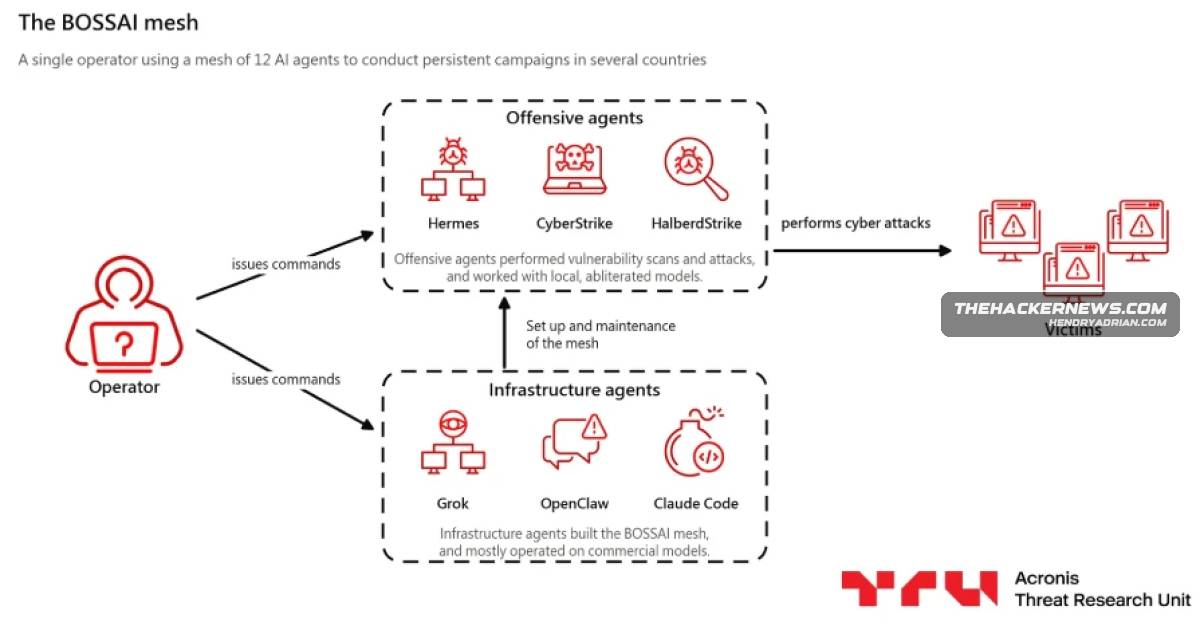
Summary
Acronis researchers say a Taiwan-based attacker used BOSSAI AI agents to access systems and collect data across several countries, including Taipei emergency dispatch records. A separate patient-data platform was exposed, but theft from it was not established.
Key points
- Researchers say the attacker used 12 BOSSAI AI agents, with nine in use, and ran most attack agents on locally operated models with safety training removed.
- The agents retrieved emergency dispatch records covering seven Taipei districts through a public-facing API; the records included incident details and street-level locations.
- A Taipei fire department platform exposed patient data dating to 2018, including ECG readings and ambulance video, but the article does not establish that the data was stolen.
- Acronis researchers say the operation accessed or collected data from about 10 organizations in Taiwan, Mexico, and Thailand; other targets were scanned or not confirmed compromised.
- The investigation was based partly on the attacker’s operational server, which held more than 90,000 files, including agent conversations, command history, tools, credentials, and victim data.
- The agents used SQL injection against a Taiwanese lending firm and three Thai universities; researchers also found false positives and fabricated CVEs in scanning results.
- The article does not say whether affected organizations or Taiwanese authorities were notified, or whether the exposed data remains accessible.
Article Details
- Attack Vectors
- AI agents scanned targets across multiple countries and attempted attacks.
- Agents retrieved Taipei emergency dispatch records through a public-facing API.
- Agents accessed exposed patient data on a Taipei fire department platform that did not require a login.
- SQL injection was used to obtain account-table data from a Taiwanese lending firm and data from three Thai universities.
- Defensive Notes
- The researchers reported that attacks failed where logins were enforced, paywalls required a valid session, or endpoints were properly filtered.
- The report identified an exposed medical-data port, a public-facing dispatch API, 16 SQL injection points at a lender, and unpatched Oracle databases at universities as security weaknesses.
MITRE ATT&CK
Products
Claude Codethat the attacker then handed to an attack agent. The attacker also redirected the coding agents Claude Code and Codex to an abliterated model, though they mostly did infrastructure work. Cursor, another codingCodexattacker then handed to an attack agent. The attacker also redirected the coding agents Claude Code and Codex to an abliterated model, though they mostly did infrastructure work. Cursor, another coding agent,Cursorcoding agents Claude Code and Codex to an abliterated model, though they mostly did infrastructure work. Cursor, another coding agent, attacked a Taiwanese emergency-services site while running such a model.DeepSeekThe abliterated models were versions of DeepSeek, GLM, and Qwen.GLMThe abliterated models were versions of DeepSeek, GLM, and Qwen.GrokCommercial cloud models did most of the building, with Grok as the main builder. When the attacker directly asked them to attack, Grok and MiniMax M3 refused and requested written proof that the work was authorized. TheMiniMax M3the building, with Grok as the main builder. When the attacker directly asked them to attack, Grok and MiniMax M3 refused and requested written proof that the work was authorized. The researchers say it is unclearOraclerecords on a public-facing API, a lender with 16 SQL injection points, and universities running unpatched Oracle databases.QwenThe abliterated models were versions of DeepSeek, GLM, and Qwen.
Tools
Countries
Mexicoand military systems. The agents collected data or accessed systems at about 10 of them in Taiwan, Mexico and Thailand.TaiwanThe researchers are highly confident that the attacker is a single person based in Hualien City, Taiwan. He aimed the agents at hundreds of organizations in at least 11 countries, including emergency services, banks,Thailandsystems. The agents collected data or accessed systems at about 10 of them in Taiwan, Mexico and Thailand.
Industries
Emergency ServicesCity, Taiwan. He aimed the agents at hundreds of organizations in at least 11 countries, including emergency services, banks, universities and military systems. The agents collected data or accessed systems at aboutMilitaryof organizations in at least 11 countries, including emergency services, banks, universities and military systems. The agents collected data or accessed systems at about 10 of them in Taiwan, Mexico and