
How Public and Private IP Addresses and NAT Shape Network Security
Summary
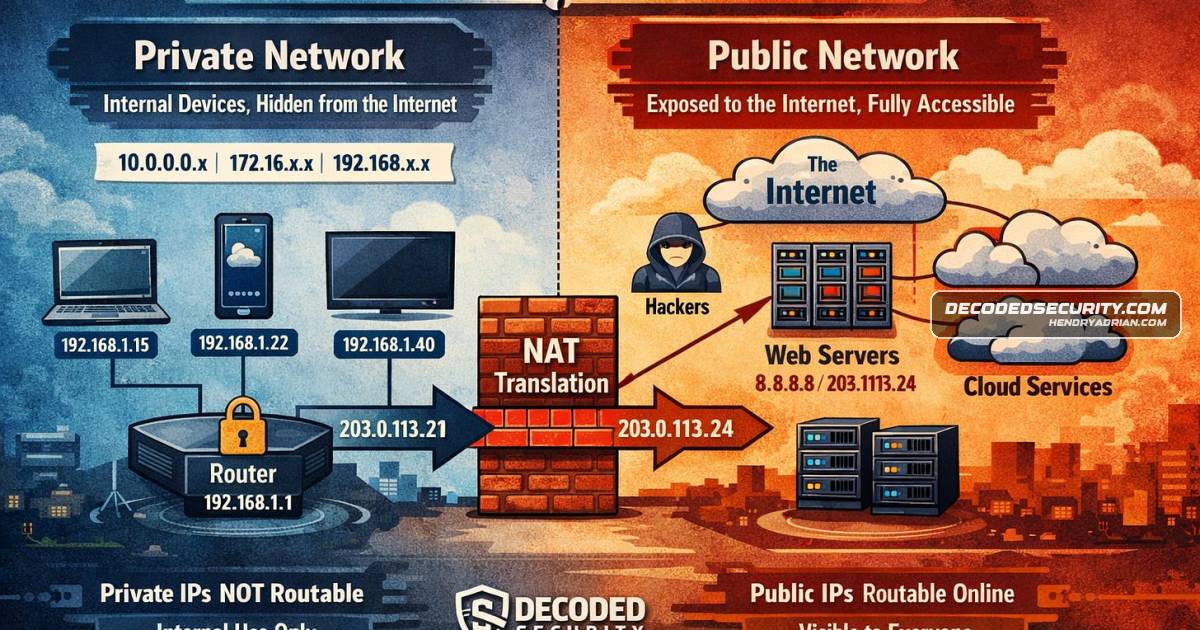
An explainer on public and private IP addresses and how NAT lets devices share a public address. It connects public-IP exposure and routine scanning to cybersecurity, while noting that private addresses were created to address IPv4 shortages, not as a security measure.
Key points
- IP addresses identify network locations so devices can send data to one another.
- Public IP addresses can receive internet traffic and are routinely scanned for exposed services and weaknesses.
- Private IP addresses are used within local networks and are not directly reachable from the internet.
- NAT translates traffic between private addresses and a shared public IP, then forwards responses to the appropriate internal device.
- The article emphasizes that private IP addresses were created to address the shortage of public IPv4 addresses, not as a security measure.
Article Details
- Topic
- Fundamentals of private and public IP addresses, NAT, and network segmentation