
GlassWorm’s ForceMemo Offshoot Uses Stolen GitHub Tokens to Inject Malware Into Python Repositories
Summary
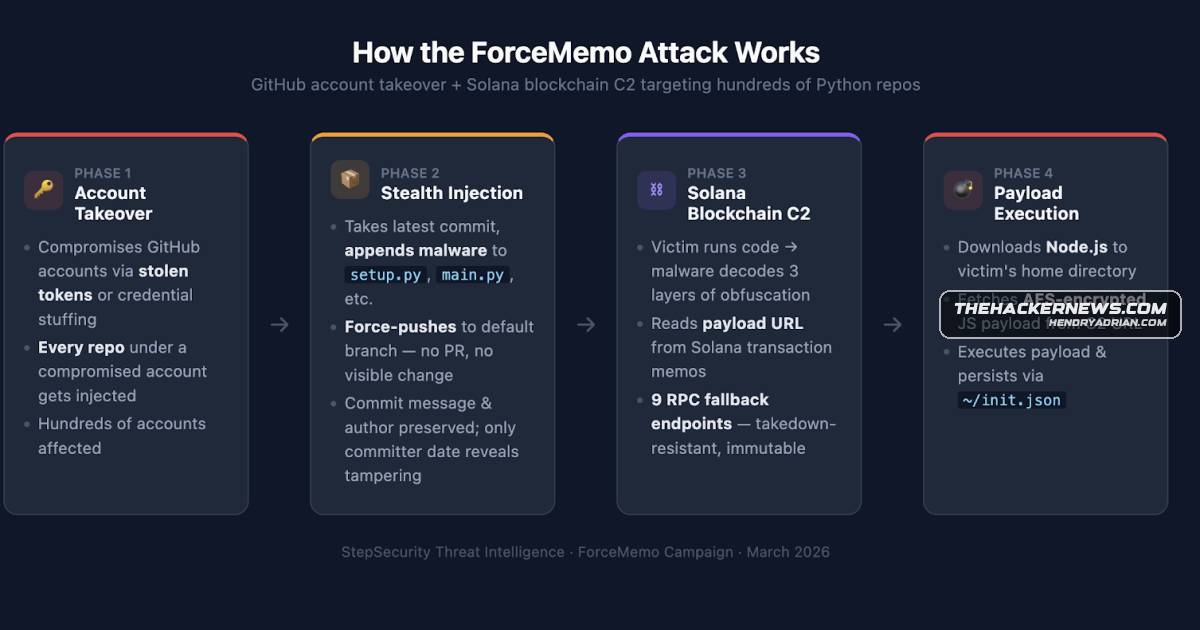
Researchers say GlassWorm’s ForceMemo offshoot uses tokens stolen through malicious VS Code and Cursor extensions to force-push obfuscated payloads into Python repositories, retrieving further payload URLs from a Solana transaction memo.
Key points
- StepSecurity says ForceMemo uses GitHub tokens stolen by GlassWorm malware delivered through malicious VS Code and Cursor extensions.
- The stolen tokens are reportedly used to force-push obfuscated code into Python files such as setup.py, main.py, and app.py across compromised repositories.
- The injected code checks for a Russian system locale and, otherwise, reads a payload URL from a Solana transaction memo.
- The payload reportedly downloads encrypted JavaScript and other files, including code designed to steal cryptocurrency and data.
- StepSecurity says the earliest observed repository injections date to March 8, 2026; the force-push method preserves commit metadata and can hide changes from GitHub’s visible history.
- Aikido separately linked a campaign affecting more than 151 GitHub repositories to the same Solana wallet, while Socket reported another GlassWorm distribution method using extension dependencies.
Article Details
- Event Type
- Software supply-chain attack using stolen GitHub tokens to force-push malware into Python repositories.
- Impact
- The article reports malicious code injected into hundreds of Python repositories. Users who install from a compromised repository or clone and execute its code may trigger additional payloads, including encrypted JavaScript designed to steal cryptocurrency and data; the article does not confirm successful theft.
MITRE ATT&CK
T1027 · Obfuscated Files or InformationThe injected payloads were obfuscated and Base64-encoded; the article also describes encrypted JavaScript payloads.T1105 · Ingress Tool TransferThe injected code reportedly retrieved a payload URL from a Solana transaction memo and downloaded additional payloads.T1195.001 · Compromise Software Dependencies and Development ToolsThe attackers reportedly used malicious VS Code and Cursor extensions to compromise developer systems and steal GitHub tokens.T1195.002 · Compromise Software Supply ChainThe attackers reportedly injected malware into Python repositories, exposing users who install or execute code from compromised repositories.T1528 · Steal Application Access TokenThe attackers reportedly stole GitHub access tokens from compromised developer systems and used them to modify repositories.T1565.001 · Stored Data ManipulationThe attackers reportedly rebased and force-pushed malicious changes to repository files, rewriting Git history.
Threat Actors
Malware
Products
CursorGlassWorm campaign’s ForceMemo offshoot uses stolen GitHub tokens — harvested via malicious VS Code and Cursor extensions — to force-push obfuscated, Base64-encoded payloads into hundreds of Python repositories byGitHubThe GlassWorm campaign’s ForceMemo offshoot uses stolen GitHub tokens — harvested via malicious VS Code and Cursor extensions — to force-push obfuscated, Base64-encoded payloads into hundreds of Python repositories byVS CodeThe GlassWorm campaign’s ForceMemo offshoot uses stolen GitHub tokens — harvested via malicious VS Code and Cursor extensions — to force-push obfuscated, Base64-encoded payloads into hundreds of Python repositories by