
GlassWorm Campaign Targets 433 GitHub, npm, and VSCode/OpenVSX Components
Summary
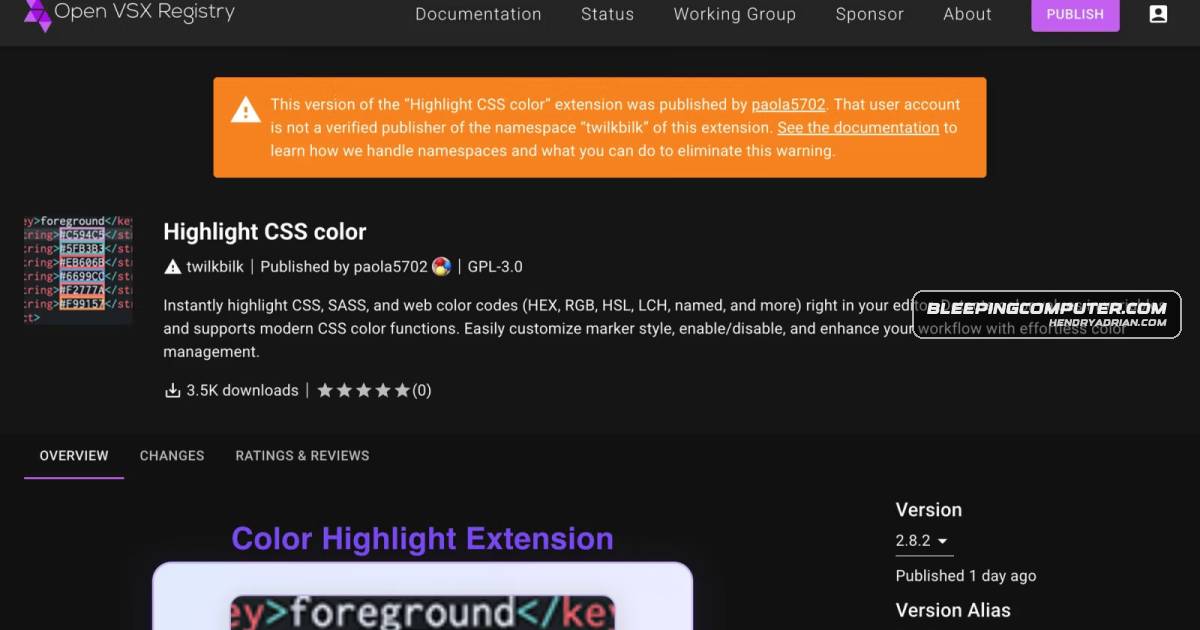
Researchers identified 433 components targeted by a renewed GlassWorm campaign. The malware uses compromised GitHub accounts, invisible Unicode obfuscation, and Solana-based C2 to deliver an information stealer; researchers also shared checks for possible compromise.
Key points
- Researchers identified 200 GitHub Python repositories, 151 GitHub JS/TS repositories, 72 VSCode/OpenVSX extensions, and 10 npm packages among 433 compromised components.
- The campaign uses compromised GitHub accounts to force-push malicious commits, then publishes malicious packages and extensions with invisible Unicode obfuscation.
- The malware queries the Solana blockchain for instructions, mainly to update payload URLs, and uses transaction memos to direct downloads and execution.
- The delivered Node.js-based JavaScript information stealer targets cryptocurrency wallet data, credentials, access tokens, SSH keys, and developer environment data.
- Researchers linked campaign activity through a shared Solana address, similar payloads, and shared infrastructure; the article says evidence is insufficient for confident attribution to Russia-speaking actors.
- Step Security recommends checking for the marker "lzcdrtfxyqiplpd", ~/init.json, unexpected ~/node-v22* installations, suspicious i.js files, and anomalous Git commit dates.
Article Details
- Event Type
- GlassWorm supply-chain malware campaign compromising open-source repositories, npm packages, and VSCode/OpenVSX extensions.
- Impact
- Researchers identified 433 compromised components: 200 GitHub Python repositories, 151 GitHub JS/TS repositories, 72 extensions, and 10 npm packages. The malware is described as targeting cryptocurrency wallet data, credentials, access tokens, SSH keys, and developer environment data; the article does not confirm that this information was successfully exfiltrated.
MITRE ATT&CK
T1027 · Obfuscated Files or InformationThe attackers used invisible Unicode characters to obfuscate malicious code and evade detection.T1059.007 · JavaScriptThe campaign delivered and executed a JavaScript-based information stealer.T1105 · Ingress Tool TransferThe instructions led to downloading the Node.js runtime and executing the information stealer.
People
Malware
Products
GitHubThe GlassWorm supply-chain campaign has resurfaced, compromising 433 open-source components across GitHub, npm, and VSCode/OpenVSX—including hundreds of Python and JS/TS repositories, extensions, and npm packages.Node.jspush obfuscated code (using invisible Unicode), use the Solana blockchain as a C2 channel to deliver a Node.js-based JavaScript information stealer that harvests crypto wallets, credentials, SSH keys and developernpmThe GlassWorm supply-chain campaign has resurfaced, compromising 433 open-source components across GitHub, npm, and VSCode/OpenVSX—including hundreds of Python and JS/TS repositories, extensions, and npm packages.OpenVSXThe GlassWorm supply-chain campaign has resurfaced, compromising 433 open-source components across GitHub, npm, and VSCode/OpenVSX—including hundreds of Python and JS/TS repositories, extensions, and npm packages.SolanaAttackers compromise GitHub accounts to push obfuscated code (using invisible Unicode), use the Solana blockchain as a C2 channel to deliver a Node.js-based JavaScript information stealer that harvests crypto wallets,VSCodeThe GlassWorm supply-chain campaign has resurfaced, compromising 433 open-source components across GitHub, npm, and VSCode/OpenVSX—including hundreds of Python and JS/TS repositories, extensions, and npm packages.