
VoidStealer Uses Hardware Breakpoints to Extract Chrome’s ABE Master Key
Summary
Gen Digital reports that VoidStealer uses hardware breakpoints and a debugger to capture Chrome’s plaintext v20_master_key from browser memory, bypassing Application-Bound Encryption without privilege escalation or code injection.
Key points
- Gen Digital says VoidStealer is the first infostealer observed in the wild using a debugger-based ABE bypass.
- The malware starts a suspended, hidden browser process, attaches as a debugger, and waits for chrome.dll or msedge.dll to load.
- It scans the browser DLL for a specific string and related LEA instruction, then sets hardware breakpoints on browser threads.
- When a breakpoint triggers during startup decryption, VoidStealer reads a register pointing to the plaintext v20_master_key and extracts it with ReadProcessMemory.
- The technique requires no privilege escalation or code injection, according to the report.
- Gen Digital says the method likely derives from the open-source ElevationKatz project; VoidStealer introduced the bypass in version 2.0.
Article Details
- Attack Vectors
- VoidStealer starts a suspended, hidden browser process and attaches to it as a debugger.
- It scans the loaded browser DLL for a specific string and a referencing LEA instruction, then sets hardware breakpoints on browser threads.
- When a breakpoint triggers during startup decryption, VoidStealer reads the register containing a pointer to the plaintext v20_master_key and extracts it with ReadProcessMemory.
- Defensive Notes
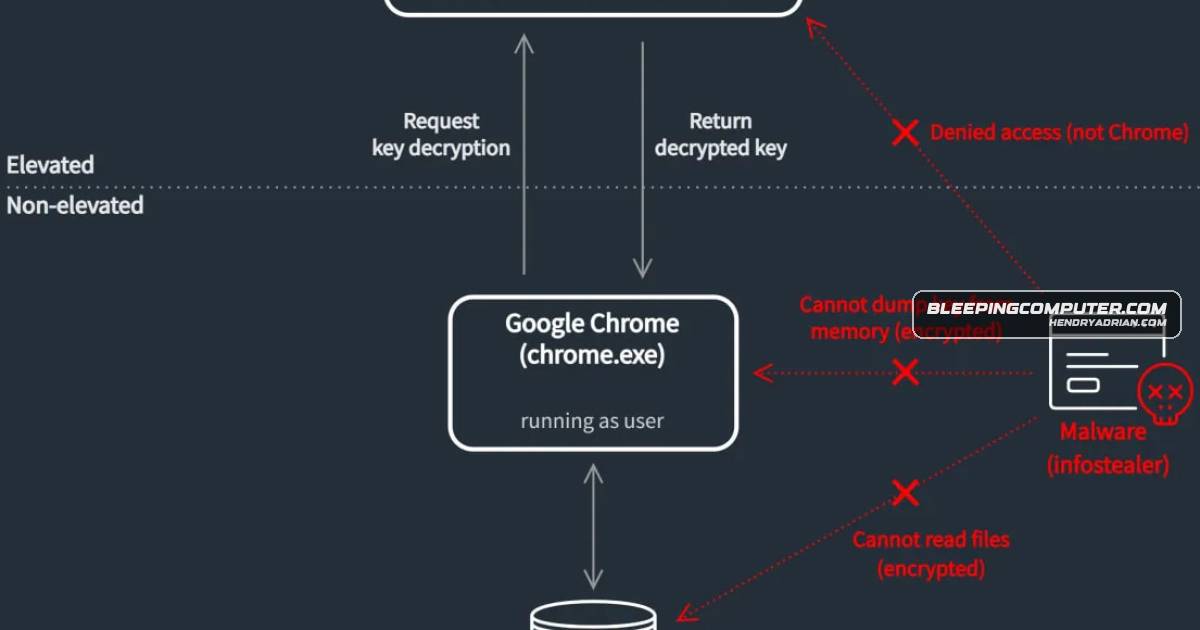
- Chrome's Application-Bound Encryption keeps the master key encrypted on disk and relies on the Google Chrome Elevation Service to validate requests to decrypt it.
- The article reports that Google implemented fixes and improvements against earlier ABE bypasses, but newer malware versions reportedly continued to succeed using other methods.
MITRE ATT&CK
People
Malware
Vendors
Products
Tools
ChromeKatzinvent this technique but rather adopted it from the open-source project ‘ElevationKatz,’ part of the ChromeKatz cookie-dumping toolset that demonstrates weaknesses in Chrome.ElevationKatzmaster key, and uses ReadProcessMemory to steal it, a technique likely adopted from the open-source ElevationKatz project.