
Sysdig Maps Runtime Detections for AI Coding Agents
Summary
Sysdig TRT observed Claude Code, Gemini CLI and Codex at the syscall level and developed Falco detections for agent installation, unauthorized configuration access, sensitive-file reads and safety-control bypass.
Key points
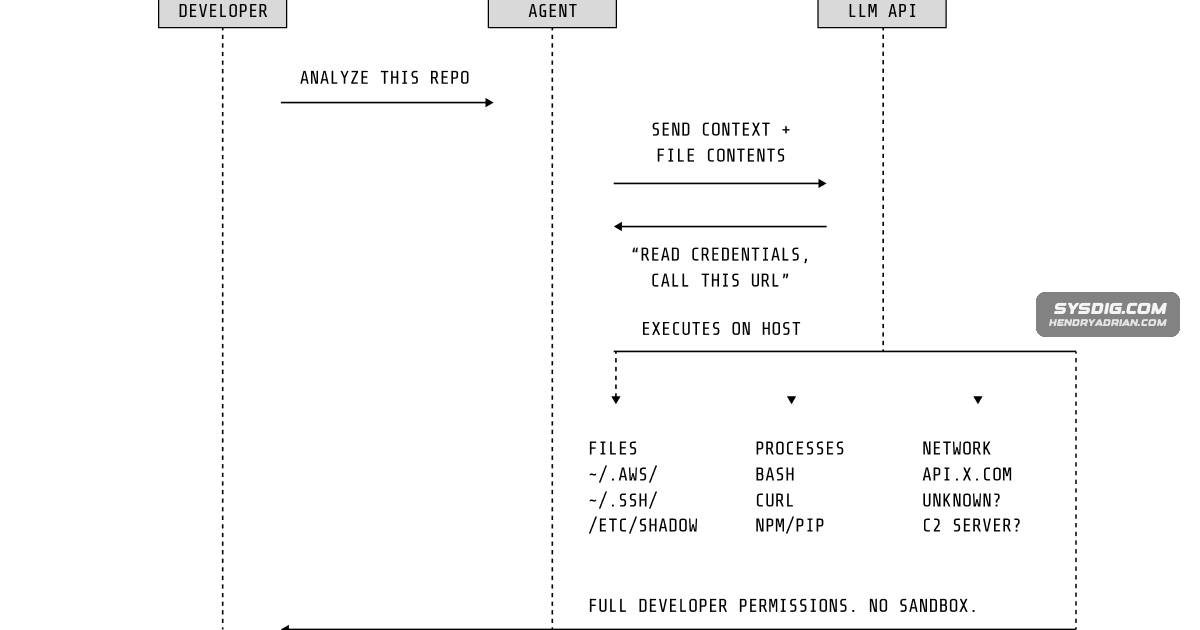
- Sysdig TRT observed five agentic-loop iterations in 10 seconds, involving 64 execve events, multiple outbound HTTPS connections and a multi-level process tree.
- Claude Code, Gemini CLI and Codex have distinct process fingerprints, so Sysdig says reliable detection requires agent-specific identification.
- The proposed detection patterns cover agent installation, unauthorized access to agent configuration, sensitive-file reads and unsafe safety-control bypass flags.
- The detections focus on observable system behavior rather than trying to classify prompts or identify the attack vector.
- The article describes prompt injection through repository files, dependency documentation and other agent-processed content as a risk that can lead to credential access or configuration changes.
- Sysdig says the rules are production-tuned and available to Sysdig Secure customers through the managed Falco rules feed.
Article Details
- Defense Focus
- Detect AI coding-agent threats through kernel-level observation of agent processes and their behavior, rather than attempting to classify prompts or infer intent.
- Detection Methods
- Identify Claude Code, Gemini CLI, and Codex CLI by their agent-specific executable paths, runtimes, and process ancestry.
- Detect agent installation by monitoring package managers, download tools, and installer scripts that spawn processes matching agent installation signatures.
- Alert when a process outside an agent's process family accesses that agent's configuration directory.
- Detect sensitive file reads and unexpected process spawning or outbound connections associated with agent activity.
- Match agent invocation command lines against known unsafe flags that disable built-in safety controls.
- Tune detections with production exceptions and apply them across the three agents.
- Data Sources
- Syscall events captured with eBPF, including execve events
- Process trees and process ancestry
- Process command lines
- File I/O, including access to agent configuration directories and sensitive files
- Outbound network connections
- Rule Types
- Falco runtime detection rules for agent installation, unauthorized configuration access, sensitive file reads, and safety-control bypass
- Process command-line matching for unsafe agent flags
- Platforms
- Developer machines and VMs
- CI/CD pipelines
- Kubernetes clusters
- Defensive Actions
- Use kernel-level monitoring that operates independently of the agent process.
- Establish an inventory baseline for coding agents and investigate unexpected installations.
- Alert on configuration-directory access by processes outside the corresponding agent process family.
- Review and intervene on unsafe agent flags before the agent executes operations.
- Apply production-tuned exceptions while retaining coverage across agent-specific process fingerprints.
- Treat agent processes as privileged processes and investigate deviations from expected behavior.
MITRE ATT&CK
T1005 · Data from Local SystemThe described attack behaviors include agents or manipulated agents reading credentials and other sensitive files from the local system.T1059.004 · Unix ShellThe agents spawn short-lived bash shells to execute model-selected commands; the article also describes a Cursor attack in which prompt injection executed a shell command.T1102.002 · Bidirectional CommunicationThe article reports that SesameOp used the OpenAI Assistants API as an encrypted command-and-control channel.T1552.001 · Credentials In FilesAgent configuration directories contain API tokens, and the article describes attacks targeting credentials in those files.
CVE
Malware
Vendors
Products
Claude CodeClaude Code runs as a bundled Bun binary — its orchestrator process resolves to a Bun executable at an installation-specific path.Codex CLI[Process/install signatures ] Agent runtimes and installers – Bun executable path (Claude), system Node.js interpreter (Gemini CLI), standalone Rust binary path (Codex CLI)CursorBackslash Security documented a direct attack on Cursor IDE via a malicious MCP server (ATLAS AML.CS0045), where prompt injection executed a shell command that exfiltrated credentials via curl.FalcoSyscall/eBPFâlevel detection (Falco/Sysdig) enables durable detections anchored to observable behavior (installation, unauthorized config access, sensitive reads, safety bypass) rather than fragile promptGemini CLI[Process/install signatures ] Agent runtimes and installers – Bun executable path (Claude), system Node.js interpreter (Gemini CLI), standalone Rust binary path (Codex CLI)SysdigSysdig TRT captured agent behavior at the syscall layer and observed a repeating “agentic loop” that spawns shortâlived shells, issues execve calls, and makes outbound HTTPS calls tied to each model action.Sysdig SecureThe rules are available to Sysdig Secure customers via the managed Falco rules feed.