
Denial-of-Wallet Attacks Can Drain AI Cloud Budgets Without Causing Outages
Summary
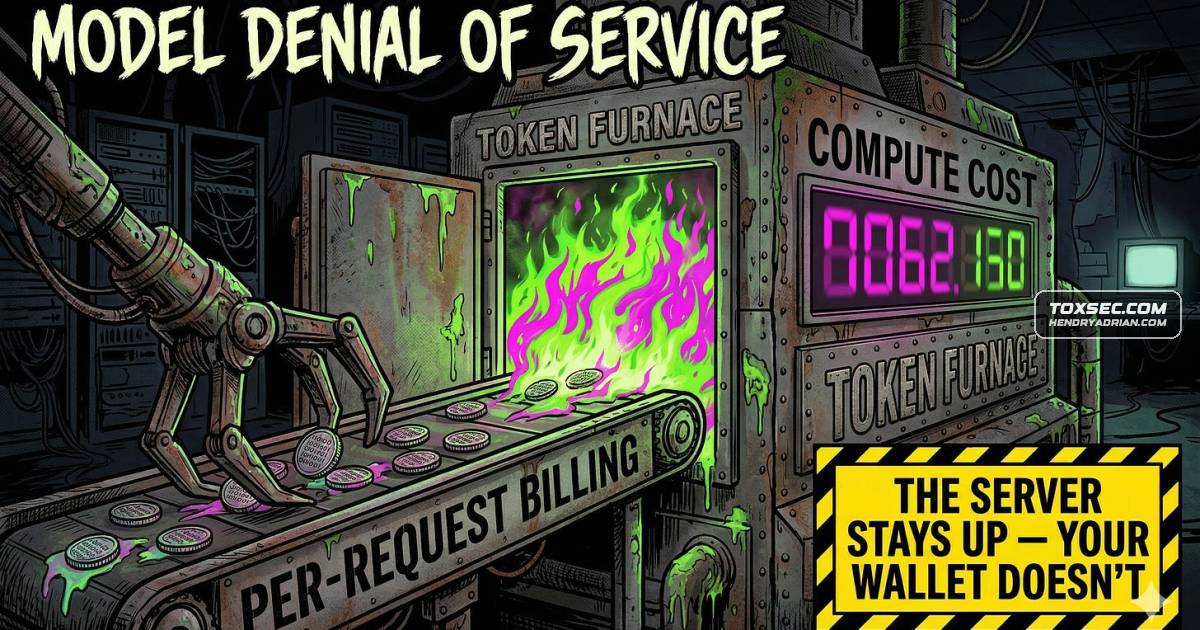
Denial-of-wallet attacks exploit per-token AI billing to inflate cloud costs while services remain online. The article describes token-amplifying techniques, reported LLMjacking losses, and defenses including token-based limits, spending caps, alerts, and credential**?
Key points
- Denial-of-wallet attacks exploit per-token billing to drive up cloud costs without necessarily taking AI services offline.
- The article describes context-window flooding, recursive prompting, and reasoning-loop exploitation as ways to increase token use.
- Sysdig documented LLMjacking on AWS Bedrock, with reported consumption costs exceeding $46,000 per day.
- A developer reportedly described an $82,000 Gemini API bill over 48 hours after a key was stolen; this account is not independently verified in the article.
- Request-based rate limits may miss cost differences between requests; the article recommends token-aware limits, hard spending caps, billing anomaly alerts, and stronger credential protection.
Article Details
- Defense Focus
- Detect and limit denial-of-wallet attacks by monitoring token-driven costs and protecting cloud and LLM credentials.
- Detection Methods
- Track token consumption per user rather than relying only on request counts.
- Monitor billing and token usage for abnormal spikes, including usage that rises while request rates remain within traditional limits.
- Data Sources
- Per-user token consumption
- Cloud billing and usage data
- API request-rate data
- Defensive Actions
- Implement cost-aware rate limits based on token consumption.
- Set hard spending caps on cloud accounts.
- Configure billing anomaly alerts to flag unusual usage before costs escalate.
- Strengthen protection of cloud and LLM API credentials.
MITRE ATT&CK
Vendors
Amazon Web ServicesReal-world LLMjacking incidents on services like AWS Bedrock and Google Gemini show six-figure bills in days, so teams must deploy cost-aware rate limiting, hard spending caps, billing anomaly alerts, and strongerGoogleReal-world LLMjacking incidents on services like AWS Bedrock and Google Gemini show six-figure bills in days, so teams must deploy cost-aware rate limiting, hard spending caps, billing anomaly alerts, and stronger
Products
AWS BedrockReal-world LLMjacking incidents on services like AWS Bedrock and Google Gemini show six-figure bills in days, so teams must deploy cost-aware rate limiting, hard spending caps, billing anomaly alerts, and strongerGoogle GeminiReal-world LLMjacking incidents on services like AWS Bedrock and Google Gemini show six-figure bills in days, so teams must deploy cost-aware rate limiting, hard spending caps, billing anomaly alerts, and stronger