
EtherRAT Uses Ethereum Smart Contracts for C2 and Collects Extensive Host Data
Summary
eSentire analyzed EtherRAT, a Node.js backdoor found at a retail customer in March 2026. It retrieves C2 addresses from Ethereum contracts, uses CDN-like HTTPS beacons, and runs a SYS_INFO module for host fingerprinting.
Key points
- eSentire TRU detected EtherRAT in a retail customer environment in March 2026; its analysts isolated the affected host and supported remediation.
- In the observed case, ClickFix used pcalua.exe to launch mshta.exe and retrieve a malicious HTA; other EtherRAT incidents used Microsoft Teams IT Support scams and QuickAssist.
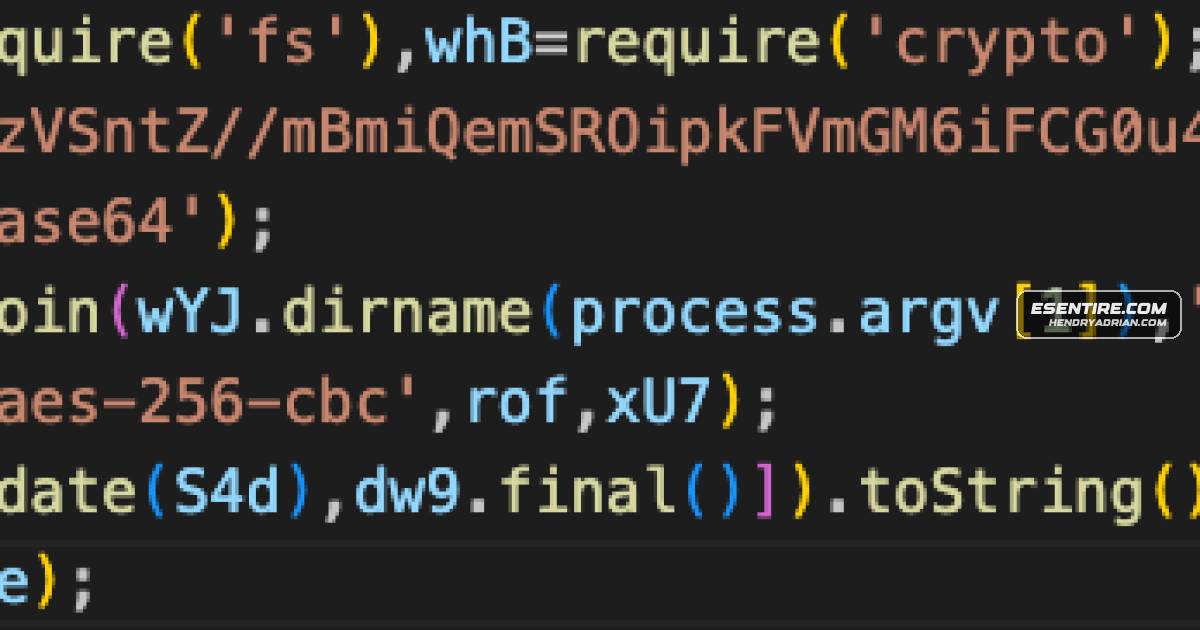
- The malware uses AES-256-CBC across staged Node.js payloads, Obfuscator.io obfuscation, and an HKCU Run key for persistence, with conhost.exe proxying node.exe.
- EtherRAT queries Ethereum RPC providers for C2 addresses stored in a smart contract; setString events can update those addresses.
- The backdoor polls C2 over HTTPS using CDN-like URL patterns, supports remote command execution, and can send its source code to C2 for reobfuscation.
- A C2-delivered SYS_INFO module collects extensive host, user, operating-system, network, and security-product details; it exits if it detects specified CIS-region languages.
- The article says EtherRAT can steal cryptocurrency wallets and cloud credentials and was reportedly linked by Sysdig to a North Korean APT through overlaps with Contagious Interview tactics.
Article Details
- Attack Vectors
- In the observed case, ClickFix used pcalua.exe to launch mshta.exe and retrieve the malicious shep.hta file from a compromised website.
- TRU reports that IT Support scams over Microsoft Teams, followed by QuickAssist remote access, occur in many other EtherRAT incidents.
- The malware stages decrypt Node.js code and execute it; the later stage writes and launches EtherRAT, which can execute commands, collect host information, and steal assets including cryptocurrency wallets and cloud credentials.
- EtherRAT establishes persistence with an HKCU Run value that uses conhost.exe to proxy-execute node.exe. It retrieves C2 addresses from Ethereum smart-contract data and polls C2 over HTTPS using CDN-like URLs.
- A C2-delivered SYS_INFO module checks for specified CIS-region languages and, if one matches, deletes itself and exits; otherwise, it collects extensive system and security-software information.
- Defensive Notes
- eSentire recommends disabling mshta.exe and pcalua.exe through AppLocker Group Policy or Windows Defender Application Control.
- eSentire recommends disabling the Run prompt through Group Policy and providing phishing and security-awareness training that covers ClickFix and IT Support scams.
- eSentire recommends blocking crypto-network RPC providers used by threat actors for payload staging.
- eSentire's SOC analysts isolated the affected host; the team also reported ongoing monitoring of EtherRAT campaigns and development of detection content.
Indicators of compromise
| Type | Indicator | Context |
|---|---|---|
| DOMAIN | aurineuroth[.]com | EtherRAT C2 domain observed returning the SYS_INFO module. |
| DOMAIN | euclidrent[.]com | Listed as an EtherRAT C2 domain. |
| DOMAIN | hayesmed[.]com | Listed as an EtherRAT C2 domain. |
| DOMAIN | jariosos[.]com | Listed as an EtherRAT C2 domain. |
| DOMAIN | justtalken[.]com | Listed as an EtherRAT C2 domain. |
| DOMAIN | mebeliotmasiv[.]com | Listed as an EtherRAT C2 domain. |
| DOMAIN | o-parana[.]com | Listed as an EtherRAT C2 domain. |
| DOMAIN | palshona[.]com | Listed as an EtherRAT C2 domain. |
| DOMAIN | regancontrols[.]com | Listed as an EtherRAT C2 domain. |
| DOMAIN | salinasrent[.]com | Listed as an EtherRAT C2 domain. |
| IPV4 | 185[.]218[.]19[.]162 | C2 IP address associated with aurineuroth.com. |
| SHA256 | 03c4e54cc775ab819752dc5d420ab2fed03bd445c3ce398d021031100b334fb4 | Hash of deobfuscated EtherRAT. |
| SHA256 | 294c597c89023093e1e175949f5104f887b89cd8e1cf1d3192ee9032739f259e | Hash of the EtherRAT MSI loader. |
| SHA256 | 2edf1ab615b489e228a89c617d24f66d1e780a6d5e30f6886608dfe79325acf8 | Hash of the EtherRAT HTA script shep.hta. |
| SHA256 | 47f74749cfcd55c8dacde2cc9b4c45282bec7a93ee19b7b81b452c99758d3370 | Hash of obfuscated EtherRAT stage 2. |
| SHA256 | 5623f4f8942872b2b7cb6d2674c126a42bdf6ed5d1f37c1afc348529e4697d73 | Hash of EtherRAT stage 1. |
| SHA256 | 7dd1bf7a58774a081062f5c8f183d24f95c433805e0bf73280c0adba1c71390d | Hash of obfuscated EtherRAT. |
| SHA256 | 83b1f11c6a0bd267e415136440559131d2d4ace9a65dc221ea3b144fe0e7199b | Hash of the EtherRAT SYS_INFO module. |
| SHA256 | b1ee812e7c786c8696f913595658e57706d97a66ca7b7634f421f5c552e7002b | Hash of deobfuscated EtherRAT stage 2. |
| URL | hxxps[:]//aurineuroth[.]com/api/5f459179/29e96c95-62a5-49e5-a8ba-7ebfbf560ab7/b435a6b1.ico?b=9e2f9c07-f85a-4089-8669-186f56bca7b3 | EtherRAT HTTPS beacon URL used to communicate with C2. |
| URL | hxxps[:]//www-flow-submission-management[.]shepherdsestates[.]uk/shep.hta | Malicious HTA delivery URL hosted on a website identified as compromised. |
MITRE ATT&CK
T1012 · Query RegistryThe module queried registry values for Windows product information and the machine hardware identifier.T1016 · System Network Configuration DiscoveryThe SYS_INFO module collected the victim's public IP and MAC address.T1027 · Obfuscated Files or InformationObfuscator.io was used to obfuscate EtherRAT stages.T1033 · System Owner/User DiscoveryThe SYS_INFO module collected the current username.T1057 · Process DiscoveryOn Linux and macOS, ps aux listed running processes for antivirus identification.T1059.001 · PowerShellPowerShell commands collected host language, GPU, antivirus, domain, and operating-system information.T1059.003 · Windows Command Shellcmd.exe command lines launched the ClickFix chain and ran discovery and persistence commands.T1059.007 · JavaScriptNode.js JavaScript stages decrypted and executed the malware, including through module._compile() and child_process.spawn().T1071.001 · Web ProtocolsEtherRAT polled C2 over HTTPS using randomized CDN-like beacon URLs.T1082 · System Information DiscoveryThe SYS_INFO module collected operating-system name, release, platform, and architecture.T1105 · Ingress Tool Transfercurl downloaded a portable Node.js runtime archive used to stage the malware environment.T1204 · User ExecutionThe reported initial access involved ClickFix or, in other incidents, IT Support scams prompting users to allow QuickAssist access.T1218.005 · MshtaThe ClickFix command used pcalua.exe to launch mshta.exe and retrieve the malicious HTA.T1518.001 · Security Software DiscoveryThe module queried Windows antivirus products and checked process names for antivirus software on Linux and macOS.T1547.001 · Registry Run Keys / Startup FolderEtherRAT persistence used an HKCU Run value to launch node.exe through conhost.exe.
Malware
EtherRATeSentire TRU discovered EtherRAT, a Node.js backdoor that retrieves C2 addresses from Ethereum smart contracts (EtherHiding), performs extensive host fingerprinting, and uses CDN-like HTTPS beaconing to blend maliciousTsundere BotnetTRU discovered many similarities between the code in the Malware-as-a-Service botnet Tsundere and EtherRAT.
Vendors
Products
EthereumeSentire TRU discovered EtherRAT, a Node.js backdoor that retrieves C2 addresses from Ethereum smart contracts (EtherHiding), performs extensive host fingerprinting, and uses CDN-like HTTPS beaconing to blend maliciousMicrosoft TeamsInitial access observed included ClickFix (LOLBin pcalua.exe -> mshta.exe indirect execution) and social-engineering IT Support scams over Microsoft Teams with QuickAssist for remote access.Node.jseSentire TRU discovered EtherRAT, a Node.js backdoor that retrieves C2 addresses from Ethereum smart contracts (EtherHiding), performs extensive host fingerprinting, and uses CDN-like HTTPS beaconing to blend maliciousQuickAssistInitial access observed included ClickFix (LOLBin pcalua.exe -> mshta.exe indirect execution) and social-engineering IT Support scams over Microsoft Teams with QuickAssist for remote access.
Tools
CyberChefUsing CyberChef we can see the decrypted plaintext of the next stage. This is a simple process, first by using the AES Decrypt operation and specifying the embedded AES key / IV as BASE64.obfuscator-io-deobfuscatorgit clone https://github.com/YungBinary/obfuscator-io-deobfuscator.gitObfuscator.ioThe campaign involved initial access via ClickFix and IT Support scams (pcalua.exe -> mshta.exe), persistence via HKCU Run with conhost proxying node.exe, and widespread use of Obfuscator.io for code obfuscation.
Industries
business servicesdata related to EtherRAT and has also been associated with attacks against other customers in the Business Services, Software, and Finance industries. These campaigns have involved IT Support scams conducted viafinancehas also been associated with attacks against other customers in the Business Services, Software, and Finance industries. These campaigns have involved IT Support scams conducted via Microsoft Teams and QuickAssistRetaileSentire TRU detected EtherRAT in a Retail customer environment; EtherRAT is a Node.js backdoor enabling arbitrary command execution and asset theft (cryptocurrency wallets, cloud credentials).Softwareto EtherRAT and has also been associated with attacks against other customers in the Business Services, Software, and Finance industries. These campaigns have involved IT Support scams conducted via Microsoft Teams