
Progress ShareFile Flaws Enable Unauthenticated RCE Through Chained Exploits
Summary
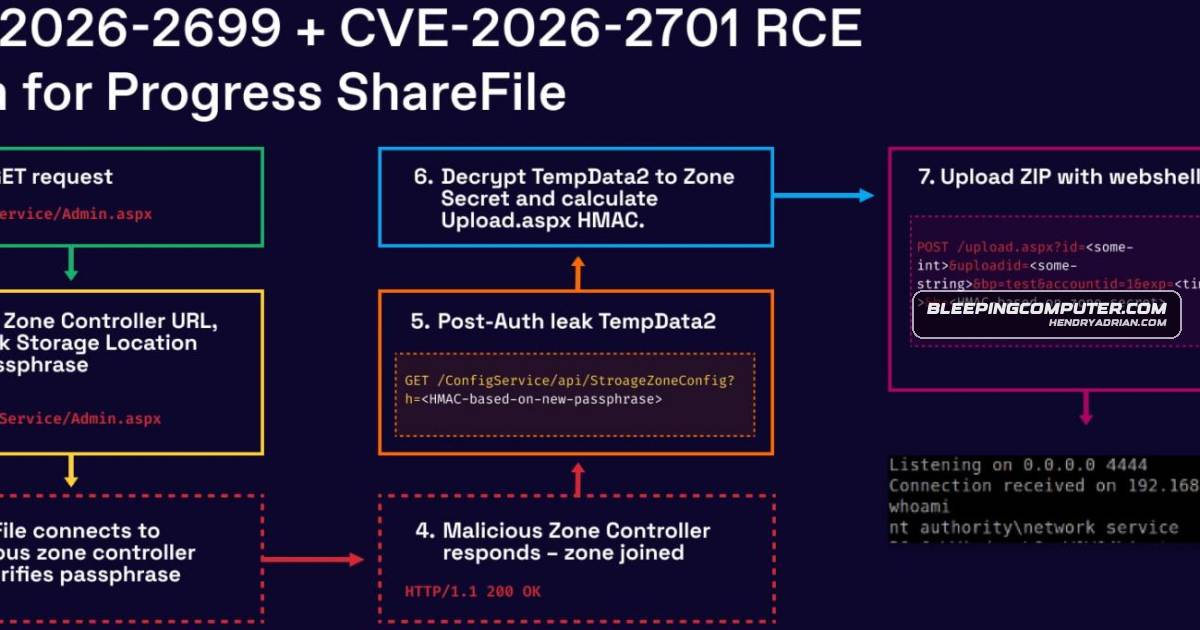
watchTowr says two ShareFile Storage Zones Controller flaws can be chained for unauthenticated access and remote code execution. Progress fixed them in version 5.12.4; no active exploitation was observed.
Key points
- CVE-2026-2699 is an authentication bypass that can expose the ShareFile admin interface.
- Researchers say attackers can use the bypass to modify storage-zone settings and control passphrase-related values and secrets.
- CVE-2026-2701 enables remote code execution by abusing file upload and extraction to place ASPX webshells in the application webroot.
- The flaws affect the Storage Zones Controller component in ShareFile branch 5.x.
- Progress fixed the vulnerabilities in ShareFile 5.12.4; exposed instances should be updated.
- No active exploitation had been observed at the time of the report. watchTowr estimated about 30,000 exposed instances, while Shadowserver observed 700.
Article Details
- Vulnerability Types
- Authentication bypass
- Remote code execution
- Severity
- Unknown
- Affected Versions
- Progress ShareFile Storage Zones Controller 5.x
- Exploitation Status
- not_reported
- Exploit Availability
- unknown
- Patch Status
- available
MITRE ATT&CK
CVE
CVE-2026-2699Progress · ShareFile Storage Zones ControllerThe flaws (CVE-2026-2699 and CVE-2026-2701) were reported by watchTowr and fixed in Progress ShareFile 5.12.4 on March 10, but exposed instances should be patched immediately.CVE-2026-2701Progress · ShareFile Storage Zones ControllerThe flaws (CVE-2026-2699 and CVE-2026-2701) were reported by watchTowr and fixed in Progress ShareFile 5.12.4 on March 10, but exposed instances should be patched immediately.
Vendors
Products
Progress ShareFileTwo vulnerabilities in Progress ShareFile’s Storage Zones Controller can be chained to enable unauthenticated file exfiltration and remote code execution on affected systems.Storage Zones ControllerTwo vulnerabilities in Progress ShareFile’s Storage Zones Controller can be chained to enable unauthenticated file exfiltration and remote code execution on affected systems.