
Citizen Lab Reports Law Enforcement Use of Webloc for Mass Location Tracking
Summary
Citizen Lab reports that agencies in several countries use Webloc, an ad-based location intelligence system with data from up to 500 million devices. The researchers raise oversight concerns; Penlink disputes the report’s accuracy.
Key points
- Citizen Lab attributes Webloc use to Hungarian intelligence, El Salvador’s national police, and U.S. law-enforcement agencies.
- The system uses mobile-app and digital-advertising data, with records containing device identifiers, location coordinates, and profile information.
- The article says customers can query location histories up to three years in the past and use IP addresses and other data to infer identities.
- Reported U.S. customers include ICE, the U.S. military, state agencies, and local police departments.
- Prior reporting and procurement information cited in the article indicate Webloc can support continuous monitoring of mobile advertising IDs and geolocated IP addresses without a warrant.
- Citizen Lab raises legal and oversight concerns and identifies 219 active servers associated with Cobwebs product deployments.
- Penlink disputes the report’s accuracy and says it complies with U.S. state privacy laws.
Article Details
- Event Type
- Citizen Lab report on the use of Webloc, an advertising-based geolocation surveillance system, by law enforcement, intelligence, and military agencies.
- Impact
- Webloc is reported to provide data from up to 500 million mobile devices, including identifiers, location coordinates, and profile data, and to support location-history queries reaching three years into the past. Reporting indicates the system can enable continuous monitoring without a warrant; Citizen Lab raised legal and oversight concerns, while Penlink disputes the report's accuracy and says it complies with U.S. state privacy laws.
People
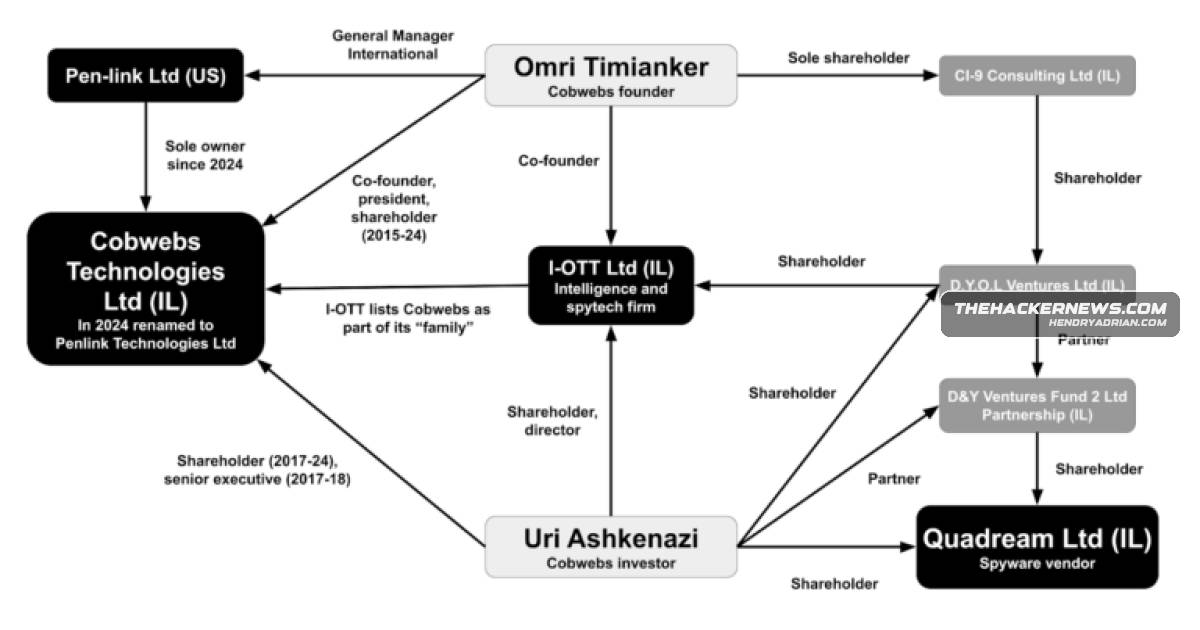
Astrid PerryCitizen Lab researcher credited with the report on Webloc's surveillance capabilities and use.Luis Fernando GarciaCitizen Lab researcher credited with the report on Webloc's surveillance capabilities and use.Omri TimiankerIdentified as Cobwebs Technologies' founder and former president, and as the person through whom the company was linked to Quadream; he now oversees Penlink's international operations.Ron DeibertCitizen Lab researcher credited with the report on Webloc's surveillance capabilities and use.Siena AnstisCitizen Lab researcher credited with the report on Webloc's surveillance capabilities and use.Wolfie ChristlCitizen Lab researcher credited with the report on Webloc's surveillance capabilities and use.
Vendors
Cobwebs TechnologiesLab reports that Webloc, an advertising-based global geolocation surveillance system developed by Cobwebs Technologies and now sold by Penlink, is being used by Hungarian domestic intelligence, El Salvador’s nationalPenlinkglobal geolocation surveillance system developed by Cobwebs Technologies and now sold by Penlink, is being used by Hungarian domestic intelligence, El Salvador’s national police, and multiple U.S.QuaDreamCitizen Lab flagged legal and oversight concerns and mapped servers and corporate links (including ties to Quadream), while Penlink contests the report’s accuracy.
Products
Tangles“Webloc is sold as an add-on product to the social media and web intelligence system Tangles,” Citizen Lab researchers Wolfie Christl, Astrid Perry, Luis Fernando Garcia, Siena Anstis, and Ron Deibert said.WeblocCitizen Lab reports that Webloc, an advertising-based global geolocation surveillance system developed by Cobwebs Technologies and now sold by Penlink, is being used by Hungarian domestic intelligence, El Salvador’s
Countries
BangladeshThe social media giant revealed at the time that it had identified Cobwebs Technologies customers in Bangladesh, Hong Kong, the United States, New Zealand, Mexico, Saudi Arabia, and Poland.El Salvadorby Cobwebs Technologies and now sold by Penlink, is being used by Hungarian domestic intelligence, El Salvador’s national police, and multiple U.S.Germany(126), Netherlands (32), Singapore (17), Germany (8), Hong Kong (8), and the U.K.Hong KongThe social media giant revealed at the time that it had identified Cobwebs Technologies customers in Bangladesh, Hong Kong, the United States, New Zealand, Mexico, Saudi Arabia, and Poland.MexicoThe social media giant revealed at the time that it had identified Cobwebs Technologies customers in Bangladesh, Hong Kong, the United States, New Zealand, Mexico, Saudi Arabia, and Poland.Netherlands(126), Netherlands (32), Singapore (17), Germany (8), Hong Kong (8), and the U.K.New ZealandThe social media giant revealed at the time that it had identified Cobwebs Technologies customers in Bangladesh, Hong Kong, the United States, New Zealand, Mexico, Saudi Arabia, and Poland.PolandThe social media giant revealed at the time that it had identified Cobwebs Technologies customers in Bangladesh, Hong Kong, the United States, New Zealand, Mexico, Saudi Arabia, and Poland.Saudi ArabiaThe social media giant revealed at the time that it had identified Cobwebs Technologies customers in Bangladesh, Hong Kong, the United States, New Zealand, Mexico, Saudi Arabia, and Poland.Singapore(126), Netherlands (32), Singapore (17), Germany (8), Hong Kong (8), and the U.K.United Kingdom(126), Netherlands (32), Singapore (17), Germany (8), Hong Kong (8), and the U.K.United Statesby Penlink, is being used by Hungarian domestic intelligence, El Salvador’s national police, and multiple U.S.
Industries
intelligencesystem developed by Cobwebs Technologies and now sold by Penlink, is being used by Hungarian domestic intelligence, El Salvador’s national police, and multiple U.S.Law enforcementlaw enforcement agencies. The tool aggregates data from mobile apps and digital advertising to track up to 500 million devices historically and infer locations and identities, findings that Penlink disputes.Militarymilitary units, state police, and many city and county departments—can query location histories up to three years back and infer identities.