
UNC1069 Uses Fake Meetings to Deploy Cross-Platform RATs and Capture Victim Media
Summary
Validin details UNC1069 fake-meeting lures against crypto and Web3 targets, browser-based audio/video capture, and Windows, macOS and Linux payload chains deploying apparent updated Cabbage RAT variants and, on macOS, a sample identified as NukeSped.
Key points
- The article describes UNC1069, a North Korean actor, using fabricated venture-capital personas and LinkedIn or Telegram outreach to lure cryptocurrency and Web3 professionals into fake meetings.
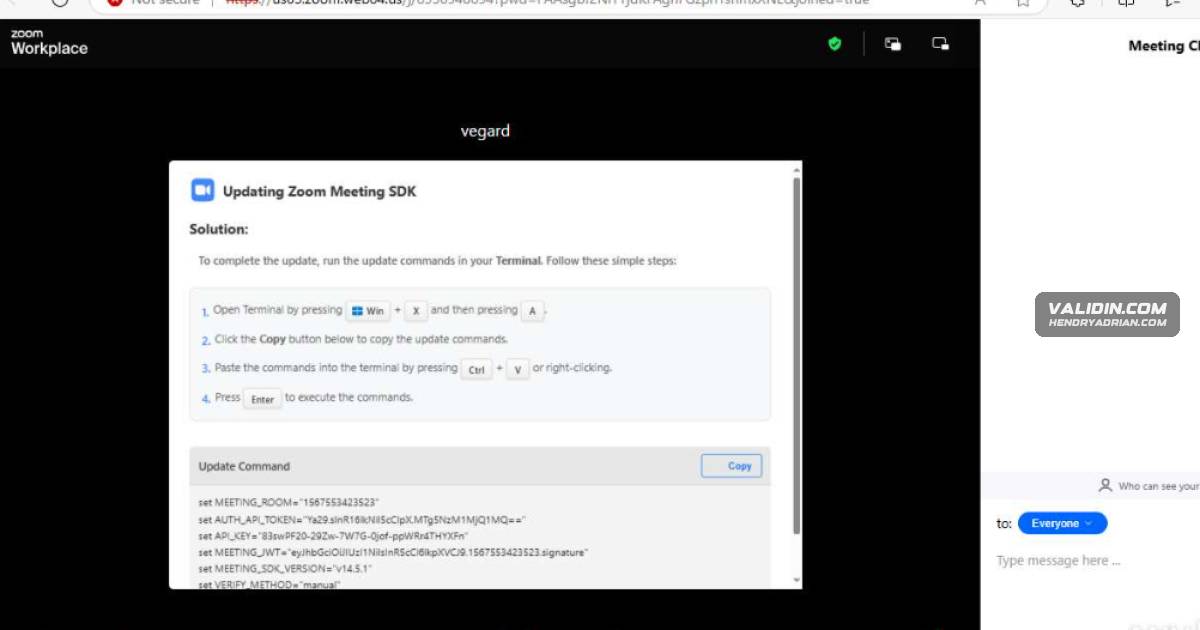
- Fake meeting pages imitate Zoom, Google Meet or Microsoft Teams and use ClickFix prompts or purported SDK and driver updates to persuade victims to run commands.
- A JavaScript sample requests microphone and camera access, streams media using WebRTC and a WebSocket signaling channel, and can record it locally for potential reuse in social engineering.
- The reported payload chains use Windows PowerShell and VBS, macOS Mach-O or Perl, and Linux ELF downloaders to retrieve additional components; the malware appears to include updated Cabbage RAT variants.
- A Windows VBS variant adds Startup-folder persistence and Chrome-extension enumeration; the article says this could help identify cryptocurrency wallet extensions.
- The macOS downloader removes quarantine attributes and applies ad-hoc signatures. A downloaded Mach-O RAT is classified by current detections as NukeSped.
- Researchers used DNS pivots and lookalike-domain searches to identify infrastructure, while noting that naming-pattern matches require validation before being linked to the campaign.
Article Details
- Attack Vectors
- UNC1069 uses fabricated venture-capital personas and out-of-band contact through LinkedIn and Telegram to build rapport with cryptocurrency and Web3 professionals, then sends meeting-scheduling links.
- Victims are directed to attacker-controlled meeting pages impersonating Zoom, Google Meet, or Microsoft Teams. ClickFix prompts and fake missing-SDK or driver-update messages pressure them to execute commands or downloaders.
- Browser JavaScript requests microphone and camera access, streams media over WebRTC/WebSocket, and can record it locally for later social engineering.
- OS-specific downloaders retrieve secondary payloads: PowerShell and VBS on Windows, Mach-O or Perl on macOS, and ELF on Linux. Reported payloads include Cabbage RAT variants and NukeSped.
- The Windows VBS variant can persist through a shortcut in the Startup folder, collect host data and running processes, and enumerate Chrome extensions. The Linux RAT also collects and exfiltrates host telemetry.
- Defensive Notes
- Verify meeting links and the meeting provider’s domain through a trusted channel before joining; the article reports attacker-controlled pages impersonating legitimate meeting services.
- Do not paste or execute terminal commands from meeting troubleshooting prompts, or install purported meeting SDKs or drivers from those pages.
- Review unexpected browser microphone and camera permission requests, particularly on pages reached through unsolicited meeting invitations.
Indicators of compromise
| Type | Indicator | Context |
|---|---|---|
| DOMAIN | meet[.]googleapps[.]eu[.]org | Listed as an example attacker-controlled lookalike meeting domain. |
| DOMAIN | web05meet[.]us | Listed as an attacker-controlled fake meeting domain used in the campaign. |
| DOMAIN | zoom[.]05ukweb[.]uk | Attacker-associated fake meeting domain; the article identifies it as the WebSocket media relay and C2 domain. |
| DOMAIN | zoom[.]us07-web[.]us | Attacker-controlled infrastructure used by a macOS downloader to retrieve payloads and beacon. |
| DOMAIN | zoom[.]web05meet[.]us | Listed as an example attacker-controlled lookalike meeting domain. |
| IPV4 | 104[.]168[.]143[.]111 | Listed as infrastructure hosting campaign C2 or payloads. |
| IPV4 | 108[.]174[.]198[.]11 | Listed as infrastructure hosting campaign C2 or payloads. |
| IPV4 | 144[.]172[.]114[.]220 | Listed as infrastructure hosting campaign C2 or payloads. |
| IPV4 | 144[.]172[.]116[.]9 | Listed as infrastructure hosting campaign C2 or payloads. |
| IPV4 | 23[.]254[.]167[.]21 | Listed as infrastructure hosting campaign C2 or payloads. |
| IPV4 | 45[.]61[.]129[.]29 | Listed as infrastructure hosting campaign C2 or payloads. |
| IPV4 | 45[.]61[.]157[.]248 | Attacker infrastructure embedded in a Perl downloader and used to retrieve payloads. |
| SHA256 | 0ed9a9b7923df0bad0be9ac7fe8ecb6a669715823f892d034b8d07ce9e0aa164 | Hash of the second PowerShell downloader. |
| SHA256 | 1c715cd40331ba2ca6559d2fdb958e7f44053080f9ffd3d90bd1916978d336cb | Hash of the first Mach-O downloader. |
| SHA256 | 48db089cf31488bcf0493e9deda3d21272c57f3be4f9031febda915f19191cdc | Hash of a Perl downloader used in the macOS infection chain. |
| SHA256 | 5cdec83048aba45a5a635f470c602c0f29fadeef5d3d5e7dc88291b1588b8dcc | Hash of a VBS Cabbage RAT payload. |
| SHA256 | 755cc133ae0519accbcfdd5f8f0d9fe1aa08cbcb306c3e5f29ebcb6ac12d9323 | Hash of the macOS application file distributed in the campaign. |
| SHA256 | 8445652beedba94a586e23bfc6af49d98d76845d178314212058258e68e51500 | Hash of the first PowerShell downloader. |
| SHA256 | 8976e76450bfb8af45f3c9ebc24a8f6a3df912d87a10b5625774fa6aace7fc19 | Hash of a second VBS Cabbage RAT payload. |
| SHA256 | ac38fb51937c123a7a52da7243ec2d25c8120158c31dc94bcd94e8935513f7b7 | Hash of the Mach-O RAT identified by current VirusTotal detections as NukeSped. |
| SHA256 | c19133aaae9f1b3fc184e7b56c6e6adef4cb4a7961061d66d1dbbc4d7a492bcd | Hash of the ELF downloader. |
| SHA256 | d60d079774cd05f11640ee7789256ed68a74fba1bbbf0f5201c6e174a9cb3bbd | Hash of the ELF Cabbage RAT payload. |
| SHA256 | eaa63d074eb82c5d798b944e7e2b6ead1617508c8413845a81ba5ebd08a00b93 | Hash of a ZIP archive containing the macOS application distributed in the campaign. |
| SHA256 | f3478504e9a0ce76eec51b656db835b661fe7df41cacf76a14cbc26fc705bbb1 | Hash of a Perl RAT payload. |
| URL | hxxps[:]//zoom[.]05ukweb[.]uk:3000 | Specific attacker-controlled WebSocket endpoint used to relay captured audio and video. |
MITRE ATT&CK
T1036 · MasqueradingFake meeting pages and downloaders masquerade as Zoom, Google Meet, Microsoft Teams, or system updates.T1041 · Exfiltration Over C2 ChannelThe RATs send collected host telemetry to attacker-controlled C2 servers.T1057 · Process DiscoveryThe VBS RAT enumerates running processes and reports them to C2.T1059.001 · PowerShellWindows victims are instructed to run PowerShell commands that retrieve and execute downloader scripts.T1059.004 · Unix ShellmacOS and Linux victims are instructed to run terminal commands that fetch and execute payloads.T1059.005 · Visual BasicThe Windows infection chain executes VBS payloads, including secondary scripts executed in memory.T1071.001 · Web ProtocolsPayloads communicate with C2 over HTTP POST/GET; the fake meeting page also uses WebSocket signaling for media streaming.T1105 · Ingress Tool TransferOS-specific downloaders retrieve ZIP archives, binaries, and secondary payload stages from attacker infrastructure.T1123 · Audio CaptureJavaScript on fake meeting pages requests microphone access through navigator.mediaDevices.getUserMedia.T1125 · Video CaptureJavaScript on fake meeting pages requests camera access and can record audio and video locally through MediaRecorder.T1547.001 · Registry Run Keys / Startup FolderA Windows VBS variant creates a shortcut in the Startup folder to rerun the payload at logon.T1566 · PhishingUNC1069 uses out-of-band contacts and scheduled meeting links to lure targets to fraudulent meeting pages.
Threat Actors
Malware
Cabbage RATand persuade victims to execute OS-specific downloaders, which then deploy updated variants of Cabbage RAT and other RATs.NukeSped RATInitial lures deliver OS-specific downloaders (PowerShell/VBS on Windows, Mach-O/Perl on macOS, ELF on Linux) that fetch and execute secondary RAT payloads, notably updated Cabbage/CageyChameleon variants and NukeSped.
Products
CalendlyThe operation uses lookalike meeting domains, Calendly scheduling links, and social engineering lures (ClickFix prompts, fake SDK/driver updates) to deliver payloads and stream or record media for later reuse.Google ChromeCollect installed Google Chrome extensions (getexts)Google MeetVictims are invited to attacker-controlled fake meeting platforms impersonating Zoom, Google Meet, or Microsoft Teams and are pressured with audio/video “fix” prompts to run commands.LinkedInUNC1069 (North Korean actor) targets crypto and Web3 professionals using fabricated venture-capital personas and out-of-band contact via LinkedIn and Telegram.Microsoft TeamsVictims are invited to attacker-controlled fake meeting platforms impersonating Zoom, Google Meet, or Microsoft Teams and are pressured with audio/video “fix” prompts to run commands.TelegramUNC1069 (North Korean actor) targets crypto and Web3 professionals using fabricated venture-capital personas and out-of-band contact via LinkedIn and Telegram.ZoomVictims are invited to attacker-controlled fake meeting platforms impersonating Zoom, Google Meet, or Microsoft Teams and are pressured with audio/video “fix” prompts to run commands.
Countries
Industries
CryptocurrencyThe UNC1069 campaign lures cryptocurrency and Web3 professionals into highly convincing fake meetings that capture audio/video and persuade victims to execute OS-specific downloaders, which then deploy updated variantsfinancialUNC1069, is a North Korean actor targeting cryptocurrency and Web3 professionals to facilitate financial theft.Web3The UNC1069 campaign lures cryptocurrency and Web3 professionals into highly convincing fake meetings that capture audio/video and persuade victims to execute OS-specific downloaders, which then deploy updated variants