
Acronis Report Finds Backup Delays and Deep MSP Hierarchies Can Undermine Recovery Readiness
Summary
Analysis of Acronis H2 2025 telemetry finds that long backup runtimes and deeply nested MSP tenant structures can leave recovery points older than expected. It recommends measuring on-time completion, planning for runtime tails, and testing restores.
Key points
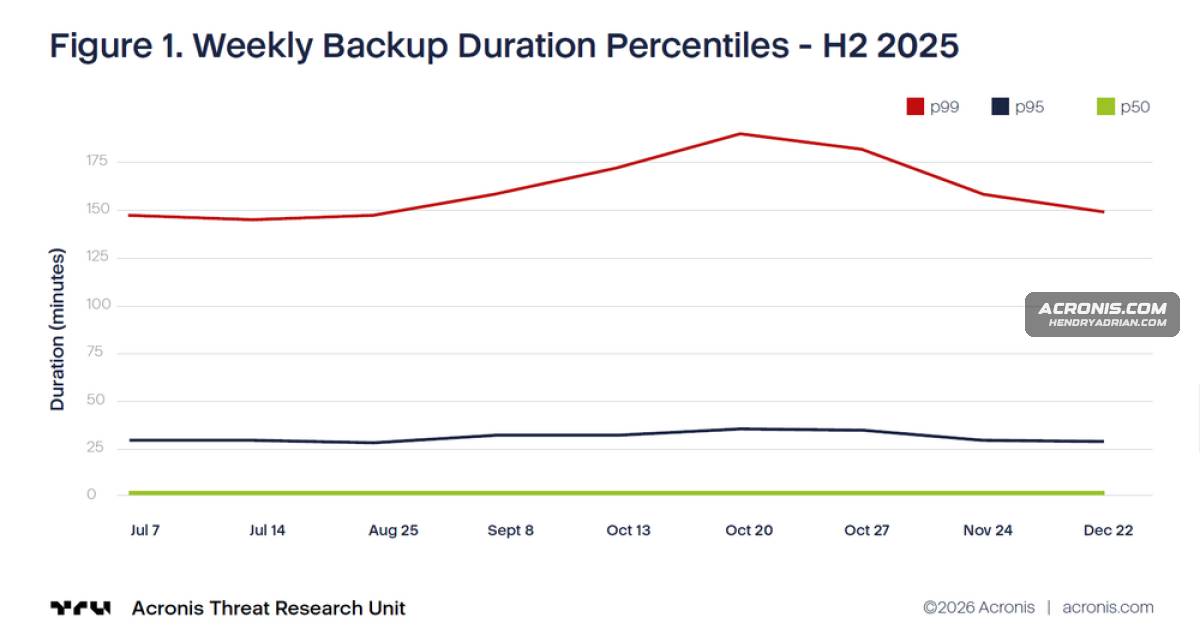
- In the slowest week analyzed, the longest 1% of backups took up to 11,125 seconds (about 185 minutes), including queue time.
- Across H2 2025, backups in the top 5% of durations took about 26.5–30.5 times as long as typical runs.
- At tenant hierarchy nesting level 12, the reported failure rate was 39.78% across 1,076 tenants, compared with 9.5% at level 11.
- Jobs can be marked successful despite finishing after their scheduled window, leaving recovery points older than expected and increasing contention.
- The report links deep MSP hierarchies to added policy inheritance, access-control, alert-routing, and remediation complexity.
- Recommendations include tracking success-in-window and recovery-point age, scheduling and sizing for long-tail runtimes, clarifying escalation ownership, and regularly testing restores.
Article Details
- Publisher
- Acronis
- Report Period
- H2 2025 (2025-07-01 to 2025-12-31); the hierarchy analysis includes an October 2025 example.
- Scope
- Aggregated global customer backup telemetry covering job outcomes, durations, schedule timing, destination classes, encryption and scheme combinations, and MSP tenant hierarchy metadata.
- Key Statistics
- In the week of 2025-10-20, p99 backup duration reached 11,125 seconds (185.4 minutes), including queue time.
- Across H2 2025, weekly p95/p50 backup-duration ratios ranged from 26.5× to 30.5×.
- At tenant hierarchy nesting level 12, the failure rate was 39.78% across 1,076 tenants; levels 7–11 ranged from 4.81% to 9.50%.
- Cloud-only backups had a p95 duration of 2,106 seconds, compared with 1,253 seconds for local-folder backups.
- AES-256 encrypted always_incremental cloud jobs had a 5.77% failure rate versus 7.91% for unencrypted jobs; the report cautions that encryption is a proxy for deployment maturity, not a cause of reliability.
- Recommendations
- Define workload-specific completion cutoffs and track success-in-window, p95/p99 completion times, newest usable recovery-point age, and restore-test pass rates.
- Stagger backup start times and plan schedules and capacity for tail behavior and peak workload periods.
- For managed providers, require customer-scoped reporting, clear overnight escalation ownership and SLAs, and regular reconciliation of inherited policies and exceptions.
- Configure after-window checks, tiered alerts, and a daily review of overnight failures, late completions, retries, and backlog.
- Run regular restore tests, record time-to-restore and verification results, keep recovery documentation current, and consider offline or logically isolated copies.