
KYCShadow Android Malware Uses Fake KYC Workflows to Steal Credentials and OTPs
Summary
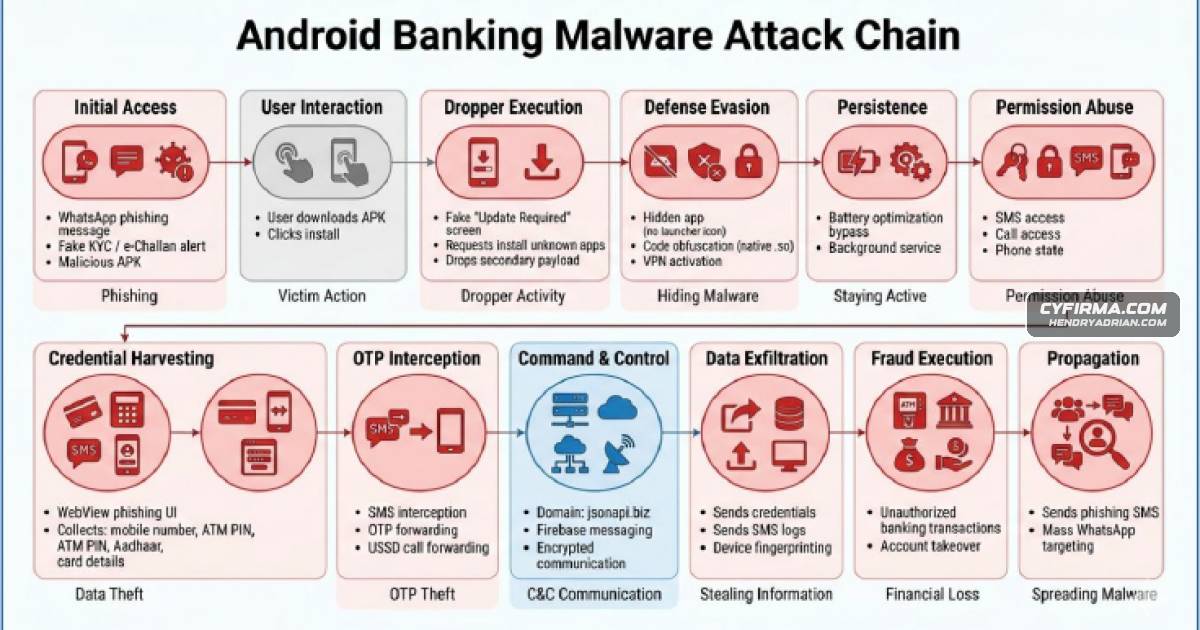
Cyfirma analyzes KYCShadow, an Android malware campaign distributed via WhatsApp. Its hidden payload uses fake KYC screens, SMS and call control, and a VPN; the report links its infrastructure to earlier e-Challan fraud with moderate-to-high confidence.
Key points
- A WhatsApp-distributed dropper uses a fake update flow to install the concealed secondary payload com.am5maw3.android.
- The dropper decrypts an embedded APK using XOR and installs it through Android's PackageInstaller.
- A Capacitor WebView presents staged KYC phishing screens seeking mobile and ATM PINs, Aadhaar details, and card credentials.
- Firebase Cloud Messaging commands support SMS interception and forwarding, inbox collection, remote SMS and calls, and USSD operations.
- A full-tunnel VPN routes device traffic through the app, while battery-exemption requests and launcher hiding help maintain concealment.
- The report says the malware encrypts collected data before sending it to hxxps://jsonapi[.]biz; native library code conceals the endpoint and configuration.
- Shared infrastructure naming and e-Challan-themed phishing artifacts support the report's moderate-to-high-confidence hypothesis of a link to earlier RTO e-Challan fraud operations.
Article Details
- Attack Vectors
- The dropper is distributed via WhatsApp using a fake update and banking KYC workflow to induce APK installation.
- The dropper XOR-decrypts an embedded APK and installs the secondary payload through a PackageInstaller session; the payload is hidden from the launcher.
- A staged WebView phishing flow requests mobile and ATM PIN details, Aadhaar and date of birth, and payment-card information.
- Firebase Cloud Messaging delivers commands for SMS interception and forwarding, inbox extraction, remote SMS sending, calls, and USSD operations.
- A custom full-tunnel VPN routes device traffic through an application-controlled layer for monitoring and potential filtering.
- The malware encrypts collected data locally and sends it to its C2 server using HTTP POST.
- Defensive Notes
- Block and monitor jsonapi[.]biz, jsonserv[.]biz, and jsonserv[.]xyz in network security and DNS-filtering controls.
- Monitor for fake update prompts, VPN activation requests, silent APK installation, hidden applications, and unusual SMS, USSD, or call-forwarding activity.
- Warn users not to install APKs delivered through messaging platforms or enter OTPs, PINs, CVVs, or banking credentials into unverified applications.
- Keep installation of unknown apps disabled and review unexpected VPNs, installed applications, and call-forwarding settings.
- Use transaction monitoring and step-up authentication for suspicious activity, including unusual OTP requests, SIM changes, or unfamiliar devices.
- Analyze suspicious applications statically and dynamically, including native libraries that may conceal configuration and C2 values.
Indicators of compromise
| Type | Indicator | Context |
|---|---|---|
| DOMAIN | jsonapi[.]biz | Current campaign C2 domain used for encrypted HTTP POST exfiltration and backend communication. |
| DOMAIN | jsonserv[.]biz | Domain identified as C2 infrastructure associated with the earlier RTO e-Challan fraud operation linked in the report. |
| DOMAIN | jsonserv[.]xyz | Domain identified as C2 infrastructure associated with the earlier RTO e-Challan fraud operation linked in the report. |
| SHA256 | 1d261b45e73b5b712becb12ed182ec89d3dd0d73143a2dd8ff5512da489a50eb | SHA-256 hash identified for the dropped APK payload. |
| SHA256 | 34479b18597f1a0deb5d55b8450bc21af1d1f638c4ceca1ee19e6f5ac89d6be2 | SHA-256 hash identified for the KYCShadow dropper APK. |
MITRE ATT&CK
T1406The dropper XOR-decrypts its embedded APK, while C2 configuration and keys are concealed in libnative-lib.so.T1417A bundled WebView presents staged forms for mobile and ATM PINs, Aadhaar and date of birth, and card details.T1418The dropper manifest queries for com.am5maw3.android to check for the secondary payload.T1426Heartbeat and event data can include device identifiers, timestamps, and battery level.T1437.001The malware sends structured data to jsonapi[.]biz using HTTP POST.T1481Firebase Cloud Messaging delivers remote commands that AgentService forwards to command-processing handlers.T1521The malware encrypts collected runtime and event data locally before transmission to its backend.T1541The payload requests battery-optimization exemption and uses WAKE_LOCK to maintain background operation.T1616Remote commands can initiate calls and execute USSD codes, including codes for call-forwarding control.T1628.002The secondary payload omits the LAUNCHER category and does not appear in the device's app drawer.T1636.004The payload intercepts incoming SMS, can forward messages, and extracts the SMS inbox for transmission.T1646Harvested credentials and logs are exfiltrated through encrypted POST requests to jsonapi[.]biz.T1660Fake update and banking KYC screens socially engineer users into installing the APK and entering financial details.
Malware
Products
AndroidKYCShadow is a multi-stage Android banking malware distributed via WhatsApp that uses a dropper (com.***appad.andr) to install a hidden secondary payload (com.am5maw3.android) which harvests credentials and OTPs throughFirebase Cloud MessagingFirebase Cloud Messaging is used as a remote command channel (AgentService â ProcessCommand) enabling SMS forwarding, inbox exfiltration, remote SMS sending, call initiation, and USSD execution.WhatsAppKYCShadow is a multi-stage Android banking malware distributed via WhatsApp that uses a dropper (com.***appad.andr) to install a hidden secondary payload (com.am5maw3.android) which harvests credentials and OTPs through