
Slopsquatting Targets AI-Hallucinated Package Names; slopcheck Screens Dependencies
Summary
Attackers can register package names hallucinated by AI coding assistants and add malicious install hooks. A 2025 study found nearly 20% of sampled AI-generated code referenced nonexistent packages; the article describes slopcheck’s registry checks and CI controls.
Key points
- Slopsquatting involves registering nonexistent package names suggested by AI coding assistants and adding malicious install hooks that may run when developers install them.
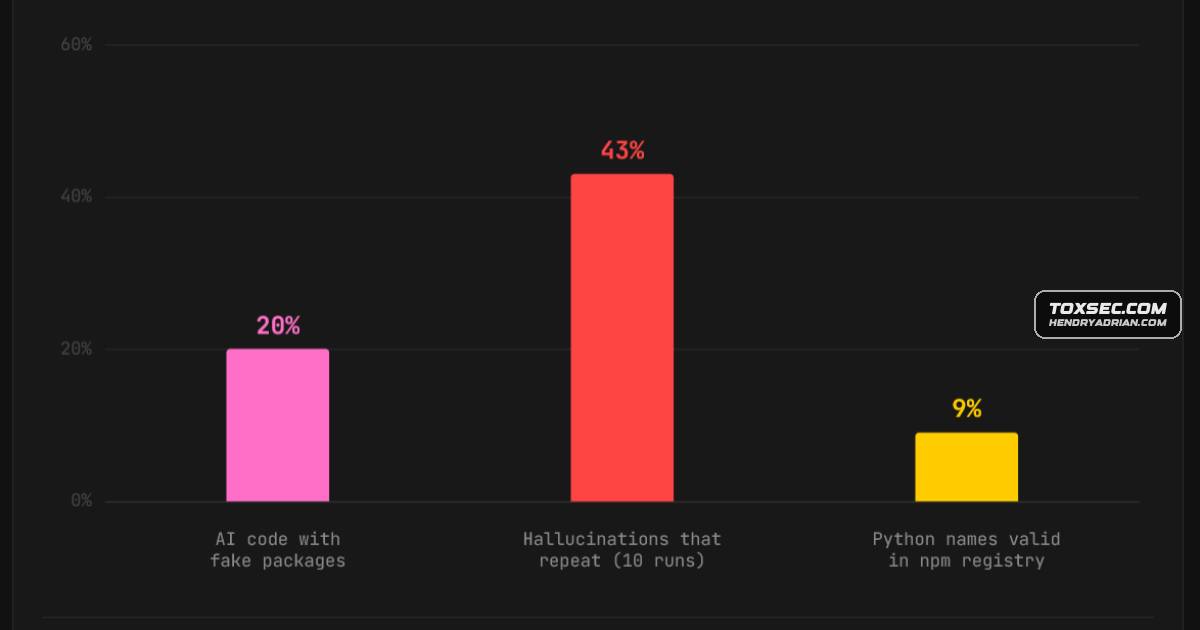
- A 2025 USENIX Security study tested 16 code-generating models across 576,000 samples; nearly 20% referenced nonexistent packages, and 43% of hallucinated names recurred across runs.
- The article says researcher Bar Lanyado registered huggingface-cli as a harmless test package on PyPI; it received 30,000 downloads in three months, and Alibaba copied the install command into a public repository README.
- The article reports that react-codeshift spread through 237 repositories via AI-generated agent skill files, without deliberate planting.
- slopcheck checks dependency names against registries, blocks nonexistent packages, and flags suspicious ones; its author says it supports seven ecosystems and can run in CI.
- The tool’s own test on a 100-dependency project flagged two legitimate packages as suspicious, illustrating that flagged results may need review.
- The article says no large-scale breach had been publicly pinned to slopsquatting as of 2026.
Article Details
- Defense Focus
- Prevent slopsquatting by verifying dependency names against their package registries before installation.
- Detection Methods
- Check whether each dependency exists in its ecosystem's live registry; block names that do not resolve.
- Flag existing packages using signals including registration within the last seven days, fewer than 100 downloads, hallucination-pattern naming, or no source repository link.
- Compare dependency names with popular packages using Levenshtein distance to identify likely near-miss typosquats.
- Scan dependency manifests automatically and check dependencies in parallel.
- Data Sources
- Dependency manifests, including requirements.txt, pyproject.toml, package.json, Cargo.toml, go.mod, Gemfile, pom.xml, build.gradle, and composer.json.
- Live package-registry data on package existence, registration age, download counts, and source repository links.
- Popular package names in each ecosystem for similarity checks.
- Rule Types
- Machine-readable JSON scan output
- Platforms
- slopcheck CLI
- GitHub Actions
- Defensive Actions
- Run slopcheck before installing AI-recommended dependencies.
- Block nonexistent packages and review suspicious packages before installation; use safe install mode to prevent flagged packages from reaching pip or npm.
- Use allowlists for internal packages that are absent from public registries.
- Add the GitHub Action to scan pull requests that change dependency files and fail checks when slop is detected.
- Use the --fix option to remove hallucinated dependencies from dependency files while retaining a comment in the diff.
MITRE ATT&CK
People
Bar LanyadoRegistered huggingface-cli as an empty PyPI package after observing GPT recommend it; the article reports it received 30,000 downloads in three months.Karen SpinnerEvaluated slopcheck on her projects and described its package-checking workflow and results.Seth LarsonThe article says he named the slopsquatting attack in April 2025.
Products
ClaudeYou ask Claude or Copilot for code that talks to a new API.Claude CodeWhen I use vibe coding tools like Claude Code, my overall approach is “trust but verify.” I personally look at the code and make sure I know what it’s doing before I ship it.CopilotYou ask Claude or Copilot for code that talks to a new API.