
Study Finds Reputation Feeds Miss Most Software Supply Chain Threat Indicators
Summary
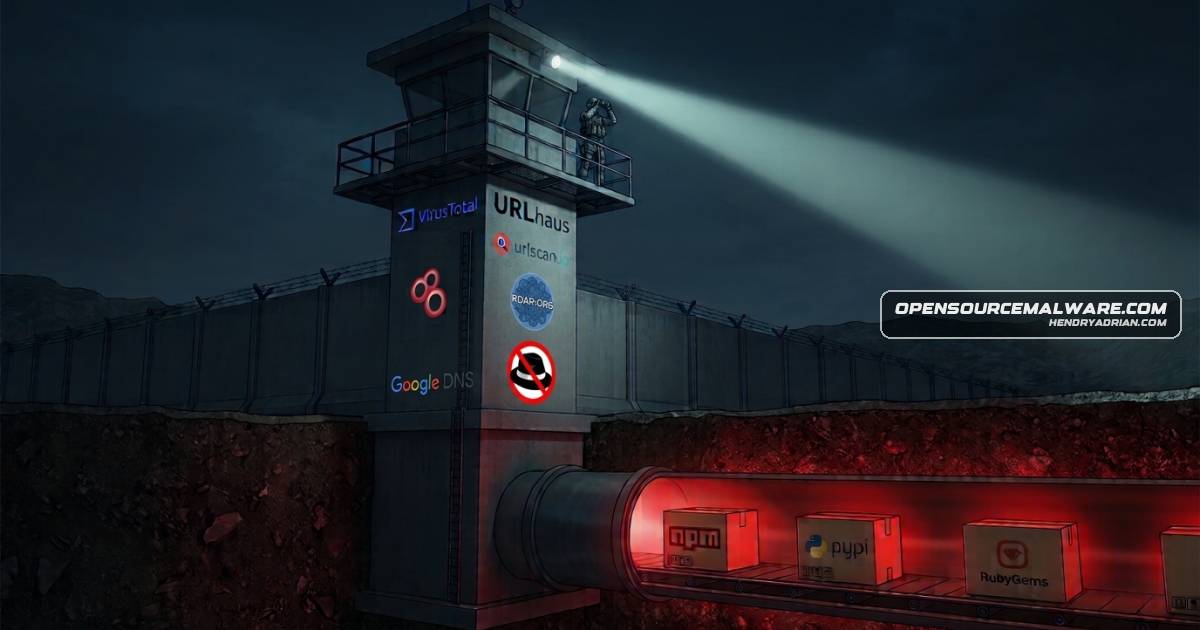
An evaluation of 624 indicators found reputation services often missed software supply chain threats: 62.2% had no VirusTotal detections at ingestion, and 71.3% remained undetected months later.
Key points
- The study evaluated 450 network indicators at package ingestion and 174 indicators from ten supply chain campaigns months after disclosure.
- At ingestion, 62.2% of indicators had zero VirusTotal detections, while 70.7% fell below the study's three-detection enterprise alert threshold.
- In the retrospective dataset, 71.3% of indicators remained VirusTotal blind spots; 87.9% of malicious package files and scripts were never seen or were scanned clean.
- For 54 attacker-controlled network indicators, the study reports blind-spot rates of 98.1% for URLhaus, 88.9% for AbuseIPDB, and 87.0% for urlscan[.]io; none detected an indicator missed by VirusTotal.
- The article attributes the gaps to attacks executing from developer environments, quiet and short-lived infrastructure, and malicious code in interpreted package lifecycle scripts.
- Its triage guidance recommends inspecting install hooks, checking publisher and release provenance, tracing unexpected outbound connections, and rotating credentials potentially exposed to executed malicious code.
Article Details
- Publisher
- Open Source Malware
- Report Period
- 2026-03 to 2026-11
- Scope
- Evaluation of external reputation and threat-intelligence feed coverage for software supply-chain attack indicators.
- Sample Size
- 624 indicators across two cohorts: 450 day-zero network indicators and 174 retrospective indicators.
- Key Statistics
- Day-zero cohort: 62.2% of 450 indicators had zero VirusTotal detections; 70.7% had two or fewer detections.
- Retrospective cohort: 124 of 174 indicators (71.3%) remained complete VirusTotal blind spots; 131 of 174 (75.3%) had two or fewer detections.
- The report states that 87.9% of malicious package files and scripts were either not seen by VirusTotal or were scanned and cleared as clean.
- Among 54 attacker-controlled historical network indicators, URLhaus flagged 1, a 98.1% blind-spot rate.
- The report says 13 of 174 retrospective indicators (7.5%) were legitimate shared services abused by attackers.
- Recommendations
- Inspect package installation lifecycle hooks for unexpected child processes, encoded strings, and network calls.
- Audit publisher provenance, including maintainer changes and releases lacking a matching upstream commit or tag.
- Trace outbound connections from install hooks, especially to untrusted or non-registry endpoints.
- If malicious code executed, identify accessible secrets and rotate exposed credentials immediately rather than waiting to confirm exfiltration.
Indicators of compromise
| Type | Indicator | Context |
|---|---|---|
| DOMAIN | git-tanstack[.]com | Typosquatted Git host used by the Mini Shai-Hulud worm for command distribution. |
| DOMAIN | holiday-themes[.]dev | Command-and-control host used by malicious IDE extensions to stage payloads and receive exfiltrated developer telemetry. |
| DOMAIN | sfrclak[.]com | Attacker-registered primary exfiltration host used in the Axios compromise. |
| DOMAIN | stanionstudios[.]com | Lure domain used to stage fake company branding and malicious project requirements for Contagious Interview operations. |
| DOMAIN | status[.]oastify[.]com | Exfiltration destination embedded in multiple malicious Python packages in the PyPI stealer activity. |
| DOMAIN | verify[.]build-standards[.]org | Command and validation domain embedded across 37 backdoored packages in the TrapDoor campaign. |
| DOMAIN | x[.]oast[.]fun | Out-of-band collection endpoint used to collect stolen npm authentication tokens in the AntV maintainer takeover. |
| HOSTNAME | csec-supply-chain-attack-1tcq[.]onrender[.]com | Render-hosted command-and-exfiltration endpoint used in the Trivy supply-chain compromise. |
| IPV4 | 166[.]88[.]134[.]62 | Primary RPC relay endpoint used by PolinRider to interact with malicious smart contracts. |
| SHA256 | ad111858f73ef39e955ea4a6cdc83d92b53d5ca0248a94095ff0448c7b147e29 | Secondary credential-harvesting payload staged during the Keyv and Cacheable compromise; the report says it had zero detections across 63 engines. |
MITRE ATT&CK
T1027 · Obfuscated Files or InformationThe report describes obfuscated JavaScript and Python payloads, including encoded strings.T1041 · Exfiltration Over C2 ChannelThe report describes stolen credentials and other data being exfiltrated to attacker-controlled endpoints.T1059.004 · Unix ShellThe report describes shellcode retrieval and shell commands as part of package-based attack activity.T1059.006 · PythonObfuscated Python scripts in malicious packages extracted credentials and other secrets.T1059.007 · JavaScriptMalicious JavaScript ran in package lifecycle scripts and IDE extension activation events.T1071.001 · Web ProtocolsMalicious lifecycle scripts used outbound HTTPS requests for command-and-control and data exfiltration.T1105 · Ingress Tool TransferSome attacks retrieved second-stage payloads from staging infrastructure or serverless hosting.T1195.001 · Compromise Software Dependencies and Development ToolsAttackers published malicious or backdoored packages and compromised software dependencies.T1528 · Steal Application Access TokenThe AntV payloads harvested npm authentication tokens, and other attacks stole developer credentials.T1552.001 · Credentials In FilesMalicious packages extracted authentication tokens from local .npmrc files and secrets from build environments.T1567.004 · Exfiltration Over WebhookThe report says some attackers routed exfiltration through webhook listeners and developer services.
Threat Actors
Malware
Products
AbuseIPDBtools security teams assume will catch what VirusTotal misses (like URLhaus, urlscan.io, and AbuseIPDB) performed with blind-spot rates exceeding 85% to 98%.ShodanNetwork reputation and host exposure: AbuseIPDB & ShodanURLhausthreats. Even worse, the specialized tools security teams assume will catch what VirusTotal misses (like URLhaus, urlscan.io, and AbuseIPDB) performed with blind-spot rates exceeding 85% to 98%.urlscan.ioworse, the specialized tools security teams assume will catch what VirusTotal misses (like URLhaus, urlscan.io, and AbuseIPDB) performed with blind-spot rates exceeding 85% to 98%.VirusTotalVirusTotal, URL reputation engines, and IP blocklists are built to answer a specific question: “Has the wider security industry already analyzed this artifact and agreed that it’s malicious?”