
CrowdStrike Details SaaS Intrusions by CORDIAL SPIDER and SNARKY SPIDER
Summary
CrowdStrike says CORDIAL SPIDER and SNARKY SPIDER use vishing and AiTM pages to steal IdP credentials and session tokens, manipulate MFA, hide alerts, and rapidly exfiltrate SaaS data; it outlines Falcon Shield detections and configuration defenses.
Key points
- CrowdStrike reports observing the SaaS-focused campaigns since October 2025.
- The actors use vishing and adversary-in-the-middle login pages to capture credentials and active session tokens, then access connected SaaS apps through identity providers.
- They register attacker-controlled MFA devices, sometimes after removing legitimate devices; SNARKY SPIDER also uses inbox rules and email deletion to hide security alerts.
- CrowdStrike reports targeted searches for sensitive terms such as “SSN” and “contracts,” followed by rapid, large-scale downloads from SaaS services.
- The campaigns use commercial VPN and residential proxy services, including Mullvad, NetNut, 9Proxy, Infatica and NSOCKS, to blend in with normal traffic.
- Falcon Shield detections cover anomalous sign-ins, MFA enrollment, inbox activity, sensitive searches and unusual download patterns. The article also recommends phishing-resistant MFA and tighter access controls.
Article Details
- Defense Focus
- Detect and disrupt SaaS-focused intrusions by monitoring identity-provider and SaaS activity, including anomalous sign-ins, MFA enrollment, notification suppression, targeted searches, and rapid data downloads.
- Detection Methods
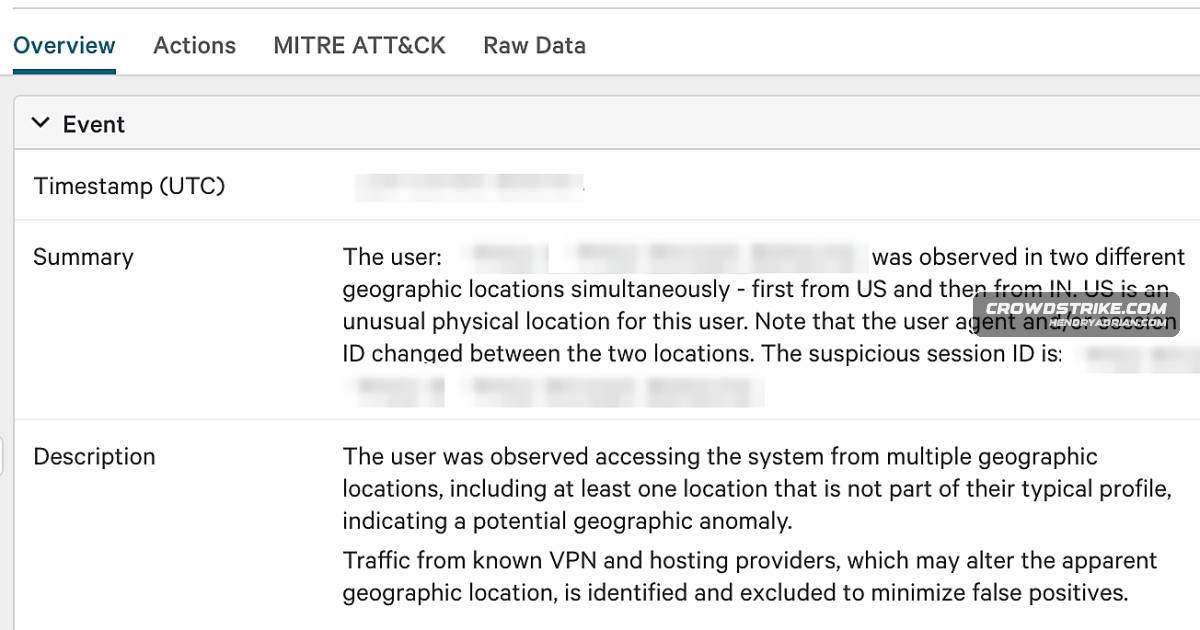
- Use authentication-flow and behavioral anomaly detection to identify suspicious sign-ins based on source location, device fingerprint, working hours, and historical user behavior.
- Detect unusual geographic access and connections through anonymization services, residential proxies, or non-enterprise-grade servers.
- Identify suspicious MFA-device registrations, including one device enrolled across multiple accounts and enrollments from Android emulators.
- Monitor for inbox rules that delete security-related messages and for manual deletion of security emails.
- Correlate sensitive-content searches with anomalous sign-ins.
- Detect file downloads whose volume or velocity departs from user or organizational baselines.
- Data Sources
- SaaS and identity-provider sign-in and authentication-flow events
- Network characteristics, source IP and ASN information, anonymization-service classifications, and session-clustering data
- Device fingerprints, device telemetry, and MFA-device registration events
- Mailbox rule changes and security-email deletion activity
- SaaS search activity and search terms
- File-download events, volumes, and velocities
- Historical user behavior and organizational baselines
- Platforms
- Falcon Shield
- Defensive Actions
- Deploy phishing-resistant MFA and review identity-provider and SaaS access controls.
- Reduce overly permissive access to sensitive data and monitor identity, access-control, and configuration settings.
- Investigate anomalous sign-ins and unexpected MFA registrations, including devices enrolled across multiple accounts.
- Review suspicious inbox rules and deletion of security notifications.
- Correlate targeted searches and high-volume downloads with anomalous sign-ins and unusual network sources.
MITRE ATT&CK
T1070.008 · Clear Mailbox DataThe actors delete security-related emails to conceal unauthorized MFA enrollment and other post-compromise activity.T1078 · Valid AccountsThe actors use harvested credentials and session tokens to access identity providers and connected SaaS applications as legitimate users.T1098.005 · Device RegistrationThe actors register adversary-controlled MFA devices on compromised accounts, sometimes removing existing MFA devices first.T1213 · Data from Information RepositoriesThe actors search SaaS services for sensitive terms such as “confidential,” “SSN,” and “contracts” to locate valuable data.T1530 · Data from Cloud StorageThe actors rapidly aggregate and download data from SaaS platforms including SharePoint, HubSpot, and Google Workspace.T1557 · Adversary-in-the-MiddleThe actors use SSO-themed AiTM pages that relay authentication to legitimate services while capturing credentials and active session tokens.T1564.008 · Email Hiding RulesSNARKY SPIDER creates inbox rules that automatically delete messages containing security-related terms.T1566.004 · Spearphishing VoiceCORDIAL SPIDER and SNARKY SPIDER use vishing calls impersonating IT support to direct employees to fraudulent AiTM login pages.
Threat Actors
Cordial SpiderCrowdStrike reports observing CORDIAL SPIDER conducting SaaS-focused intrusions involving vishing, AiTM credential and session-token capture, MFA-device enrollment, targeted data discovery, and exfiltration.SNARKY SPIDERCrowdStrike reports observing SNARKY SPIDER conducting SaaS-focused intrusions involving vishing, AiTM credential and session-token capture, MFA-device enrollment, inbox-rule-based notification suppression, targeted data discovery, and exfiltration.
Vendors
Products
Falcon ShieldFalcon Shield is built to detect these anomalous sign-in attempts.Genymobile Android emulatorAdversaries register attacker-controlled MFA devices (e.g., Genymobile Android emulator, QEMU) to maintain persistent access and sometimes remove legitimate MFA devices first.Google Workspacesecurity notifications, and rapidly exfiltrate high-value data from platforms like SharePoint and Google Workspace, complicating detection for traditional endpoint defenses.HubSpot[T1530 ] Exfiltration: Data from Cloud Storage – Rapid aggregation and large-volume downloads from SaaS platforms (SharePoint, HubSpot, Google Workspace) to exfiltrate high-value datasets.Microsoft SharePointdevices, suppress security notifications, and rapidly exfiltrate high-value data from platforms like SharePoint and Google Workspace, complicating detection for traditional endpoint defenses.QEMUAdversaries register attacker-controlled MFA devices (e.g., Genymobile Android emulator, QEMU) to maintain persistent access and sometimes remove legitimate MFA devices first.